The Ultimate Guide to IIC and SMBus in Power and Battery Systems
In power management and battery systems, communication protocols are not about “whether they can be used,” but rather about “whether the system is reliable, predictable, and scalable.“
Although IIC (I²C) and SMBus share significant similarities at the physical layer, their design philosophies and engineering constraints differ fundamentally in power and battery management applications (BMS, PMIC, Smart Battery, server power supplies).
This article systematically analyzes the differences, applicable boundaries, and selection logic of IIC and SMBus from the perspective of power and battery system engineering practice.
1.Industry Context: Why Do Power and Battery Systems “Favor” SMBus?
I²C was originally proposed by Philips for universal chip-to-chip communication, while SMBus was developed under Intel’s leadership with a clear objective:
|
To provide a “predictable, manageable” system management and power communication bus for PCs, servers, and portable devices. |
Power and battery systems face several critical requirements:
- Ability to detect communication anomalies (bus deadlocks, out-of-control slave devices)
- Standardized access to battery and power status must be supported
- Must remain recoverable under low-power, standby, and abnormal conditions
- Must enable cross-vendor interoperability
👉 This is precisely why SMBus was created.
2.Core Concepts
I²C (I²C)
- A universal, flexible serial bus specification
- Non-mandatory:
- Timeout mechanism
- Error recovery strategy
- Power-related semantics
- More like a “communication toolkit”
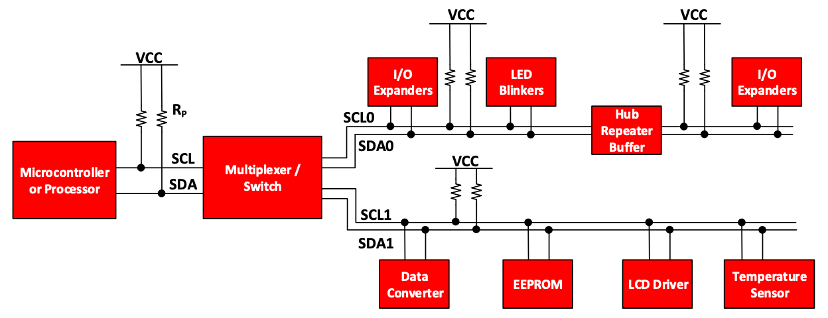
SMBus (System Management Bus)
- Based on the I²C physical layer
- Mandatory Definitions:
- Timeout
- Minimum/maximum clock frequency
- ACK/NACK Behavior
- Standard Command Set (Battery, Power, Temperature, Voltage)
- More like a “system-level management protocol”
👉 Conclusion in a nutshell:
|
IIC addresses “how to connect,” while SMBus addresses “how the system survives.” |
3.Key Technical Mechanisms
1️⃣ Timeout Mechanism — Determines whether the system “freezes”
SMBus (Mandatory)
- SCL or SDA low level must not exceed 35 ms
- The host must detect and recover from abnormal devices
📌 Implications for power management systems:
- Prevents PMIC/Battery Gauge from locking the bus
- System can automatically recover after anomalies
IIC (non-mandatory)
- Support for timeouts depends entirely on the host controller implementation
- Many MCU IIC peripherals lack hardware timeouts by default
👉 In battery systems, this is a critical difference
2️⃣ Clock Frequency Constraints—For Low Power and Reliability
|
Protocol |
Frequency requirement |
Engineering significance |
|
IIC |
No minimum frequency |
Easily affected by low-power mode |
|
SMBus |
10 kHz ~ 100 kHz |
Ensure stable low-speed communication |
📌 In battery systems:
- Lower speed = Stronger interference resistance
- Easier to maintain consistency during sleep/wake phases
3️⃣ Error Detection (PEC) — Preventing “Errors That Appear Successful”
SMBus introduces PEC (Packet Error Code, CRC-8):
- Performs checksum verification on each communication frame
- Particularly suitable for:
- Battery capacity
- Voltage / Current
- Charge/discharge status
I²C:
- Only ACK / NACK
- Cannot detect data bit inversion
👉 In BMS:
|
“Invalid data ≠ No data,” with potentially more severe consequences. |
4️⃣ Standardized Command Model (Smart Battery / PMBus)
SMBus derived:
- Smart Battery Specification
- PMBus (Power Management Bus)
These specifications define:
- Remaining battery capacity
- Cycle count
- Temperature, voltage, current
- Power management status word
👉 IIC has no equivalent standard
4.Systematic Comparison
|
Dimension |
IIC |
SMBus |
|
Design Objective |
Universal Communication |
System/Power Management |
|
Timeout mechanism |
❌ No mandatory |
✅ Mandatory |
|
Lowest clock |
❌ No |
✅ 10 kHz |
|
Error checking |
❌ No |
✅ PEC |
|
Battery semantics |
❌ No |
✅ Smart Battery |
|
Power management |
❌ No |
✅ PMBus |
|
System recoverability |
Depends on the implementation |
Protocol-level guarantee |
|
Interoperability across manufacturers |
Weak |
Strong |
5.Why SMBus is the Better Choice for Power Supply/Battery Systems
From an Engineering Perspective
- Easier to pass system-level reliability verification
- Abnormal states are predictable and manageable
- More conducive to mass production consistency
From a procurement/supply chain perspective
- Smart Battery / PMBus devices enable cross-vendor compatibility
- Reduced software adaptation costs
- Easier supplier replacement
6.Typical Power Supply and Battery Application Scenarios
✅ Mandatory SMBus Scenarios
- Medical devices / Industrial detection equipment / Industrial battery packs
- BMS (Battery Management System)
- Server power supplies, redundant PSUs
- Smart Batteries (Fuel Gauge)
- PMIC + Host System Management
⚠️ Scenarios Where IIC Is Available
- Simple DC-DC configuration
- No battery, no system management required
- Single MCU + slave device with watchdog fallback
7.Selection and Implementation Recommendations
- Prioritize SMBus whenever “battery” is involved
- For “system-level power state” applications, prioritize SMBus / PMBus
- Although the MCU is labeled as I²C, please verify:
- Whether SMBus timeout is supported
- Whether PEC is supported
- Software layer:
- Linux/Windows offer mature SMBus support
- I²C often requires proprietary drivers
8.Summary
|
IIC represents communication capability, while SMBus represents system capability. |
If you’re also seeking SMBus lithium-ion battery packs, contact Tefoo’s expert technical team! We’ll provide you with the perfect lithium-ion battery solution!