What is SMBus?
Understanding System Management Bus from a Systems Engineering Perspective
In the embedded systems field, SMBus (System Management Bus) is often briefly described as:
“A communication bus based on I²C.”
While this is technically correct, it provides little value from an engineering decision-making standpoint.
If your system involves power management, battery systems, server hardware, or industrial source devices, what you really need to understand is not how similar SMBus is to I²C, but rather:
Why, in these systems, “just communication” is often insufficient, and why SMBus becomes the de facto standard choice for system management.
This article will explain, from a systems engineering perspective, what problems SMBus was designed to solve, the core mechanisms it introduces, and what these mechanisms mean in real-world power and battery systems.
1. Why System Management Cannot Rely Solely on I²C
I²C was created in the 1980s with a clear objective:
To connect EEPROMs, RTCs, simple sensors, etc., on the same circuit board at minimal cost.
This application scenario inherently assumes several conditions: stable power supply, predictable peripheral behavior, and low probability of communication failure.
In most peripheral communication cases, these assumptions hold true. But when I²C is used directly for system management, the problems begin to emerge.
In power and battery systems, the communication counterpart is often the most unstable part of the system:
Batteries may be in undervoltage, sleep, or protection modes; PMICs may be in current limit or thermal shutdown; and the system itself might be operating near power-up or power-down thresholds.
In this environment, communication failure is no longer an “occasional anomaly,” but rather a situation that must be assumed to occur.
If the communication protocol does not have clear failure boundaries and recovery rules, a single failure can escalate into a system-level fault—such as a bus lock, task blockage, or an unrecoverable system state.
The emergence of SMBus is to solve these types of problems.
2. Re-defining SMBus from an Engineering Perspective
From a systems engineering point of view, SMBus is not “another version of I²C,” but rather:
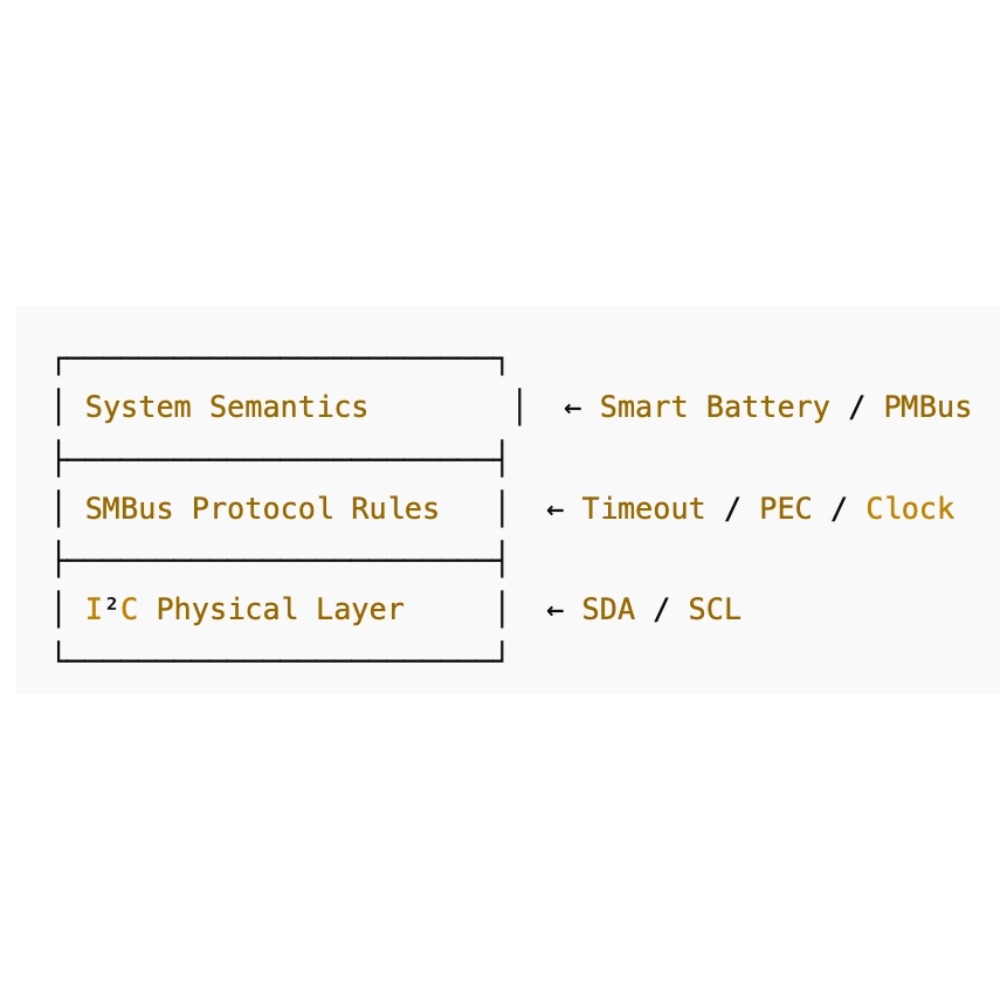
A communication protocol built on top of I²C, incorporating a whole set of system management constraints.
It does not aim to increase bandwidth or offer greater flexibility; instead, it imposes clear limits on parameters and behavior.
The goal of these limitations is simple:
To ensure that systems behave predictably and recoverably, even under abnormal conditions.
In one sentence, the difference can be summarized as:
I²C focuses on “how to transmit data,”
SMBus focuses on “how the system should respond when things don’t go as expected.”
3. Core Mechanisms of SMBus: Engineering Trade-offs Behind the Logic
1. Forced Timeout: The System Cannot Be “Stuck” by a Single Failure
In system management communication, the most dangerous scenario is not the communication failure itself, but when the system cannot escape from the failure.
When a battery or power module is in an abnormal state, the slave device might be unable to release the bus as expected. If the protocol does not have a clear timeout boundary, the master device could be blocked indefinitely, preventing the continuation of system tasks.
SMBus addresses this by clearly defining in the protocol that:
If the SCL or SDA line is held low for more than 35 ms, the communication must be considered a failure, and the master device must enter an error-handling process.
This value is not arbitrarily chosen. It is enough to cover the possible clock stretching of the slave under normal conditions but short enough to avoid interfering with the system’s task scheduling. More importantly, it provides the system with a clear, predictable failure boundary.
In contrast, in an I²C system, the existence of a timeout and its duration often depend on the MCU peripheral and driver implementation. This variation becomes a risk in OEM-level systems.
2. Controlled Clock Frequency: Stability Over Performance
In SMBus classic mode, the clock frequency is limited to 10 kHz to 100 kHz.
At first glance, this seems like a “performance compromise,” but it’s precisely the design approach of SMBus.
The characteristic of system management communication is that:
-
Data volume is small,
-
Access frequency is limited,
-
But the communication environment is complex and noisy, and often operates in low-power or state-switching conditions.
By limiting the frequency range, SMBus does not trade off performance but instead buys:
-
Lower EMI and crosstalk risk
-
Greater timing margins
-
More consistent cross-vendor behavior
In power and battery systems, stability and predictability are far more important than throughput. The frequency constraint in SMBus embodies this engineering philosophy.
3. PEC Check (CRC-8): Avoiding “Errors That Seem Successful”
In many engineering failures, the real problem is not a communication failure, but a successful communication with erroneous data.
The ACK/NACK mechanism in I²C only confirms that data has been received, but it does not verify whether the data was corrupted during transmission. In environments with strong EMI, transient current spikes, or complex wiring, bit-flips are not rare events.
SMBus introduces PEC (Packet Error Code) based on CRC-8 to check the address, command, and data.
This allows the system to identify whether the data is trustworthy.
In battery systems, a corrupted current value or a wrong temperature reading could directly impact power limits or shutdown strategies. PEC ensures that errors do not silently enter the system decision-making process.
4. System Semantics: Communication Is Just the Means, Management Is the Goal
SMBus is not just about “reliable communication.”
On top of it, Smart Battery and PMBus specifications were developed, which define the meaning of data in a system-level context.
This means that when the system reads the battery capacity or power status, it is not reading a vendor-specific register, but a field that is clearly defined in the specifications. The unit, behavior, and boundary conditions of these fields are consistent across different implementations.
This standardization of semantics lays the foundation for system software reuse, multi-vendor strategies, and long-term maintenance.
4. Typical Applications of SMBus in Real Systems
Because SMBus is designed for system management, it is often found in modules where any failure could immediately impact system operation and must be detected.
In intelligent battery systems, SMBus is the key communication bus between the main system and the Fuel Gauge. The Fuel Gauge is not just a simple sensor, but a system module with algorithms and state machines, responsible for calculating remaining capacity, state of health, and various safety-related parameters.
The forced timeout, PEC check, and standardized semantics provided by SMBus ensure that the system can make the correct decisions even in undervoltage or abnormal states.
In the BMS architecture, SMBus is commonly used for state exchanges between the battery management subsystem and the main controller. The main system needs to know whether the battery is allowed to continue operating or if it is in a protected state, and the BMS needs to understand whether the system is in operation mode or standby mode.
SMBus ensures predictable communication behavior, making this system-level collaboration more reliable.
In power management, SMBus and its derivative PMBus are widely used in PMICs, VRMs, and server power modules, transforming the power module from a “black-box” supply unit into a monitorable, diagnosable, and manageable system component.
In servers and industrial devices, SMBus serves as the foundation communication bus between the system management controller (such as BMC), power supplies, fans, and temperature sensors, supporting the 7×24 operational reliability.
5. SMBus Smart Battery Solutions in Engineering Practice: Tefoo’s Approach
In real-world OEM projects, the value of SMBus is not just in the protocol itself, but in whether there is a mature, mass-producible, and replaceable system-level solution.
Take intelligent batteries, for example: many source device manufacturers face similar challenges during project development:
-
Batteries have communication capabilities, but protocol behaviors are inconsistent.
-
Different batches or suppliers of batteries lead to high software adaptation costs.
-
Communication reliability is insufficient under abnormal states (undervoltage, low temperature, aging).
-
System-level validation and mass-production consistency are hard to ensure.
To address these issues, Tefoo provides a complete SMBus smart battery solution for source device manufacturers. This solution is designed around the SMBus and Smart Battery standards from the beginning, ensuring consistent communication behavior, clear recovery mechanisms, and standardized battery semantics.
From a systems engineering perspective, this solution is not just about “supporting SMBus,” but about designing the battery as a system management object.
For OEMs, this translates to lower integration risks, better mass-production consistency, and clearer long-term maintenance paths.
6. SMBus Frequently Asked Questions (FAQ)
Q1: SMBus and I²C are very similar at the hardware level. Why is there such a large difference in engineering risks?
A1: The difference is not in the physical layer, but in whether the protocol assumes “abnormal conditions will occur.”
SMBus defines failure boundaries and recovery rules in the protocol layer, while I²C does not.
Q2: If the system already has a watchdog mechanism, is the SMBus timeout still necessary?
A2: Yes. The watchdog monitors the CPU, while SMBus timeout monitors whether the communication is blocked by an abnormal device. They address different layers of the system.
Q3: Will PEC checking significantly increase system complexity?
A3: The added computational and bandwidth overhead is minimal, but it significantly reduces the risk of system misjudgments caused by erroneous data.
Q4: Is SMBus only suitable for PC or server systems?
A4: No. Any system that requires reliable power and battery management, such as industrial devices, medical devices, and source devices, can benefit from SMBus.
Q5: What is the most important consideration when source device manufacturers choose an SMBus smart battery solution?
A5: It is not just about “supporting SMBus,” but whether the solution is designed around SMBus and Smart Battery standards and whether it ensures predictable behavior even under abnormal conditions.
References
-
SMBus Specification
https://www.smbus.org/specs/ -
NXP I²C-bus Specification and User Manual (UM10204)
https://www.nxp.com/docs/en/user-guide/UM10204.pdf - Texas Instruments – SMBus Compatibility with I²C Devices
https://www.ti.com/lit/an/slva704/slva704.pdf -
Linux Kernel Documentation – I²C and SMBus Subsystem
https://www.kernel.org/doc/html/latest/i2c/index.html