
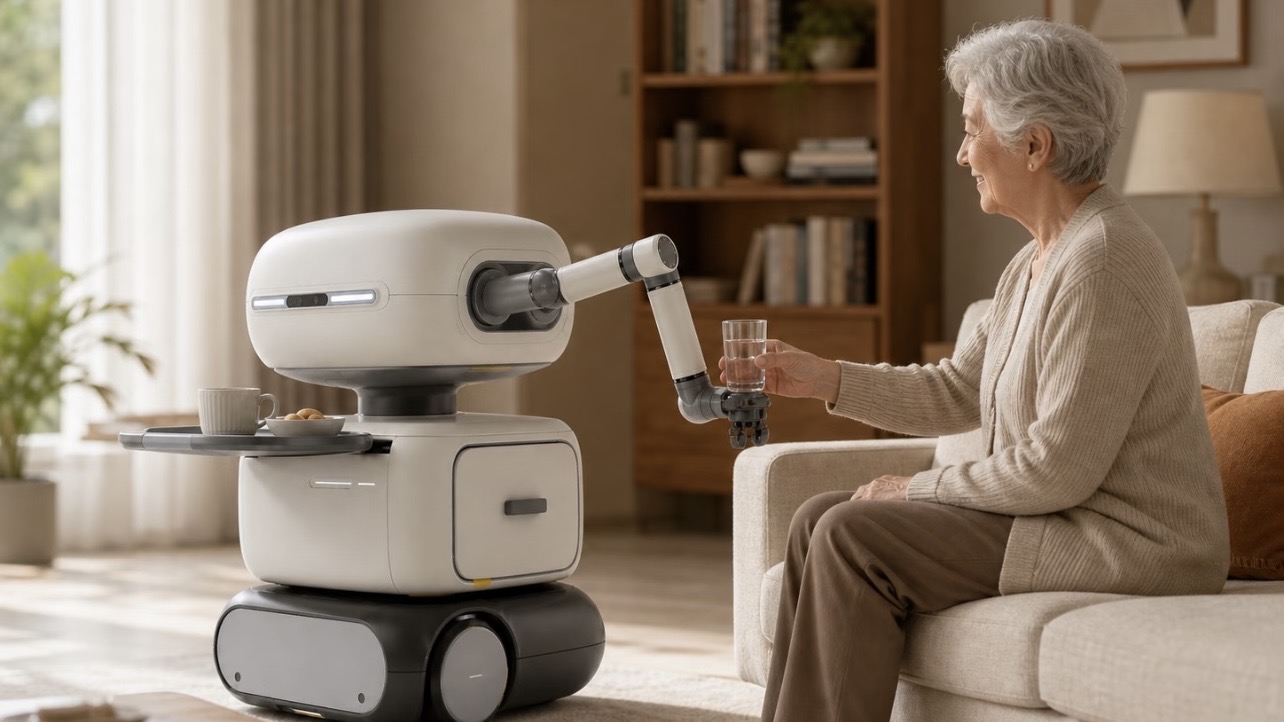
Medical service robots are a broad group. A telepresence robot that moves around a ward has little in common with a hospital delivery AGV or a surgical assistant. The right medical service robot battery depends on the job, not the label.
power ventilators, monitors and other equipment. This page helps you decide whether one of our standard packs fits your robot, or whether the robot needs a custom pack.
Key Takeaways
- Compact medical service robots — telepresence, nursing assistance, medical carts and sensor payloads — can use our 14.4V, 47.5–95Wh standard packs.
- Large delivery AGVs, disinfection robots and surgical assistants need 24–48V and roughly 0.5–3kWh. Our standard packs are not the right fit.
- Our medical packs ship with pack-level evidence. The robot OEM remains the legal manufacturer of the robot.
What Counts as a Medical Service Robot?
Medical service robots work in hospitals, clinics and care homes. They carry supplies, support nurses, disinfect rooms, or let a specialist join a ward round remotely. Some are medical devices. Some are not. The duty cycle decides what the pack has to do.
The table below gives a practical starting point.
| Robot type | What it does | Typical drive power | Standard pack fit? |
|---|---|---|---|
| Telepresence / nursing assistance | Video, mobility, sensors | 50–150W | Yes, with 95Wh and a swap plan |
| Medical cart / sensor / control | Payload, display, edge compute | 20–100W | Yes |
| Hospital delivery AGV | Tow or carry supplies | 300–1000W | Not with a standard pack |
| Disinfection robot | UV, plasma or spray | 300–1000W+ | Not with a standard pack |
| Surgical assistant | Precision arms, imaging | >1kW | Not with a standard pack |
These are typical values. A robot that carries a heavy payload, climbs ramps or runs a heater will draw more. Calculate the real duty cycle before you choose a pack.
We also build packs for . The power range is different, so we keep the pages separate.
What Power and Energy Does a Medical Service Robot Need?
Start with average power, not peak power.
Average power sets runtime. Peak power sets the BMS, connector and cable rating. A 95Wh pack can run a 50W load for about 1.9 hours at nominal energy. At 100W, it is about 57 minutes. At 20W, it is about 4.75 hours.
These numbers ignore conversion losses, cutoff voltage and cold temperature. Use them as a first estimate, then test the real robot.
| Load | Approximate runtime from 95Wh |
|---|---|
| 20W | 4.75 hours |
| 50W | 1.9 hours |
| 100W | 57 minutes |
| 150W | 38 minutes |
Most compact service robots run at 20–100W for drive, sensors and compute. A robot that needs 500W continuously needs a larger pack. It does not need a more optimistic datasheet.
Which Medical Service Robot Battery Fits?
These four standard packs fit many compact medical service robots.
| Model | Voltage | Energy | Discharge | Dimensions | Best for |
|---|---|---|---|---|---|
| 14.4V | 95.04Wh | 200W | 167.3 × 106.8 × 21.4mm | Higher-power compact robots | |
| 14.4V | 95.04Wh | 100W | 150.5 × 77.4 × 22.7mm | Smaller footprint, standard runtime | |
| 10.8V | 97.2Wh | 80W | 148.9 × 88.8 × 19.9mm | 10.8V systems | |
| 10.8V | 87.48Wh | 80W | 214.0 × 58.5 × 22.0mm | Low-temperature operation |
The GS2024HH is the highest-power standard pack in this group. The GS2054HH has the same energy in a smaller footprint, with a 100W discharge rating. The GS2020IM and GS4040IL are 10.8V options. The GS4040IL is the low-temperature version; it is designed for cold operating environments.
All four use Li-ion cells and a smart BMS. SMBus is available on our standard smart packs. Check the model and protocol version before you design the communication layer.
Need 24V or 48V? That is a custom project. We do not recommend using a 14.4V standard pack for a 500W drive.
What Medical-Grade Evidence Comes with the Pack?
Medical buyers ask for documents, not slogans. Our standard packs can ship with:
- ISO 13485 and ISO 9001 quality systems.
- IEC 62133-2 and UL 2054 pack safety reports.
- UN 38.3 transport summary and MSDS.
- CE, FCC, RoHS, UKCA, PSE and KC documentation where applicable.
- CCC certification for models sold in China, where applicable.
- SMBus data and BMS parameters.
- Change notification and long-term supply.
ISO 13485 is a quality system certificate. It is not a certificate that the pack is a medical device. If your robot is a medical device, you remain the legal manufacturer. We supply the pack and the evidence you need for your technical file.
Standard packs have no MOQ. Lead time is typically 7–30 days for standard models. Custom packs have their own schedule.
How Do You Integrate the Pack?
Most integration problems are mechanical, not electrical. You need a battery compartment that holds the pack, a connector that survives vibration, and a door or latch that a technician can open. If the robot needs to run all day, design for swap, not just charge.
Use this checklist:
- Voltage and connector type.
- Average and peak load.
- Runtime target and swap plan.
- Enclosure size and center of gravity.
- IP rating and cleaning method.
- SMBus and charger compatibility.
- Target market and documentation.
Send us these seven items and we can tell you in one review whether a standard pack fits. If it does not, we will say so before you open a tooling order.
For a deeper design discussion, read our . It covers cells, BMS, structure and compliance in more detail.
FAQ
What battery does a medical service robot use?
Most compact medical service robots use 10.8V or 14.4V Li-ion packs, roughly 50–100Wh. Larger robots use 24V or 48V packs with much higher capacity.
Can a standard 14.4V pack power a hospital delivery AGV?
Usually no. A delivery AGV often needs 300–1000W and 0.5–2kWh. That is a custom pack, not a standard 95Wh pack.
Does TEFOO certify the robot as a medical device?
No. We supply the pack and pack-level evidence. The robot OEM is the legal manufacturer and holds the device certification.
Can you customize a pack for a medical robot?
Yes. Send the duty cycle, enclosure size and target market. We will review the cell, BMS, connector and enclosure together.
Tell Us About Your Robot
Send the voltage, average and peak power, runtime target, enclosure size and target market. We will reply with a pack shortlist and the documents you need for your technical file.
If a standard pack is not enough, we will tell you before you open a tooling order.