Tefoo Energy - BMS Series Capacity Mismatch Simulator (3S)
In the development of industrial controls and precision instruments, the stability of the battery pack directly dictates the lifecycle and reliability of the device. When engineers troubleshoot prototype failures or unexpected power shut-downs, the root cause is frequently traced back to an underestimated physical hazard: cell capacity mismatch.
Below is a deep-dive technical analysis of this issue, spanning from fundamental electrochemistry to Battery Management System (BMS) electronic control logic.
The “Wooden Barrel Effect” in Series Circuits
In multi-series battery pack designs (e.g., 3S, 4S, or higher), the fundamental physics of a series circuit dictates that the current flowing through every single cell is absolutely identical:
Because the current is uniform, the effective discharge capacity of the entire battery pack is not determined by the highest-capacity cell, but strictly limited by the cell with the lowest capacity. Much like a wooden barrel made of uneven staves, the water level can only reach the height of the shortest stave. Once the lowest-capacity cell is depleted, the entire pack must cease operation, stranding the residual energy in the higher-capacity cells.
The Fatal Chain Reaction in Charge/Discharge Cycles
When cells with varying capacities undergo charge and discharge cycles at the same current, their voltage curves drastically diverge, directly challenging the system’s safety limits:
-
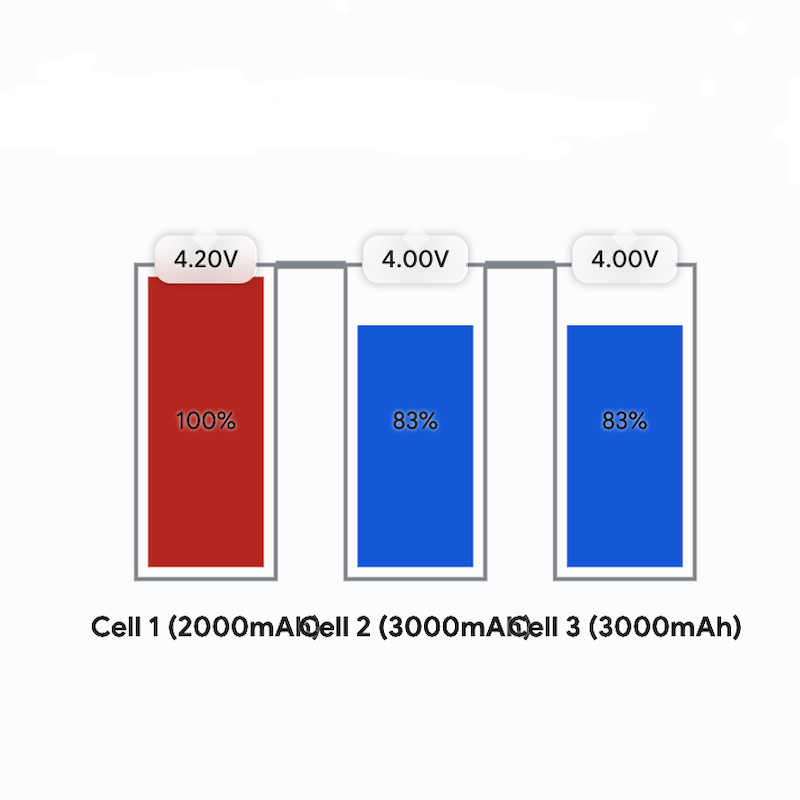
Discharge Phase (Deep Over-Discharge): Assume a 3S pack contains one 2000mAh cell alongside two 2500mAh cells. Once 2000mAh is discharged, the smaller cell’s voltage will rapidly plummet to the discharge cut-off threshold (e.g., 2.75V), while the larger cells remain comfortably in their 3.6V plateau. If the device continues to draw current, the small cell is forced into a state of deep over-discharge. According to electrochemistry data, discharging a lithium-ion cell below 2.5V causes the copper current collectors to dissolve, leading to irreversible internal structural damage and a high risk of internal short-circuiting during subsequent recharges.
-
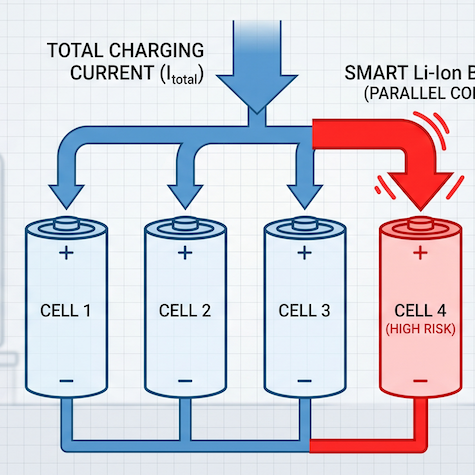
Charge Phase (Forced Overcharge & Thermal Runaway): The charging cycle is equally perilous. The small-capacity cell will hit the 4.2V fully-charged threshold first. If the Constant Current (CC) charging phase is maintained to fill the larger cells, the smaller cell is forced into overcharge. This leads to electrolyte oxidation, gas generation (swelling), lithium plating, and can ultimately trigger a catastrophic thermal runaway event [2].
Can a BMS Solve Capacity Inconsistency?
A common misconception among hardware developers is that equipping a Battery Management System (BMS) with cell-balancing capabilities will automatically rectify voltage differences. From an electronic control logic perspective, this is false.
Standard BMS architectures rely on Passive Balancing, which utilizes bleed resistors in parallel with the cells to dissipate the excess energy of higher-voltage cells as heat. However, this design faces severe physical limitations:
-
Insufficient Balancing Current: Most industrial-grade protection boards restrict passive balancing currents to between 50mA and 100mA to manage heat dissipation. If there is a 500mAh capacity gap between cells, the theoretical time required to balance them is:

During a standard 2-to-3-hour charge cycle, the BMS simply lacks the time to bridge this capacity chasm.
-
Hard Protection Triggering: When a BMS monitoring IC (such as the Texas Instruments BQ series) detects that any single cell has hit the Over-Voltage Protection (OVP, e.g., 4.25V) or Under-Voltage Protection (UVP, e.g., 2.50V) threshold, its highest priority is to immediately cut off the charge/discharge MOSFETs.
-
The Result: The BMS does not “fix” the mismatched capacities; instead, it frequently triggers overcharge/over-discharge protections. To the user, this manifests as a battery that refuses to fully charge and shuts down prematurely.

Real-World Disasters in Industrial and Medical Devices
When a battery pack with this underlying defect is deployed into B2B applications, the hard-protection triggers executed by the BMS lead to severe operational failures.
-
Medical Ventilator Batteries: Ventilators require stable, high-current draws to maintain air pressure pumps. If a mismatched cell hits the UVP floor mid-operation, the BMS instantly severs the discharge MOSFET. For the host device, this is not a graceful “low battery warning”—it is an abrupt power failure that directly jeopardizes patient safety. The ECRI Institute consistently ranks power supply and battery management failures among the top health technology hazards.
-
Programmable Logic Controller (PLC) Backup Batteries: PLCs rely on backup battery power to save critical operational states during a facility power outage. A capacity mismatch causing premature voltage drop means the PLC fails to retain its memory, leading to expensive industrial downtime and data loss.
How Professional Pack Manufacturers Completely Solve This
Eradicating the hazards of capacity mismatch requires moving beyond reactive BMS protections and implementing stringent front-end Cell Sorting & Matching combined with Smart Communication Architectures.
1. Stringent Dynamic Cell Sorting
At Tefoo Energy, manufacturing high-end intelligent lithium-ion battery packs for medical and instrumentation applications begins with rigorous cell selection. We do not just procure Grade-A cells; we subject them to dynamic matching. Cells are grouped ensuring identical static capacities, internal resistance (ACIR/DCIR), and overlapping dynamic discharge curves across varying C-rates. This eradicates the “wooden barrel effect” at the physical source.
2. Advanced BMS Integration with SMBus v1.1
Even with perfect initial matching, lithium-ion cells can develop slight degradation deviations over hundreds of cycles. A purely hardware-based protection board is insufficient for high-reliability applications.
Tefoo Energy’s smart battery packs integrate advanced Gas Gauge ICs utilizing the SMBus v1.1 protocol. Instead of relying solely on abrupt MOSFET cut-offs, our intelligent BMS continuously transmits highly granular, cell-level data directly to the host device’s MCU:
- Real-time voltage of each individual cell.
- The dynamically calculated lifespan health of the pack.
- Predictive remaining run-time based on the current load.
The Engineering Value
Utilizing this communication logic, the host machine (e.g., a portable oscilloscope or patient monitor) detects abnormal voltage drops in a specific cell long before the hardware UVP triggers a blackout. The host software can then proactively alert the user to “Connect AC Power” or execute a safe, automated data-saving shutdown sequence.
Engineering Support
Exceptional power design is your device’s ultimate safety net. Are you developing the power architecture for a next-generation medical monitor or industrial tester? Connect with the Tefoo Energy engineering team for custom intelligent lithium battery pack structures and seamless SMBus integration solutions.