How 18650 Battery Packs Are Designed: Structure, Applications and OEM Selection Guide
Why Can’t 18650 Cells Be Used Directly?

At a basic level, many people assume that an 18650 battery can be used directly as a power source. In real engineering applications, however, a single 18650 cell is almost never used on its own.
This is mainly because a single cell provides a relatively low voltage (typically around 3.6V–3.7V) and lacks essential protection and control mechanisms. As a result, it cannot meet the voltage requirements of most devices, nor can it ensure safe and stable operation.
For this reason, 18650 cells must be integrated into a complete battery pack system, which includes structural design, protection, and system-level control.
👉 The main limitations of a single 18650 cell include:
- Insufficient voltage for most devices
- No built-in protection (risk of overcharge/over-discharge)
- Lack of stable and controllable output
👉 Conclusion:
In practical applications, 18650 batteries are used as part of a battery pack system rather than as standalone cells.
How Voltage and Capacity Are Determined in 18650 Battery Packs?
To understand 18650 battery pack design, it is essential to understand two key concepts: series (S) and parallel (P) connections.
Series connections increase voltage, while parallel connections increase capacity. By combining these two dimensions, the same 18650 cells can be adapted to very different application requirements.
👉 This can be summarized as:
-
Series (S) → increases voltage
- 2S ≈ 7.2V
- 3S ≈ 10.8V
- 4S ≈ 14.4V
-
Parallel (P) → increases capacity
- 2P → capacity ×2
- 3P → capacity ×3
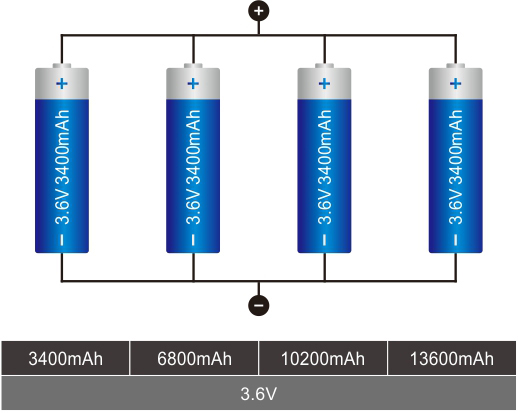
In real-world design, engineers balance S and P configurations to match both voltage requirements and runtime expectations.
👉 Conclusion:
Battery pack performance is defined by “series for voltage” and “parallel for capacity,” not by individual cell specifications.
Why Do Different Devices Use Different 18650 Battery Pack Designs?

Although the same 18650 cells may be used, battery pack designs vary significantly across different devices. This is because each application has unique performance and reliability requirements.
👉 Typical differences across applications include:
-
Medical devices
- Require high stability and safety
- Commonly use higher voltage platforms (e.g., 14.4V / 4S)
-
Test and measurement equipment
- Require stable voltage and precise monitoring
- Often use 10.8V (3S) configurations
-
Industrial inspection devices
- Focus on durability and long-term reliability
- Designed for continuous operation
👉 Conclusion:
Differences in battery pack performance are driven by application requirements, not by the cell itself.
Why Is Battery Pack Design More Complex Than It Seems?
In real engineering scenarios, battery design involves far more than just voltage and capacity. Many critical issues arise at the system level rather than at the individual cell level.
For example, small variations between cells can accumulate over time, affecting overall performance and lifespan. Charging strategies must also account for environmental conditions such as temperature.
👉 The main sources of complexity include:
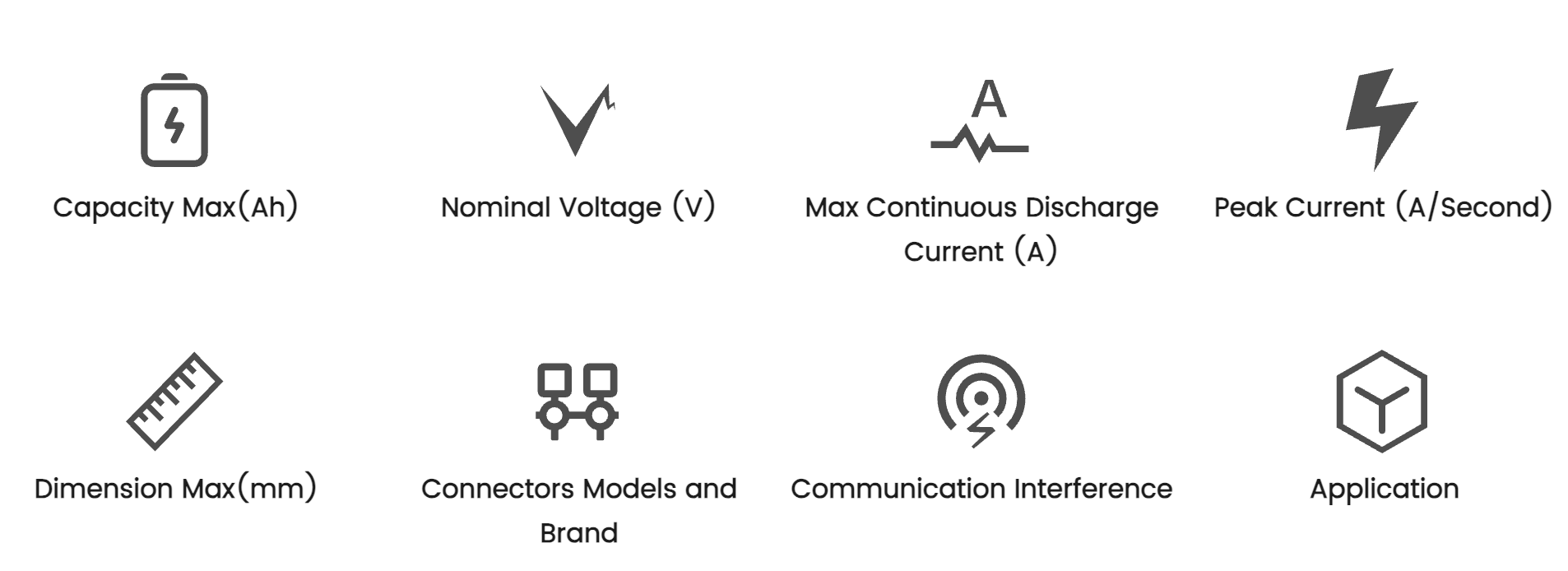
- Cell consistency: Affects lifespan and performance stability
- Charging strategy: Impacts safety and charging efficiency
- System-level monitoring: Ensures reliable operation and fault detection
Because of these factors, a battery that “works” is not necessarily a battery system that is stable and reliable over time.
👉 Conclusion:
Battery system complexity comes from consistency management, charging control, and system-level monitoring—not just cell specifications.
How Do Smart Battery Packs Solve These Problems?
As device requirements increase, battery packs have evolved from simple power sources into intelligent systems with monitoring and control capabilities.
By integrating communication, algorithms, and adaptive control, modern battery packs can significantly improve safety and performance.
👉 Key technologies include:
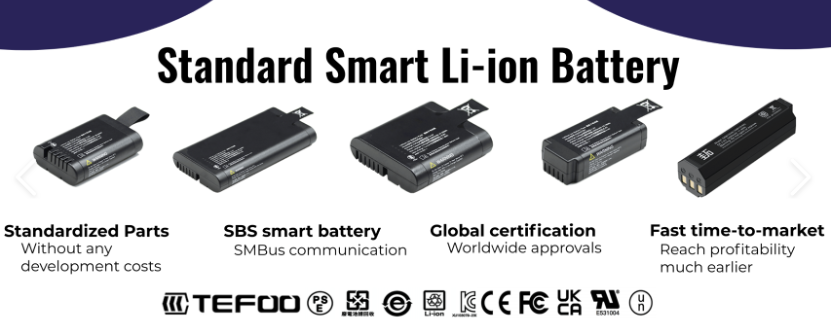
- SMBus communication: Enables real-time data exchange between battery and host
- Fuel gauge systems: Provide accurate State of Charge (SOC) estimation
- JEITA-based charging: Adjusts charging behavior based on temperature conditions
These features allow the battery to be actively managed rather than passively used.
👉 Conclusion:
Smart battery packs improve safety and reliability through communication, accurate monitoring, and temperature-aware charging control.
What Are the Real Challenges in OEM Battery Projects?
In OEM projects, battery-related challenges are often not purely technical. Instead, they are closely tied to supply chain flexibility and regulatory requirements.
These issues become especially evident during early-stage development and small-batch production.
👉 Common challenges include:
- Small-batch supply constraints: High MOQ requirements from traditional suppliers
- Certification and compliance complexity: Different requirements such as CCC and CE
- Compatibility and replacement needs: Matching existing battery form factors and interfaces
👉 Conclusion:
In OEM projects, battery challenges are primarily related to supply flexibility, certification compliance, and system compatibility.
How to Choose the Right 18650 Battery Pack?
Selecting the right battery pack requires evaluating multiple factors beyond basic specifications. In practice, it is a system-level decision rather than a simple parameter comparison.
👉 Key considerations include:
- Voltage platform (series configuration)
- Capacity requirements (parallel configuration)
- Application type (medical, industrial, test equipment)
- Certification requirements (CCC, CE, etc.)
- Supplier capability (customization and small-batch support)
A well-matched battery pack should align with both the technical requirements and the operational constraints of the project.

Medical application intelligent battery
👉 Conclusion:
The right 18650 battery pack must balance electrical performance, application needs, certification requirements, and supply flexibility.
Conclusion: The Core of 18650 Battery Packs Lies in System Capability
18650 cells are only the foundation of a battery system. The actual performance and reliability depend on how these cells are configured and managed within a battery pack.
👉 This can be summarized as:
- Structure → defines voltage and capacity
- System design → determines performance and safety
- Supply capability → determines project feasibility
👉 Final takeaway:
The true value of an 18650 battery pack lies in its system design, control capability, and application adaptability—not in individual parameters alone.