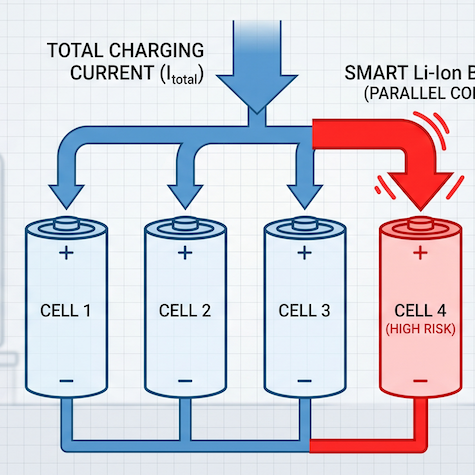
Single-Cell Short Circuits Drain Parallel Connections
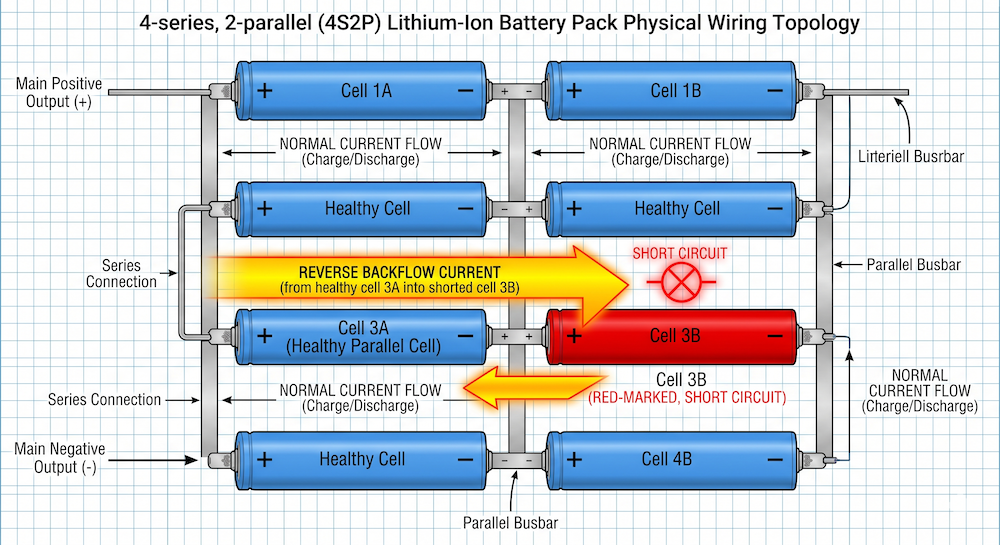
A short circuit within a single lithium-ion cell alters the electrical circuit of the entire battery pack. In a parallel configuration, a faulted cell creates a lower-resistance path, causing all healthy cells in the same group to discharge their stored energy into it.
- Reverse Current: The internally shorted cell draws a continuous reverse current from the connected healthy cells.
- Accelerated Depletion: This rapid energy transfer drains the entire parallel group, leading to an immediate drop in output voltage and total power loss to the medical device.
Cell Faults Cause Overvoltage in Series Configurations
In a series circuit, a single cell with a severe voltage drop forces the remaining healthy cells to operate under unsafe charging conditions.
- Charging Voltage Overload: Medical device chargers supply a constant total current. When a faulted cell fails to establish proper voltage, the excess electrical load is absorbed by the healthy cells.
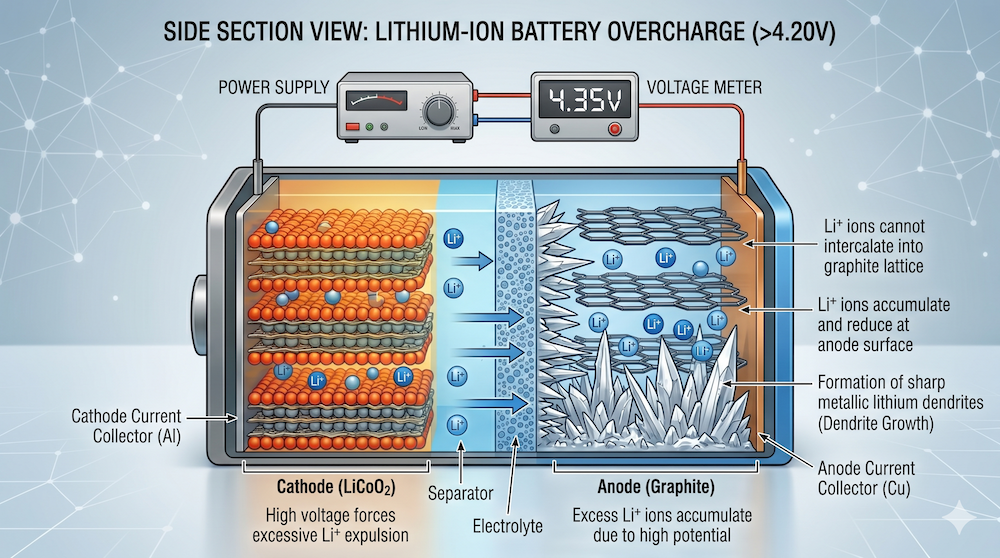
- Chemical Degradation: Pushing healthy cells beyond the standard 4.20V limit causes lithium plating on the anode. This permanently degrades cell capacity and creates localized thermal stress within the pack.
Active BMS Cut-Off Disconnects the Discharge Circuit
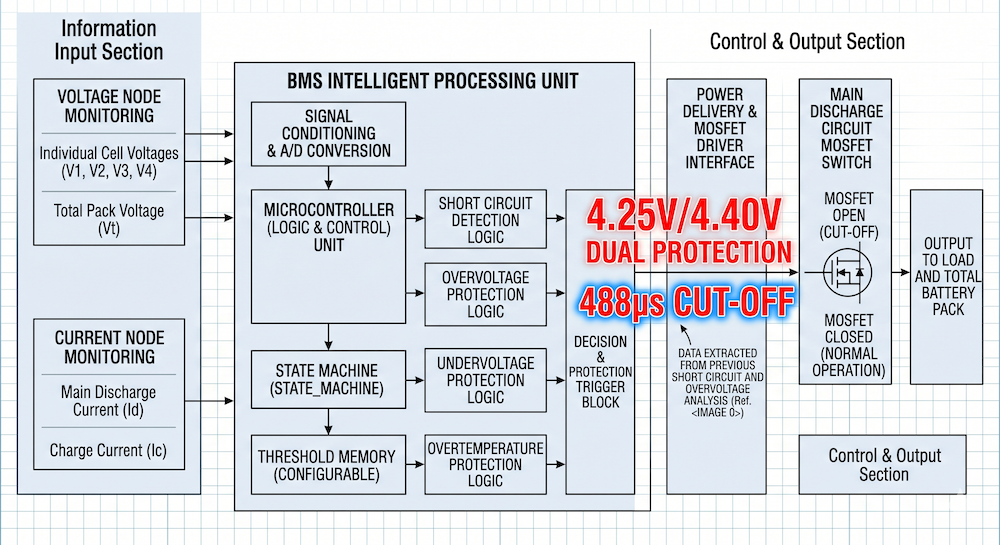
The standard engineering solution for single-cell electrical faults is an active Battery Management System (BMS) that monitors individual cell parameters and physically disconnects the main discharge circuit when an anomaly occurs.
- Node-Level Monitoring: The BMS continuously measures the voltage and current of every cell node in the pack.
- Threshold Detection: The BMS identifies faults immediately when a single cell drops below the first-level over-discharge threshold of 2.50V.
- Current Assessment: The system algorithm differentiates between normal medical equipment startup surges (tolerating 10.50A for 2 seconds) and critical over-power threats (cutting off 20.83A in 23 milliseconds).
Microsecond Hardware Responses Isolate Electrical Faults
Medical equipment requires hardware-level protection that responds faster than the propagation of electrical faults. Passive thermal fuses are insufficient for instantaneous high-current short circuits.
- Short-Circuit Cut-Off: Upon detecting an external short circuit exceeding 38.87A, the BMS drives the main power MOSFETs to open the discharge loop in 488 microseconds (μs).
- Dual-Level Voltage Protection: The BMS executes a recoverable circuit cut-off at 4.25V per cell. If extreme conditions force a cell to 4.40V, a secondary protection circuit triggers a permanent, software-controlled fuse blow to halt operation entirely and protect the host device.
- The Tefoo GS2054HH Medical Battery Specifications
The Tefoo GS2054HH is a 14.4V smart lithium-ion battery pack engineered with active BMS isolation for ventilators and critical patient monitors.
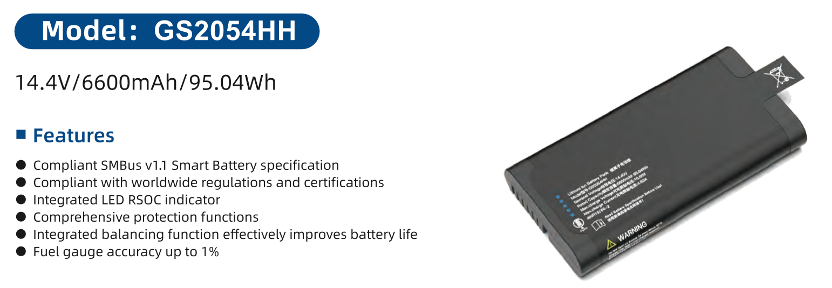
- Cell Consistency: The GS2054HH is assembled using cells with low Equivalent Series Resistance (ESR) tolerances to minimize initial impedance imbalance.
- Hardware Isolation: The integrated BMS utilizes the 488μs short-circuit response and dual-level voltage protection parameters specified above.
- SMBus Integration: The pack communicates real-time diagnostic data to the host device using standard SMBus v1.1 protocols, ensuring the medical equipment can log fault conditions prior to hardware cut-off.