What Is an MSDS (or SDS)?
An MSDS (Material Safety Data Sheet), also known as an SDS (Safety Data Sheet), is a safety document that describes the chemical composition, hazards, handling, storage, transport, and emergency measures of a product.
For lithium batteries, an MSDS explains how the battery should be safely transported, stored, handled, and disposed of, especially in cases of damage, leakage, overheating, or fire.
In modern regulatory systems, SDS is the standardized term under the Globally Harmonized System (GHS), but in practice, “MSDS” is still widely used in international trade.
Is MSDS a Certification?
MSDS is not a certification. It is a safety data document.
Unlike test-based certifications such as UN38.3 or IEC62133, an MSDS does not certify product performance or safety compliance through testing. Instead, it provides structured safety information based on the product’s composition and characteristics.
In real-world business communication, many buyers and logistics providers refer to “MSDS certification,” but this is technically incorrect. What they actually require is a compliant and accurate MSDS/SDS document.
Why Lithium Batteries Need an MSDS?
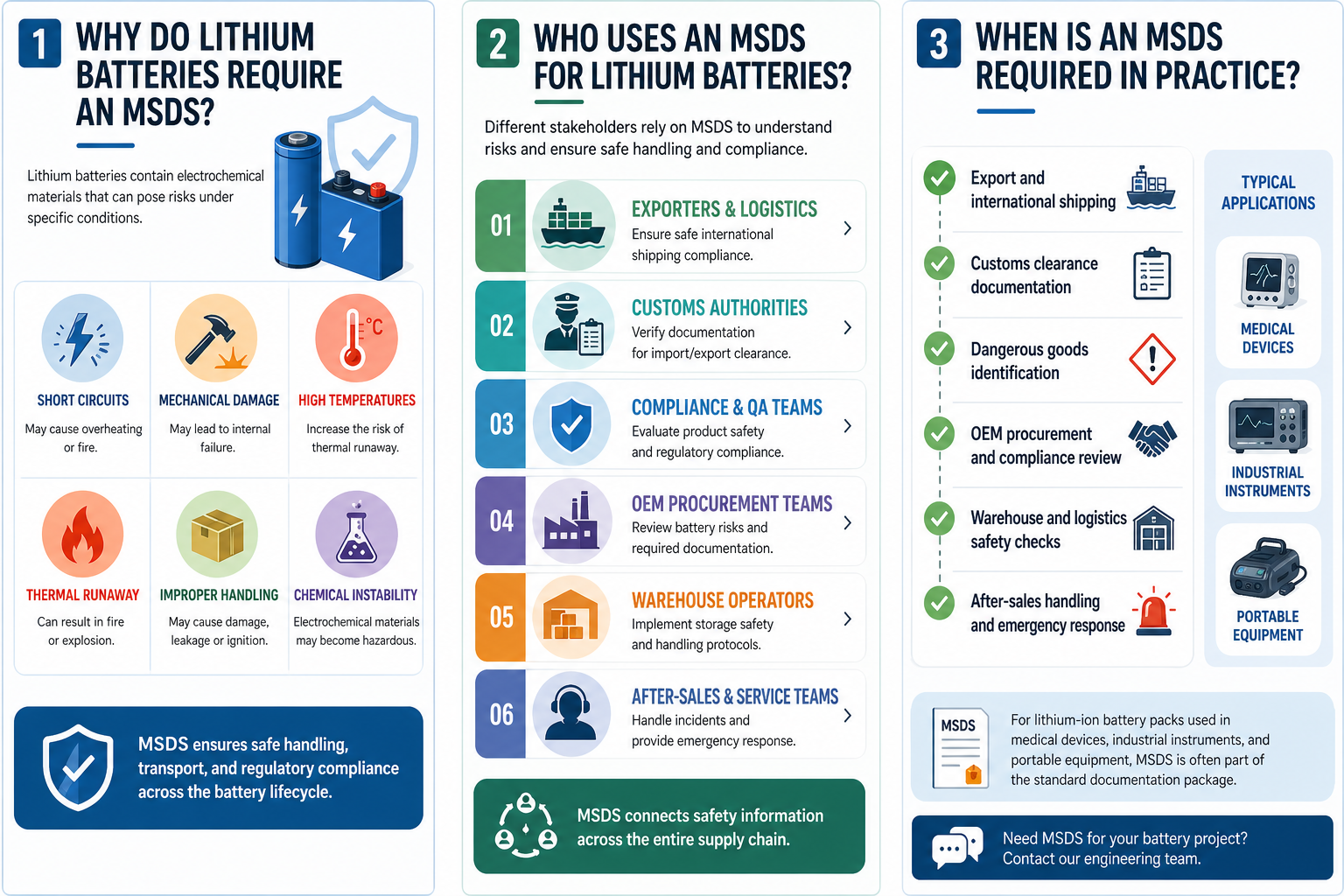
Lithium batteries contain electrochemical materials that may pose risks under certain conditions, such as short circuits, mechanical damage, high temperatures, or improper handling.
An MSDS is required because it helps different stakeholders understand how to safely manage these risks.
In practice, MSDS is commonly requested in the following scenarios:
-
Export and international shipping
-
Customs clearance documentation
-
Dangerous goods identification
-
OEM procurement and compliance review
-
Warehouse and logistics safety checks
-
After-sales handling and emergency response
For lithium-ion battery packs used in medical devices, industrial instruments, and portable equipment, MSDS is often part of the standard documentation package.
What Information Does an MSDS Include?
An MSDS follows a standardized 16-section format. Each section provides specific safety and regulatory information.
| Section | Description | Lithium Battery Focus |
|---|---|---|
| Identification | Product and supplier info | Model, manufacturer, emergency contact |
| Hazard Identification | Potential hazards | Fire, thermal runaway, leakage |
| Composition | Material components | Electrolyte, electrode materials |
| First Aid Measures | Emergency response | Contact, inhalation, burns |
| Firefighting Measures | Fire handling | Suitable extinguishing agents |
| Accidental Release | Leakage handling | Damaged battery procedures |
| Handling & Storage | Safe usage | Avoid heat, short circuit |
| Exposure Control | PPE guidance | Handling damaged batteries |
| Physical Properties | Product characteristics | Appearance, voltage |
| Stability & Reactivity | Chemical stability | Conditions to avoid |
| Toxicological Info | Health effects | Exposure risks |
| Ecological Info | Environmental impact | Disposal impact |
| Disposal Considerations | Waste handling | Battery recycling |
| Transport Information | Shipping classification | UN number, DG classification |
| Regulatory Info | Compliance standards | Regional regulations |
| Other Information | Revision data | Issue date, notes |
MSDS vs SDS: What’s the Difference?
MSDS and SDS refer to the same type of document, but SDS is the modern, globally standardized format.
The key difference is terminology and structure standardization.
| Aspect | MSDS | SDS |
|---|---|---|
| Terminology | Older term | Current global standard |
| System | Various formats | GHS standardized |
| Sections | May vary | Fixed 16 sections |
| Usage | Still widely used in trade | Preferred in regulations |
In practice, most companies use both terms interchangeably.
MSDS vs UN38.3: Key Differences Explained
MSDS and UN38.3 serve completely different purposes and cannot replace each other.
| Aspect | MSDS / SDS | UN38.3 |
|---|---|---|
| Type | Safety document | Transport test standard |
| Purpose | Safety information | Transport safety validation |
| Testing required | No (usually) | Yes |
| Focus | Handling, storage, hazards | Mechanical and thermal safety |
| Usage | Documentation & compliance | Shipping approval |
The key difference is:
MSDS explains how to handle a battery safely. UN38.3 proves that the battery is safe to transport.
When Do You Need an MSDS?
You typically need an MSDS for lithium batteries in the following situations:
-
Shipping lithium batteries internationally
-
Exporting battery packs with or without equipment
-
Providing compliance documents to OEM customers
-
Submitting documentation to logistics providers
-
Passing customs or regulatory checks
-
Meeting warehouse or platform safety requirements
In many cases, MSDS is requested together with other documents, not as a standalone requirement.
How to Prepare an MSDS for Lithium Batteries?
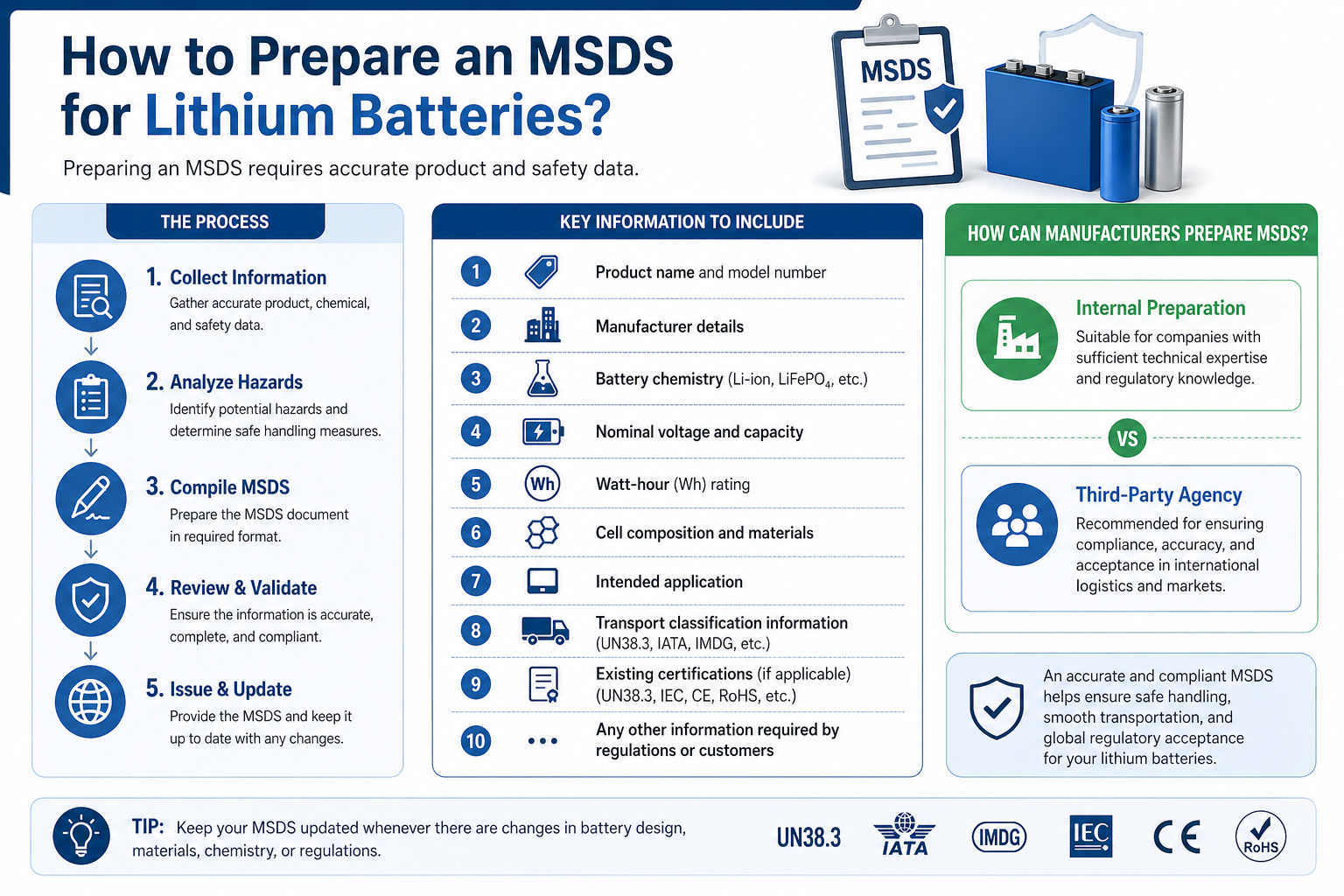
Preparing an MSDS requires accurate product and safety data.
Key information includes:
-
Product name and model number
-
Manufacturer details
-
Battery chemistry (Li-ion, LiFePO4, etc.)
-
Nominal voltage and capacity
-
Watt-hour (Wh) rating
-
Cell composition and materials
-
Intended application
-
Transport classification information
-
Existing certifications (if applicable)
Manufacturers can prepare MSDS internally if they have sufficient technical and regulatory knowledge. However, many companies choose third-party agencies to ensure compliance and acceptance in international logistics.
Common MSDS Mistakes That Lead to Rejection
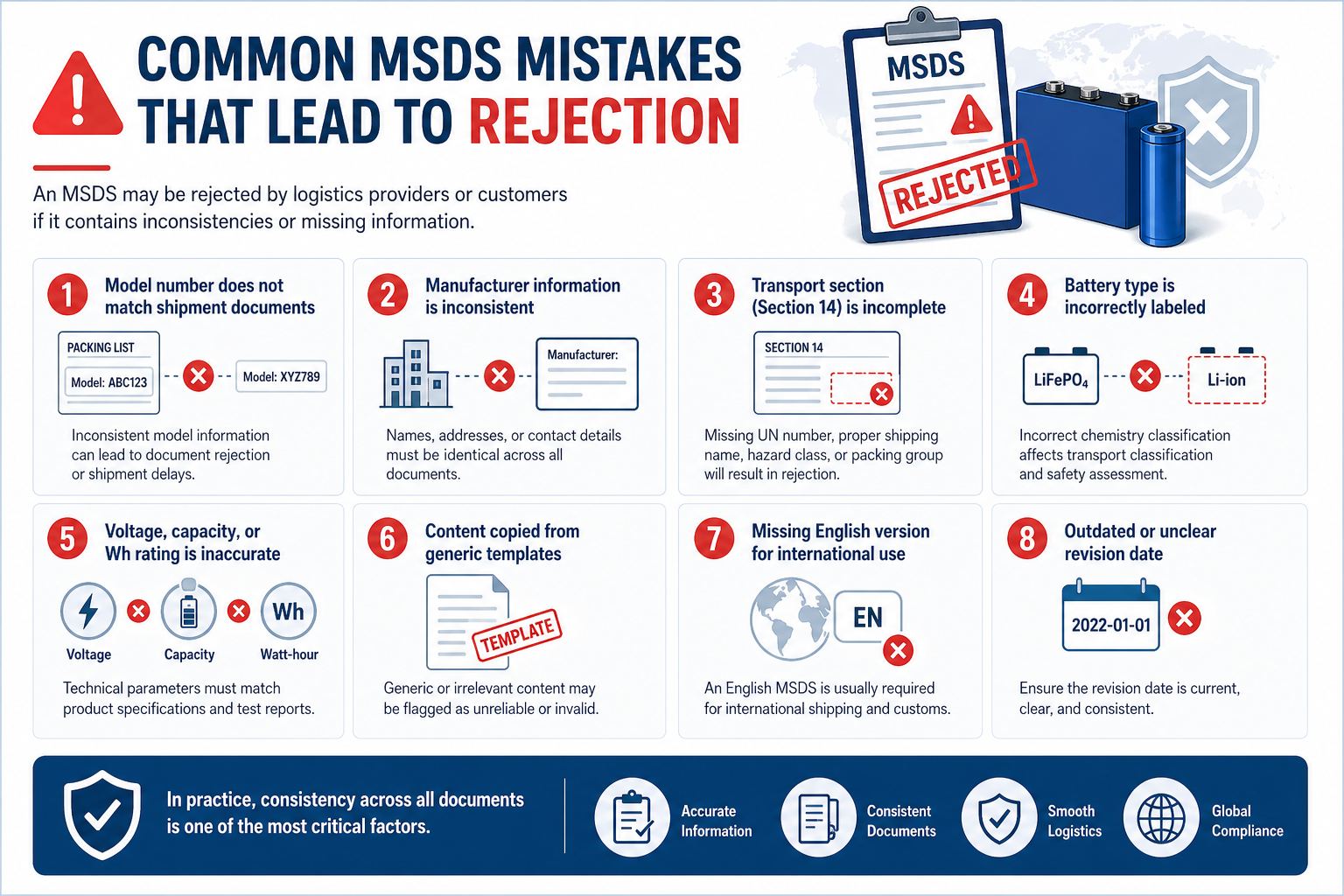
An MSDS may be rejected by logistics providers or customers if it contains inconsistencies or missing information.
Common issues include:
-
Model number does not match shipment documents
-
Manufacturer information is inconsistent
-
Transport section (Section 14) is incomplete
-
Battery type is incorrectly labeled
-
Voltage, capacity, or Wh rating is inaccurate
-
Content copied from generic templates
-
Missing English version for international use
-
Outdated or unclear revision date
In practice, consistency across all documents is one of the most critical factors.
Is MSDS Enough for Lithium Battery Shipping?
MSDS alone is not enough for shipping lithium batteries.
In most cases, additional documents are required, such as:
-
UN38.3 test report or test summary
-
Transport condition report
-
Dangerous goods declaration
-
Packaging certification
-
Lithium battery labels and markings
-
Applicable safety certifications (e.g., IEC62133)
MSDS is only one part of a complete compliance and logistics documentation package.
MSDS Validity and Update Requirements
There is no universal expiration period for MSDS documents, but in practice, many logistics providers and customers prefer recent versions.
Typically, an MSDS is considered acceptable if:
-
It reflects the current product specifications
-
It includes up-to-date regulatory information
-
It has a clear issue or revision date
Many companies update MSDS every 3–5 years or whenever there are changes in product composition, regulations, or supplier information.
Lithium Battery MSDS Checklist (Before Submission)
Before submitting an MSDS, verify the following:
-
Product model matches invoice and packaging
-
Manufacturer details are consistent across documents
-
Battery chemistry is correctly identified
-
Voltage, capacity, and Wh rating are accurate
-
Transport information (UN number, classification) is complete
-
Emergency and safety instructions are clear
-
Document includes issue or revision date
-
English version is available
-
Supporting documents (UN38.3, etc.) are prepared if needed
Common Misunderstandings About MSDS
Several misconceptions exist around MSDS in lithium battery applications:
-
MSDS is a certification ❌
-
MSDS can replace UN38.3 ❌
-
All MSDS documents are interchangeable ❌
-
MSDS alone is sufficient for shipping ❌
In reality, MSDS is a supporting safety document, not a standalone compliance solution.
FAQs About Lithium Battery MSDS
Is MSDS the same as SDS?
Yes. SDS is the standardized modern term, while MSDS is still widely used in trade.
Is MSDS a certificate?
No. It is a safety information document, not a test-based certification.
Do lithium batteries require MSDS?
Yes, especially for shipping, export, and compliance purposes.
Can MSDS replace UN38.3?
No. UN38.3 is a mandatory transport safety test for lithium batteries.
Who can issue an MSDS?
Manufacturers or qualified third-party agencies can prepare it.
How long is an MSDS valid?
There is no strict global rule, but updated versions are preferred.
Why was my MSDS rejected?
Usually due to inconsistent data, missing transport information, or outdated content.
Final Insight
MSDS is not just a document—it is part of a broader safety and compliance system for lithium batteries.
Understanding how it works alongside UN38.3, transport regulations, and OEM requirements is essential for ensuring smooth logistics, regulatory approval, and customer trust.