Selecting between 18650 and 21700 cylindrical cells for portable medical devices depends on volumetric constraints and energy demand: 21700 cells offer up to 50% higher capacity and 20% greater volumetric energy density, ideal for high-drain systems like portable ventilators, whereas 18650 cells provide superior design flexibility, compact grip ergonomics, and mature regulatory heritage for ultra-compact medical devices.
What Are the Fundamental Dimensional and Electrochemical Differences Between 18650 and 21700 Cells?
For medical device R&D engineers and procurement managers, choosing the correct cylindrical cell form factor is a foundational decision that governs the physical enclosure dimensions, thermal envelope, weight distribution, and overall runtime of portable medical electrical equipment. While both chemistries typically utilize high-energy-density Nickel Manganese Cobalt (NMC) or Lithium Nickel Cobalt Aluminum Oxide (NCA) formulations, their physical dimensions dictate dramatically different electrical characteristics:
-
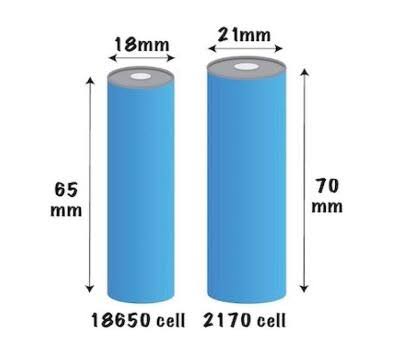
18650 Cell Standard: Measures $18\text{ mm}$ in diameter by $65\text{ mm}$ in length. Standard commercial-grade cell capacities range from $2,600\text{ mAh}$ to $3,500\text{ mAh}$, yielding single-cell stored energy between $9.36\text{ Wh}$ and $12.60\text{ Wh}$ at a nominal $3.6\text{V}$ or $3.7\text{V}$.
-
21700 Cell Standard: Measures $21\text{ mm}$ in diameter by $70\text{ mm}$ in length. Modern high-capacity 21700 cells deliver between $4,000\text{ mAh}$ and $5,000\text{ mAh}$, providing single-cell energy between $14.40\text{ Wh}$ and $18.50\text{ Wh}$.
Although a 21700 cell is only $3\text{ mm}$ wider and $5\text{ mm}$ longer than an 18650 cell, calculating its physical geometry demonstrates why this dimensional shift yields a massive increase in usable volume:
$$V_{\text{cell}} = \pi \cdot \left(\frac{d}{2}\right)^2 \cdot h$$
-
18650 Cell Volume: $V_{18650} = \pi \cdot (0.9\text{ cm})^2 \cdot 6.5\text{ cm} \approx 16.54\text{ cm}^3$
-
21700 Cell Volume: $V_{21700} = \pi \cdot (1.05\text{ cm})^2 \cdot 7.0\text{ cm} \approx 24.25\text{ cm}^3$
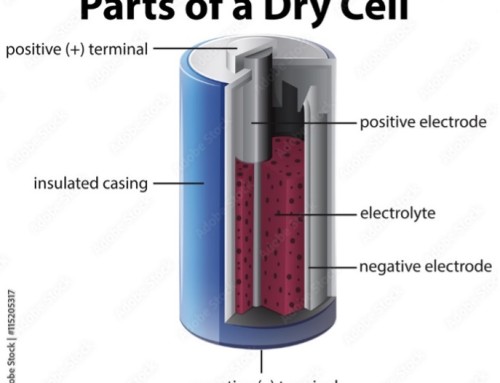
The physical volume of a 21700 cell increases by approximately $46.6\%$ compared to an 18650 cell. However, because the larger internal jelly-roll winding reduces the proportional ratio of inactive structural packaging (steel can, current collectors, top cap assembly) relative to active cathode/anode materials, a 21700 cell achieves up to $50\%$ greater electrical capacity.
To evaluate volumetric energy density ($E_v$) at the individual cell level, engineers apply the volumetric energy formula:
$$E_v = \frac{C_{\text{cell}} \cdot V_{\text{nom}}}{V_{\text{cell}}}$$
For a tier-1 $5,000\text{ mAh}$ / $3.7\text{V}$ 21700 cell, $E_v \approx 762.88\text{ Wh/L}$. At the complete pack assembly level, utilizing fewer 21700 cells to achieve a given target capacity reduces interconnect nickel tabs, busbar welding points, and BMS sensing leads, lowering pack-level parasitic electrical resistance ($I^2R$ loss) by up to $25\%$ compared to equivalent 18650 arrays.
Technical Comparison Matrix: 18650 vs. 21700 for Medical OEM Integration
| Engineering Parameter | 18650 Form Factor | 21700 Form Factor | Clinical Design Impact |
| Physical Dimensions | $18\text{ mm (D)} \times 65\text{ mm (L)}$ | $21\text{ mm (D)} \times 70\text{ mm (L)}$ | Governs device handle thickness & internal chassis volume |
| Individual Cell Volume | $16.54\text{ cm}^3$ | $24.25\text{ cm}^3$ | 21700 occupies $46.6\%$ more volume per cell |
| Single-Cell Capacity Range | $2,600\text{ mAh} – 3,500\text{ mAh}$ | $4,000\text{ mAh} – 5,000\text{ mAh}$ | 21700 offers $35\% – 50\%$ higher runtime per cell |
| Single-Cell Stored Energy | $9.36\text{ Wh} – 12.60\text{ Wh}$ | $14.40\text{ Wh} – 18.50\text{ Wh}$ | Higher energy density per cell reduces overall cell count |
| DC Internal Resistance ($R_{\text{DC}}$) | $20\text{ m}\Omega – 35\text{ m}\Omega$ | $10\text{ m}\Omega – 18\text{ m}\Omega$ | Lower $R_{\text{DC}}$ in 21700 reduces Joule self-heating under heavy load |
| Peak Discharge Current (Cont.) | $5\text{A} – 10\text{A}$ (Standard) / $20\text{A}$ (High-Drain) | $10\text{A} – 20\text{A}$ (Standard) / $35\text{A}$ (High-Drain) | 21700 handles high motor inrush currents with less voltage sag |
| Equivalent 50Wh Pack Array | 4S2P (8 Cells, ~$380\text{g}$) | 4S1P (4 Cells, ~$280\text{g}$) | 21700 reduces total pack mass by ~$26\%$ for equal energy |
| BMS Interconnect Weld Count | High (16+ spot welds) | Low (8+ spot welds) | Fewer interconnects improve ISO 13485 manufacturing reliability |
| Regulatory Maturity | 20+ years of medical history | Rapidly expanding global adoption | Both fully support IEC 62133-2 & UL 2054 approvals |
Thermal Management, Ergonomics, and Mechanical Architecture Considerations
When designing portable medical electrical equipment under IEC 60601-1, engineering teams must evaluate how cell selection influences thermal dissipation, structural housing ergonomics, and mechanical shock tolerance.
1. Ergonomics and Handheld Device Footprints
For devices that clinicians or patients hold continuously—such as handheld diagnostic ultrasound probes, vein finders, portable surgical power tools, or motorized pipettes—the physical circumference of the device handle dictates usability.
-
The 18650 Advantage: An 18mm cell diameter allows for compact, ergonomic handle contours. A single-cell (1S) or two-cell in series (2S1P) inline 18650 arrangement fits comfortably into human hands, minimizing operator fatigue during lengthy surgical or diagnostic procedures.
-
The 21700 Constraint: A 21mm diameter, combined with necessary structural plastic cell holders, silicone damping sleeves, and outer housing walls, increases handle cross-sections beyond comfortable limits for small-handed medical staff, making 21700 less suitable for fine handheld instruments.
2. Thermal Management and Heat Dissipation under High Discharge
Medical equipment housings are frequently sealed to IP65 or IP67 standards to permit rigorous chemical wipe-down and disinfection using isopropyl alcohol or hydrogen peroxide vapors. Sealed enclosures prevent convective airflow, forcing all internal heat to dissipate via conduction and radiation.
During high-power discharge pulses—such as the motor start-up cycle on a mobile infusion pump or surgical bone saw—internal cell resistance ($R_{\text{DC}}$) generates Joule heat according to the power loss equation:
$$P_{\text{loss}} = I^2 \cdot R_{\text{DC}}$$
Because 21700 cells feature larger internal electrode surface areas and thicker current collectors, their DC internal resistance ($10\text{ m}\Omega – 18\text{ m}\Omega$) is roughly half that of standard high-capacity 18650 cells ($20\text{ m}\Omega – 35\text{ m}\Omega$). Consequently, under a continuous $10\text{A}$ current draw, a 21700 cell generates significantly less internal heat, keeping internal chassis temperatures well below the IEC 60601-1 Clause 11.1 maximum surface touch limit ($T_{\text{touch}} \le 85^\circ\text{C}$ for metal / $95^\circ\text{C}$ for plastic under single-fault conditions).
[18650 Array: 4S2P (8 Cells)]  ──► Higher Interconnect Resistance (R_total) ──► Increased Heat Generation
[21700 Array: 4S1P (4 Cells)]  ──► Lower Interconnect Resistance (R_total)  ──► Reduced Self-Heating & Lower Weight
3. Mechanical Shock, Vibration, and Assembly Reliability
Under IEC 60601-1-11 (Home Healthcare Environment), portable devices must withstand multiple $1.0\text{m}$ to $1.5\text{m}$ drops onto concrete without structural or electrical failure. Utilizing a 4S1P 21700 pack configuration instead of a 4S2P 18650 pack halves the number of individual cells that must be secured within the battery bay. Fewer cells translate to fewer spot-welded nickel connections, directly lowering the probability of mechanical weld fracture or trace fatigue during shock and vibration events.
Regulatory Readiness and Supply Chain Longevity for Medical OEMs
Medical device lifecycles typically span 7 to 12 years from initial design freeze to end-of-life service support. Choosing a cell form factor requires careful evaluation of long-term component availability, second-sourcing options, and regulatory approval pathways:
-
18650 Regulatory Heritage & Supply Depth: The 18650 format remains the most widely produced cylindrical lithium-ion cell globally. Tier-1 manufacturers (including Panasonic, LG Energy Solution, Samsung SDI, and Murata) maintain extensive product lines with guaranteed manufacturing continuity. Furthermore, because millions of 18650-based packs hold active IEC 62133-2, UL 2054, and UN 38.3 certifications, choosing 18650 cells offers a well-established, low-risk regulatory pathway for conservative medical device approvals.
-
21700 Modern Industry Standard: Driven by electric vehicle and industrial power tool demand, tier-1 cell manufacturers have heavily shifted capital expenditure toward 21700 production lines. For new, ground-up medical device platforms intended for market release over the next decade, specifying 21700 cells protects the OEM against premature cell obsolescence while offering superior volumetric energy density.
Frequently Asked Questions by Medical Device R&D Engineers
Q1: Can we directly replace 18650 cells with 21700 cells in an existing medical battery pack enclosure?
No. A 21700 cell is $3\text{ mm}$ wider and $5\text{ mm}$ longer than an 18650 cell. Replacing 18650s with 21700s requires redesigning the internal mechanical enclosure, updating cell isolation holders, revising PCB layout dimensions, and re-submitting the battery assembly for UN 38.3 transport and IEC 62133-2 safety re-certifications.
Q2: Which cell form factor is better for high-power surgical tools with frequent motor inrush spikes?
21700 cells are superior for high-drain surgical tools. Their lower DC internal resistance ($10\text{ m}\Omega – 18\text{ m}\Omega$) minimizes transient voltage sag ($I \times R$ drop) during motor start-up spikes, allowing the device to maintain stable torque without triggering premature BMS under-voltage lockout (UVLO).
Q3: Does switching from a 4S2P 18650 pack to a 4S1P 21700 pack affect BMS complexity?
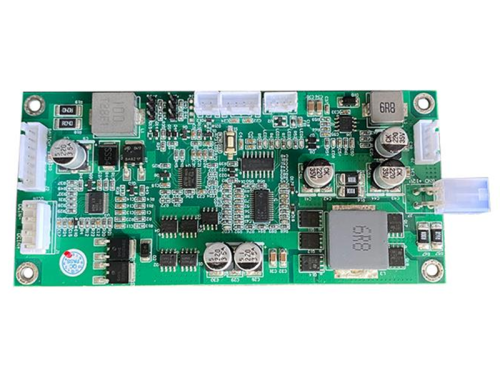
Switching to a 4S1P configuration simplifies BMS hardware. Because there are no parallel cell banks to balance within a series node, cell voltage monitoring logic becomes more straightforward, potential parallel cell cross-charging risks are eliminated, and total spot-weld interconnection points are reduced by half.
Q4: How do 18650 and 21700 cells compare regarding UN 38.3 air transport compliance?
Both cell form factors undergo identical UN 38.3 transport safety testing (including altitude simulation, thermal test, vibration, shock, external short circuit, impact/crush, overcharge, and forced discharge). Single-cell Wh ratings for both formats remain well under the $20\text{ Wh}$ per cell standalone transport restriction limit.
Optimize Your Medical Power Architecture with Tefoo Energy
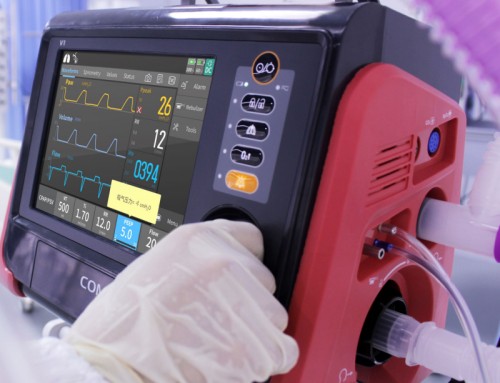
Whether your medical device engineering team requires ultra-compact 18650 pack configurations for ergonomic handheld tools or high-density 21700 power systems for mobile clinical monitors and ventilators, Tefoo Energy provides end-to-end custom engineering under strict ISO 13485 quality management systems.
Request 3D STEP Models, Custom BMS Protocols & OEM Engineering Support
Accelerate your medical device design freeze and regulatory submission timelines. Contact senior application engineers at Tefoo Energy to receive custom battery design proposals, 3D CAD STEP files, SMBus/I2C Smart BMS protocol specifications, and turnkey IEC 62133-2 / UL 2054 test documentation.