14500 Li-Ion vs AA Battery Selection in Medical Equipment Design
Handheld medical diagnostic instruments—such as portable pulse oximeters, digital otoscopes, electronic stethoscopes, and wireless ECG monitors—require high power density within strict volumetric footprints. Design engineers face a frequent trade-off between legacy 1.5V AA alkaline or NiMH cells and high-voltage 3.7V 14500 li-ion rechargeable cells. While both form factors share identical physical dimensions ($14\text{ mm}$ diameter by $50\text{ mm}$ length), their electrochemical characteristics, voltage platforms, and integration requirements diverge significantly. Selecting the appropriate power source requires evaluating circuit voltage limits, energy density, internal resistance, and regulatory compliance under medical safety mandates.
How Do Electrical Specifications Differ Between 14500 Li-Ion and AA Batteries in Medical Device Design?
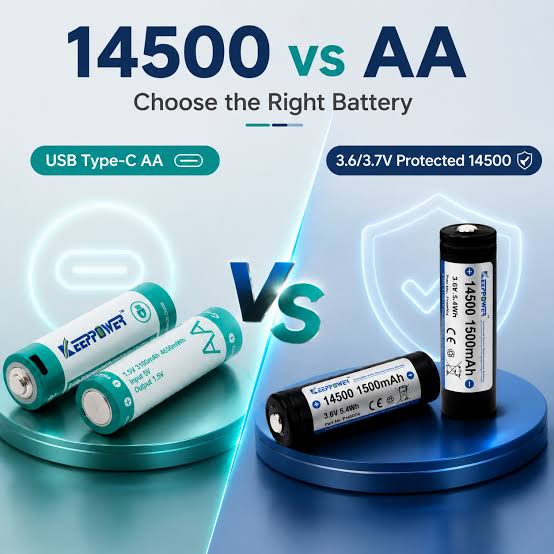
A 14500 li-ion battery delivers a 3.7V nominal output in a 14mm by 50mm footprint, providing more than double the operating voltage of a 1.5V AA alkaline cell.
Voltage Platforms and Discharge Curves for 3.7V Battery 14500 Chemistries
The 3.7V nominal voltage of a 14500 li-ion cell allows engineers to replace multi-cell AA batteries in series with a single cell. While a standard AA alkaline cell operates at $1.5\text{V}$ nominal (dropping to $0.9\text{V}$ at end-of-discharge) and a NiMH AA operates at $1.2\text{V}$, a 14500 li-ion cell operates between a peak charging voltage of $4.2\text{V}$ and a cut-off threshold of $2.5\text{V}$ to $3.0\text{V}$. Lithium-ion chemistries—such as Lithium Cobalt Oxide (LCO) or Lithium Manganese Oxide (LMO)—maintain a flat voltage plateau during discharge, ensuring stable power delivery to sensitive medical analog-to-digital converters (ADCs).
Energy Density and Capacity Trade-offs in Compact Cylindrical Form Factors
Although 1.5V AA batteries exhibit higher milliamp-hour ratings, 14500 li-ion cells deliver comparable total watt-hour energy due to higher operating voltage. Standard 14500 li-ion cells offer capacities between $600\text{ mAh}$ and $1,200\text{ mAh}$. Calculating total stored energy ($E = V \times C$) demonstrates that a $3.7\text{V}$, $1,000\text{ mAh}$ 14500 cell provides $3.7\text{ Wh}$ of energy, matching or exceeding a $1.5\text{V}$, $2,400\text{ mAh}$ alkaline AA cell ($3.6\text{ Wh}$) while weighing only 21 grams ($0.7\text{ oz}$).
Why Is the 14500 Li-Ion Cell Critical for Compact Medical Equipment and Instruments?
Integrating 14500 li-ion cells enables medical OEMs to consolidate battery compartment volumes by up to 60% compared to dual-AA battery setups.
Footprint Reduction in Handheld Diagnostic Ultrasounds and Otoscopes
Replacing two series-connected AA cells with one 14500 li-ion cell reduces internal chassis length while maintaining a nominal 3.7V supply rail. In ergonomic medical devices where handle diameter and device weight directly influence clinical usability, eliminating additional battery bays frees up PCB area for advanced digital signal processing (DSP) components, wireless Bluetooth/Wi-Fi telemetry modules, or optical sensor drivers.
Low Self-Discharge Rates and Storage Longevity in Emergency Clinical Equipment
Lithium-ion chemistry exhibits a low self-discharge rate of approximately 8% in the first month, preserving standby power in crash carts and emergency diagnostic tools. Unlike rechargeable NiMH AA batteries—which experience high self-discharge rates and risk deep discharge depletion while stored—a battery 14500 retains operational charge during extended shelf storage. Storing 14500 cells at $3.7\text{V}$ ($40\%$ state of charge) in temperature-controlled environments further extends long-term storage life.
What Are the Engineering Considerations When Replacing AA Alkaline Cells with 14500 Li-Ion Batteries?
Substituting a 1.5V AA alkaline cell with a 3.7V battery 14500 without step-down voltage regulation causes immediate overvoltage destruction of standard 1.5V integrated circuits.
Overvoltage Protection and Buck Regulator Architecture for 3.7V Inputs
Integrating a high-efficiency DC-DC buck converter down-regulates 3.7V 14500 inputs to 3.3V or 1.8V system logic rails while extending runtimes. Because a single 14500 li-ion cell outputs up to $4.2\text{V}$ when fully charged, medical equipment designed for $1.5\text{V}$ AA inputs must incorporate overvoltage protection or explicit DC-DC buck topologies. OEM engineering teams must specify user manual warnings prohibiting clinicians from inserting 14500 cells into non-regulated AA compartments.
Integrated Battery Management Systems (BMS) and Thermal Cut-Off Safety
Custom 14500 battery assemblies require an integrated Protection Circuit Module (PCM) to prevent overcharging, over-discharging, and short circuits. While unprotected 14500 cells offer high continuous discharge rates (up to 4A–10A), medical electrical devices mandate protected cells featuring an onboard BMS circuit board. The PCM cuts off current during:
-
Overcharge voltage conditions exceeding $4.25\text{V}$.
-
Over-discharge voltage drops below $2.5\text{V}$.
-
External short-circuit events or continuous overcurrent loads exceeding safe limits.
For detailed engineering comparisons of larger cylindrical formats used in high-capacity equipment, evaluate our technical guide on [18650 vs 21700 for portable medical devices].
How Do Regulatory Safety Certifications Apply to Custom 14500 Battery Pack Assemblies?
Commercializing medical devices incorporating 14500 li-ion cells mandates compliance with IEC 62133-2, UL 1642, and UN 38.3 transport standards prior to global export.
IEC 62133-2 Component Testing and Single-Fault Tolerance in Medical Facilities
IEC 62133-2 certification verifies that 14500 li-ion cells withstand mechanical crush, continuous overcharge, and thermal shock without venting or catching fire. Under IEC 60601-1 Clause 15.4.3.4, medical equipment regulators require secondary lithium cells to maintain active IECEE CB Scheme Test Certificates under IEC 62133-2. This ensures single-fault tolerance in hospital environments where power supply faults must not risk patient safety.
UN 38.3 Air Transport Regulations and Custom Enclosure Structural Integrity
UN 38.3 transport testing ensures 14500 battery packs survive altitude simulation, thermal cycling, and impact forces during international air freight shipping. Custom 14500 battery packs integrated into medical equipment must feature robust mechanical insulation and flame-retardant enclosures (UL 94-V0) to pass UN 38.3 vibration and mechanical shock criteria.
Frequently Asked Questions
Q1: Can a 14500 li-ion battery directly replace a standard 1.5V AA battery?
Direct replacement is prohibited unless the device explicitly supports 3.7V input ranges.
-
Voltage Difference: A 14500 battery outputs 3.7V nominal (4.2V peak), compared to 1.5V for AA.
-
Overvoltage Risk: Inserting a 14500 cell into a standard 1.5V circuit destroys sensitive ICs.
-
Design Requirement: Devices must feature wide-input buck regulators or dedicated 14500 support.
Q2: What is the main capacity difference between a 14500 li-ion battery and a AA NiMH battery?
AA NiMH batteries offer higher mAh ratings, but 14500 li-ion cells deliver equal or higher Wh energy due to voltage.
-
14500 Capacity: $600\text{ mAh} – 1,200\text{ mAh}$ at $3.7\text{V}$ ($2.2\text{ Wh} – 4.4\text{ Wh}$).
-
AA NiMH Capacity: $1,500\text{ mAh} – 2,500\text{ mAh}$ at $1.2\text{V}$ ($1.8\text{ Wh} – 3.0\text{ Wh}$).
-
Operating Profile: 14500 delivers flatter discharge voltage curves under load.
Q3: What safety mechanisms are built into protected 14500 li-ion batteries?
Protected 14500 batteries integrate a microscopic Protection Circuit Module (PCM) on the cell terminal.
-
Overcharge Protection: Cuts off charging current if cell voltage exceeds $4.25\text{V}$.
-
Over-discharge Protection: Cuts off output if voltage drops below $2.5\text{V}$.
-
Short-Circuit Protection: Prevents thermal runaway during external short circuits.
Q4: What is the average cycle life of a 14500 li-ion battery in medical equipment?
Standard 14500 li-ion cells deliver 300 to 500 complete charge-discharge cycles before capacity drops below 80%.
-
Standard Li-Ion: Delivers 300–500 cycles under normal operating conditions.
-
Optimal Care: Smart BMS charging limits extend overall operational service life.
-
Low Self-Discharge: Retains charge across long standby periods.
Q5: What regulatory certifications are required to export 14500 medical battery packs globally?
Global export requires IEC 62133-2 component safety, UN 38.3 transport safety, and RoHS/REACH compliance.
-
IEC 62133-2: Mandatory for medical equipment compliance under IEC 60601-1.
-
UN 38.3: Required for air and sea transport safety compliance.
-
RoHS / REACH: Mandates lead-free SMT assembly and heavy-metal limits.
Optimize Your Compact Power Architecture with Tefoo Energy
Engineering compact medical equipment that utilizes 14500 li-ion cells requires balancing energy density, protective circuitry, and regulatory compliance. Tefoo Energy manufactures ISO 13485-certified custom 14500, 18650, and 21700 lithium battery solutions tailored for global OEM medical and instrumentation applications.
Request Custom 14500 Battery CAD Models & OEM Engineering Support
Accelerate your medical device design cycle. Contact Tefoo Energy’s application engineering team to receive custom 14500 battery design proposals, 3D STEP CAD models, custom PCM schematics, and IEC 62133-2 test documentation.