A mountain rescue team sweeps an avalanche debris field at -25°C (-13°F), and the search leader’s radio battery — fully charged that morning — drops to one bar before the second pass. In emergency response, a dead battery is not a warranty ticket or a productivity loss; it is a search that stops, a crew that goes silent, or a victim found an hour later than the equipment should have allowed. Most battery specifications are written for laboratories at 23°C. This checklist rewrites the specification for the conditions rescue and field equipment actually face.
Key Takeaways
– Rescue duty is standby-plus-burst with no recharge access: the battery pack must be sized for the coldest expected mission temperature, because a standard lithium-ion pack may deliver only about 30% of rated capacity at -20°C (-4°F).
– Define the temperature envelope from standards, not slogans: MIL-STD-810H Method 502.7 distinguishes basic cold, cold, and severe cold down to -51°C (-60°F), and treats storage, operation, and manipulation as separate procedures.
– The design checklist has four layers: cold-rated cells, a BMS with sub-0°C charge lockout, mechanical hardening verified against IEC 60529 ingress ratings and MIL-STD-810H shock/vibration methods, and a runtime plan with explicit cold-weather margin and spares.

Why Do Rescue and Field Devices Fail Differently in the Cold?
The Rescue Duty Cycle: Standby, Burst, No Recharge
Emergency and field equipment spends most of its life waiting. A thermal imaging camera sits on the apparatus for weeks, then must deliver full brightness and full framerate for hours on a winter call-out. A geophysical survey instrument idles in a vehicle overnight at -30°C (-22°F) and is expected to log data all day. Two properties of this duty cycle punish weak battery designs. First, there is no recharge access during the mission — the energy budget must cover the entire operation plus reserve. Second, burst loads (transmit bursts on a two-way radio, heater elements in a portable analyzer) hit the pack when its internal resistance is highest, driving the voltage under load straight into the BMS cutoff threshold.
Failure Here Is a Mission Failure, Not a Warranty Claim
Consumer electronics tolerate graceful degradation: a phone throttles its processor and dims its screen. Rescue equipment cannot. A fire service thermal camera that drops frames in a smoke-filled structure, or a gas detector that shuts down during confined-space entry, creates life-safety consequences. This asymmetry changes the engineering target: the battery pack must guarantee a known minimum runtime at the mission temperature, with margin — “up to 8 hours” from a room-temperature datasheet is not an acceptable specification.
How Cold Should the Battery Pack Be Rated For?
The MIL-STD-810H Method 502.7 Temperature Envelope
MIL-STD-810H Method 502.7, the standard most rescue and defense procurement documents reference for low-temperature qualification, defines three climatic categories. The category should be chosen from the mission profile, not from a marketing preference for a round number:
|
Category |
Temperature Range |
Typical Scenario |
|---|---|---|
|
Basic cold |
-21°C to -33°C (-5°F to -28°F) |
Temperate winter operations, vehicle-stored equipment |
|
Cold |
-37°C to -46°C (-35°F to -50°F) |
Continental and subarctic winter, unheated storage |
|
Severe cold |
-51°C (-60°F) |
Arctic deployment, high-altitude storage |
For equipment sold outside defense channels, IEC 60068-2-1 (Test A, Cold) is the civil equivalent, and the same logic applies: the test temperature must match the real deployment environment. A pack verified at -20°C has told the buyer nothing about its behavior at -35°C.
Storage, Operation, and Charging Are Three Different Ratings
MIL-STD-810H Method 502.7 separates Procedure I (storage), Procedure II (operation), and Procedure III (manipulation — whether a gloved operator can work the latches and connectors). Procurement teams should demand the same separation on any battery datasheet:
- Storage rating: the pack survives cold-soaking to the minimum temperature without cracked seals or damaged cells, then operates normally after warm-up.
- Operation rating: the pack delivers its specified capacity and discharge power while cold-soaked — this is the number that decides mission runtime.
- Charge rating: almost always the narrowest range. Mainstream field devices typically limit battery charging to 0°C to 50°C (32°F to 122°F), because charging a lithium-ion pack below 0°C causes lithium plating and permanent cell damage. A “rated to -40°C” pack without a stated charge range is hiding this problem.
What Belongs on the Electrical Design Checklist?
Cells and Chemistry: The Foundation
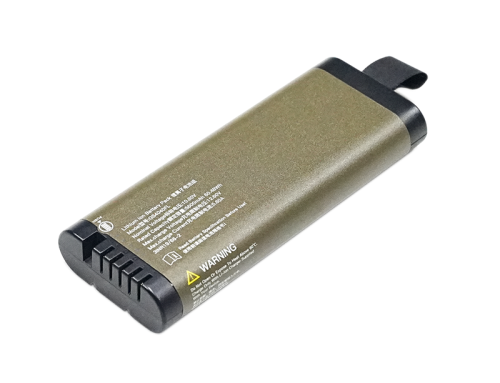
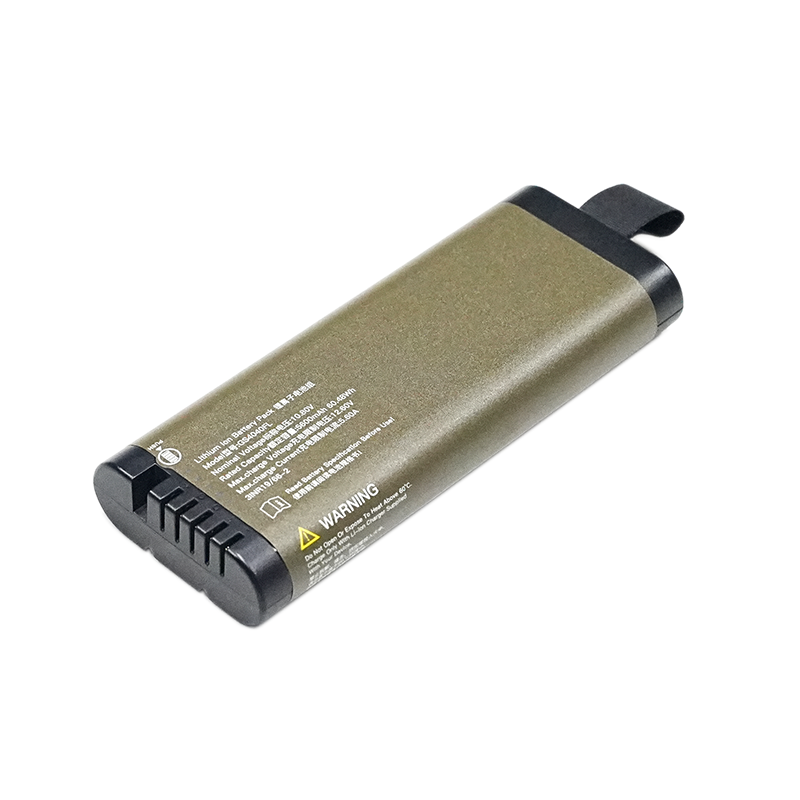
Low-temperature capability is decided at the cell level before any pack design begins. Cold-rated lithium-ion cells use low-viscosity electrolyte formulations and electrode designs that keep ionic conductivity and diffusion rates usable at sub-zero temperatures. The specification must name the cell model and freeze that model for production — a “low-temperature battery pack” built on unspecified general-purpose cells is a claim, not a design. Measured industry data for standard NMC packs shows deliverable capacity falling to roughly 30–50% of rating at -20°C and below 15–20% at -40°C; purpose-built cold-rated cells shift every row of that table. TEFOO’s GS4040 series, for example, retains more than 70% of nominal capacity at -40°C discharge.
Self-Heating vs Passive Design
Two architectures solve the cold problem differently:
|
Dimension |
Passive (cold-rated cells + insulation) |
Self-Heating Pack |
|---|---|---|
|
Warm-up delay |
None; delivers immediately at rated temperature |
Minutes of heating before full discharge power |
|
Energy overhead |
None |
Published figures put heating draw at roughly 4–6% of pack capacity in moderate cold, climbing steeply in deep cold |
|
Complexity and failure points |
Low |
Heater films, control loop, additional firmware |
|
Charging in the cold |
Still locked out below 0°C |
Can pre-heat cells to enable cold-weather charging — its strongest argument |
|
Best for |
Missions sized within the pack’s rated envelope |
Severe-cold storage followed by immediate high-power use, or on-site charging |
For most handheld and portable instruments operating continuously in the cold, passive cold-rated packs are simpler and more reliable. Self-heating earns its complexity when the pack must be charged at sub-zero temperatures or started from a severe-cold soak into immediate full power.
BMS Policy: Charge Lockout and Trustworthy Gauging
The battery management system carries two non-negotiable responsibilities in cold service. The first is a charge temperature lockout: the BMS must block charging below 0°C, because no thermal design can make cold charging safe without pre-heating. The second is temperature-compensated gauging: cold raises internal resistance, and an uncompensated fuel gauge will report a healthy state of charge minutes before an early voltage cutoff. SMBus-based smart packs that compensate for temperature give the incident commander a remaining-runtime figure that can be trusted — the difference between planning a battery swap and improvising one.
What Mechanical and Procurement Items Complete the Checklist?
Environmental Hardening Beyond Temperature
Cold rarely arrives alone. Winter rescue adds meltwater, sleet, drops onto frozen ground, and vehicle vibration. The mechanical specification should cover:
- Ingress protection: an IEC 60529 IP rating matched to the exposure — splash and immersion ratings matter because equipment moves between freezing air and warm, condensing vehicle interiors.
- Shock and vibration: MIL-STD-810H Method 516.8 (shock, including transit drop) and Method 514.8 (vibration) are the references buyers should see in test reports.
- Gloved operation: latches, release buttons, and fuel-gauge displays sized and positioned for operators wearing cold-weather gloves — the manipulation check that Method 502.7 Procedure III formalizes.
- Condensation control: venting and sealing strategy for repeated freeze-thaw transitions, which pump moist air into poorly designed enclosures.
The Consolidated Rescue-Pack Specification Checklist
|
Checklist Item |
What to Specify |
Failure It Prevents |
|---|---|---|
|
Cell model |
Named cold-rated cell, frozen for production |
Mid-contract capacity drift |
|
Discharge rating |
Verified capacity at mission temperature, with discharge rate and cutoff voltage |
“Works at -40°C” slogans |
|
Charge policy |
BMS lockout or reduced current below 0°C, stated in writing |
Lithium plating and permanent damage |
|
Runtime plan |
Required runtime at -40°C (-40°F) from measured curves, not extrapolation |
Dead radio mid-mission |
|
Spares and swap |
Spare-pack ratio, hot-swap or fast-swap mechanics |
Mission gap during battery changes |
|
Environment |
IEC 60529 IP rating; MIL-STD-810H Methods 516.8 and 514.8 test reports |
Water ingress, drop and vibration damage |
|
Human factors |
Glove-operable latches and readable gauge display |
Fumbled swaps with frozen hands |
|
Documentation |
Discharge curves at room temperature, -20°C, and minimum mission temperature |
Unverifiable supplier claims |
Teams building rescue equipment, field instruments, or winter-deployed robotics can hand this checklist directly to TEFOO’s engineering team as a starting specification. TEFOO designs custom 18650- and 21700-based packs around named cold-rated cells — the GS4040 low-temperature series retains over 70% of nominal capacity at -40°C — and supplies the multi-temperature discharge data, SMBus documentation, and 2D/3D mechanical files needed to verify every line of the checklist before commitment.
Conclusion
A rescue-grade battery pack is not a standard pack with a wider number printed on the label. It is a specification built in the correct order: mission temperature envelope first, cold-rated cells second, BMS charge lockout and compensated gauging third, mechanical hardening and a documented runtime plan last. Buyers who work through this checklist convert a life-safety risk into a line item with a test report behind it.