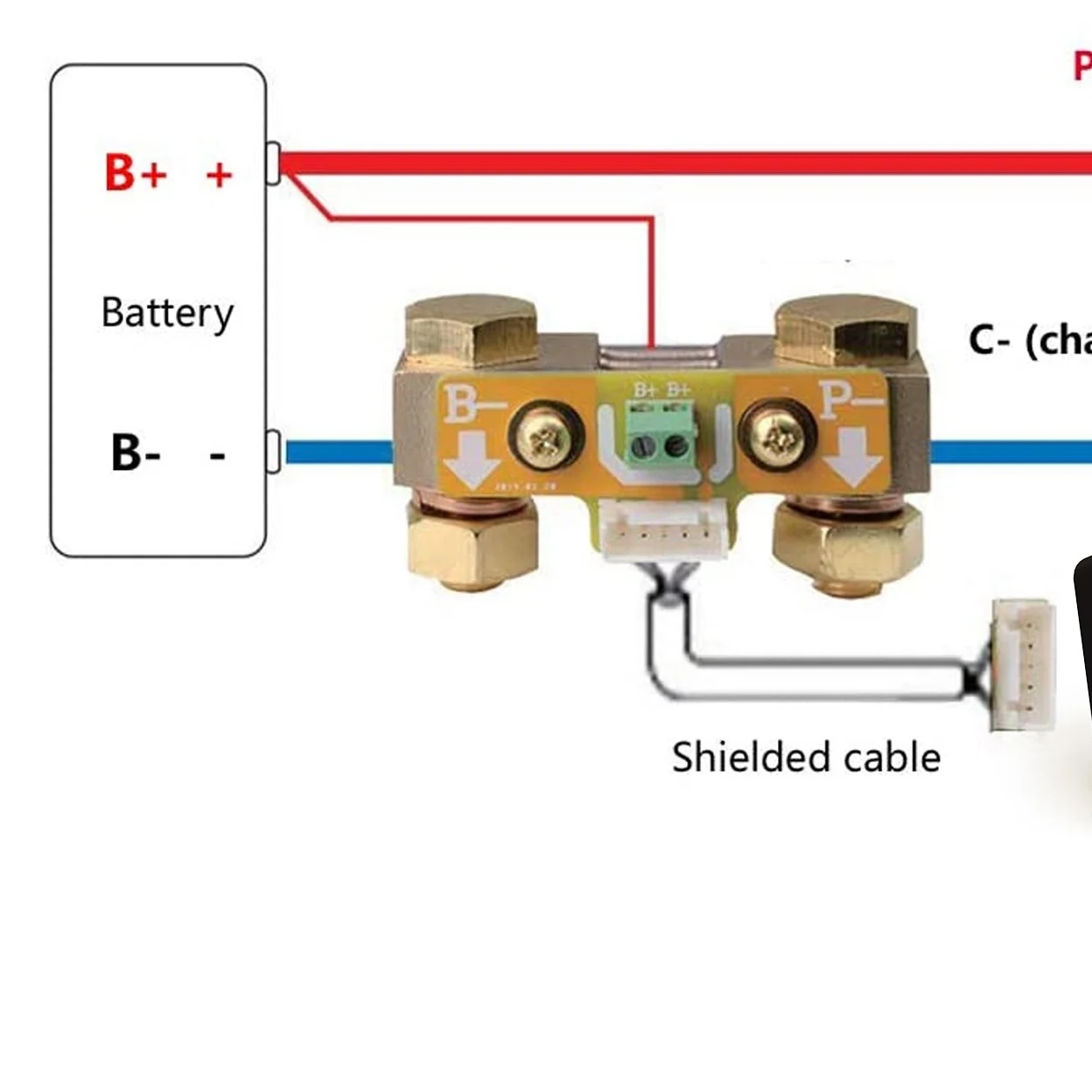
A battery management system that estimates state of charge (SOC) from voltage alone can drift by 10–20% on a LiFePO4 pack, because the LiFePO4 discharge curve stays nearly flat between 20% and 80% SOC. A battery monitor shunt eliminates that drift. The battery shunt is a precision low-resistance sensor installed in series with the pack’s main negative or positive line; every ampere entering or leaving the lithium battery pack passes through the shunt resistor, producing a millivolt-level voltage drop that the battery monitor converts into accurate, bidirectional current and amp-hour data.
- A battery monitor shunt measures current directly via Ohm’s Law (V = I × R), typically with a 50 mV or 75 mV full-scale voltage drop and resistance in the 0.1–1.0 mΩ range.
- Shunt-based SOC tracking outperforms voltage-only estimation for LiFePO4 and NMC lithium battery packs, especially under load.
- Correct shunt sizing—current rating, voltage drop, accuracy class, and temperature coefficient—determines both measurement precision and long-term TCO.
How Does a Battery Monitor Shunt Work in a Lithium Battery System?
Shunt Purpose and Operating Principle
The core purpose of a battery shunt is to convert high battery current into a small, measurable voltage signal. The shunt resistor is a calibrated conductor—usually a manganin or similar copper-manganese-nickel alloy strip—placed in series with the battery circuit. Because the shunt resistance is fixed and precisely known, the monitor calculates current using Ohm’s Law: a 500 A / 50 mV shunt has a resistance of exactly 0.1 mΩ, so a measured 25 mV drop equals 250 A of current flow.
The measurement chain works in three steps:
- Current sampling: The shunt carries the full pack current in both directions—charging and discharging.
- Signal conversion: A differential amplifier in the shunt battery monitor reads the millivolt drop and converts the value into a digital current reading.
- Coulomb counting: The monitor integrates current over time to compute amp-hours consumed, from which the BMS derives SOC, remaining runtime, and state of health (SOH).
In short, the battery shunt acts as the “fuel gauge sensor” of a lithium battery system: without an accurate current measurement at the shunt, every downstream SOC and SOH algorithm loses its reference.
Key Electrical Specifications of a Battery Monitor Shunt
Shunt selection starts with four datasheet parameters. The table below summarizes typical industrial values:
| Parameter | Typical Range / Value | Engineering Note |
|---|---|---|
| Rated current | 50 A – 1000 A | Size for continuous current + 20–25% margin |
| Full-scale voltage drop | 50 mV / 75 mV / 100 mV | 50 mV minimizes power loss; 100 mV improves low-current resolution |
| Shunt resistance | 0.05 mΩ – 1.0 mΩ | R = V drop / I rated (e.g., 500 A / 50 mV = 0.1 mΩ) |
| Accuracy class | Class 0.5 or better (per IEC 60051 conventions) | Class 0.2 recommended for fuel-gauge-grade monitoring |
| Temperature coefficient | ≈ ±20 ppm/°C (manganin alloy) | Critical for outdoor and automotive temperature swings |
| Power dissipation at rated current | P = I² × R (e.g., 25 W for 500 A / 0.1 mΩ) | Requires thermal derating and free-air mounting |
These specifications are not interchangeable: a higher voltage drop improves signal-to-noise ratio at low currents but increases heat, so the trade-off must match the application’s current profile.
How Does a Shunt Battery Monitor Compare with Other SOC Measurement Methods?
Shunt-Based Monitoring vs. Voltage-Only Estimation
A shunt-based monitor delivers markedly better SOC accuracy than a voltage-only monitor, and the gap is widest on LiFePO4 chemistry. Voltage-only estimation fails on LiFePO4 because the cell’s open-circuit voltage barely moves across most of the usable capacity range, and terminal voltage under load is distorted by internal resistance and temperature. A shunt battery monitor instead counts actual amp-hours, so load conditions, Peukert-type effects, and temperature swings do not corrupt the SOC baseline. For NMC packs—whose voltage curve has more slope—voltage estimation works better, but coulomb counting still wins during high-rate charge/discharge events common in industrial equipment.
Shunt Resistor vs. Hall-Effect Sensor
Hall-effect current sensors are the main alternative to shunt resistors. The comparison below shows why shunts remain the default choice for precision battery monitoring:
| Dimension | Shunt Resistor | Hall-Effect Sensor |
|---|---|---|
| Measurement principle | Ohm’s Law (resistive) | Magnetic field sensing |
| Typical accuracy | 0.1–0.5% of reading | 1–2% of reading, with offset drift |
| Galvanic isolation | No (in-line) | Yes (non-contact) |
| Power loss at 200 A (0.25 mΩ) | ≈ 10 W | Negligible |
| Cost at comparable rating | Low | Medium to high |
| Best fit | Precision SOC/SOH tracking, fuel gauges | Very high current, isolation-critical systems |
For lithium battery packs in medical devices, survey instruments, and industrial detection equipment—where SOC accuracy directly affects runtime prediction—the shunt’s lower drift and higher resolution usually outweigh its modest insertion loss.
How Should Engineers Select a Battery Monitor Shunt for a Lithium Battery Pack?
Sizing the Current Rating and Voltage Drop
Select the shunt’s rated current at 125% of the pack’s maximum continuous current, and match the voltage drop to the monitor’s input range. Undersizing causes overheating and resistance drift; oversizing degrades resolution at light loads. Practical sizing rules:
- Continuous current: Verify against the BMS overcurrent trip threshold, not the nominal load.
- Peak current: Confirm the shunt survives short-duration peaks (motor inrush, pulse loads) without exceeding its thermal limit.
- Voltage drop: Choose 50 mV for high-current packs to limit dissipation; choose 75–100 mV when low-current accuracy matters (standby drain measurement).
- Mounting: Bolt the shunt in the main negative line where possible, keep sense leads twisted and short, and use Kelvin (4-wire) connections at the shunt’s dedicated sense terminals.
B2B Selection Criteria and Total Cost of Ownership
For procurement teams, the purchase price of a shunt is a minor line item; integration quality and measurement reliability dominate lifecycle cost:
| Procurement Dimension | Low-Grade Generic Shunt | Industrial-Grade Shunt (Class 0.2+) |
|---|---|---|
| Unit cost | Lowest | Moderate premium |
| Measurement drift over life | Higher; alloy quality varies | Stable; certified alloy and calibration |
| SOC error impact | Premature pack “end-of-life” calls, field complaints | Accurate runtime prediction, fewer warranty claims |
| Documentation | Datasheet only | Calibration data, material traceability |
| Integration support | None | Pack-level design-in with BMS vendor |
When a shunt is designed into a custom lithium battery pack from the outset—matched to the BMS fuel gauge, harness layout, and enclosure thermal budget—the monitor achieves its rated accuracy without field recalibration. TEFOO designs custom smart lithium battery packs with integrated fuel-gauge and protection electronics for medical, instrumentation, and industrial equipment; share your current profile and accuracy target with our engineering team for a pack-level monitoring proposal.
Where Are Shunt Battery Monitors Used in Industrial Lithium Applications?
Shunt-based monitoring is standard practice wherever a lithium battery pack must report trustworthy remaining runtime. Typical deployments include:
- Medical devices and patient monitors: Accurate SOC prevents mid-procedure shutdowns and supports regulated maintenance records.
- Surveying, geophysical, and non-destructive testing instruments: Field crews depend on precise runtime prediction far from charging infrastructure.
- Robotics and AGVs: Bidirectional current measurement captures regenerative braking currents that voltage-only monitors miss.
- Renewable and backup energy storage: Coulomb counting across long idle periods keeps SOC honest where self-discharge would corrupt voltage-based estimates.
In each case, the battery monitor shunt is a small component with outsized system value: the shunt anchors every safety, runtime, and warranty decision that follows.