A fleet of golf carts arrives at a service depot with melted terminal clamps. The cause is not the battery — it is a zinc-plated steel clamp substituted for the specified lead-alloy clamp, running 40 °C (104 °F) hotter at the same 200 A load. Terminal hardware is the smallest cost line in a battery system and the most common origin of high-resistance failures and thermal incidents. For battery engineers and B2B procurement managers, battery terminal types are a three-layer specification decision: post geometry, terminal material, and wire-to-battery connector.
Key Takeaways
– The main car battery terminal types are SAE tapered posts (positive 19.5 mm / 0.77 in, negative 17.5 mm / 0.69 in), GM side terminals (3/8-16 insert), and stud terminals (5/16-18 or 3/8-16); JIS posts are smaller than SAE.
– Brass battery terminals resist corrosion and hold torque better than lead, but copper carries current best — typical conductivity is ~100 % IACS for copper, ~28 % IACS for brass, and ~8 % IACS for lead.
– Lug terminals are commonly used on deep-cycle batteries (marine, golf cart, solar, UPS) with threaded stud posts; B2B specifications should define post geometry, clamp material, torque, and corrosion testing in writing.
What Are the Different Types of Battery Terminals and Posts?
What Are the Main Car Battery Terminal Types and Automotive Battery Terminal Types?
Five terminal geometries dominate automotive and industrial batteries — SAE tapered top post, JIS small post, GM side terminal, threaded stud, and dual (marine) terminals — each with dimensions clamps must match exactly.
|
Terminal Type |
Post / Thread Dimension |
Polarity Coding |
Typical Application |
|---|---|---|---|
|
SAE tapered top post |
Positive 19.5 mm (0.77 in); negative 17.5 mm (0.69 in) at top |
Positive post larger |
Most North American and global SLI car batteries |
|
JIS small post |
Smaller diameter than SAE |
Positive larger, but below SAE size |
Japanese and Asian-market vehicles |
|
GM side terminal |
3/8-16 threaded insert, recessed |
Recessed side pockets |
General Motors vehicles, some marine |
|
Threaded stud (L-terminal) |
5/16-18 or 3/8-16 studs |
Marked studs |
Commercial trucks, industrial and stationary batteries |
|
Dual / marine terminal |
SAE post plus 3/8-16 stud on one battery |
Both conventions |
Marine and RV house batteries |
The table shows why clamp substitution fails across regions: a clamp bored for SAE positive posts fits loosely on JIS positives, and side-terminal batteries accept only bolt-down lugs. In summary, post geometry is the first filter in terminal selection, and dimensioned drawings should accompany every purchase order.
What Are the Parts of a Battery Terminal?
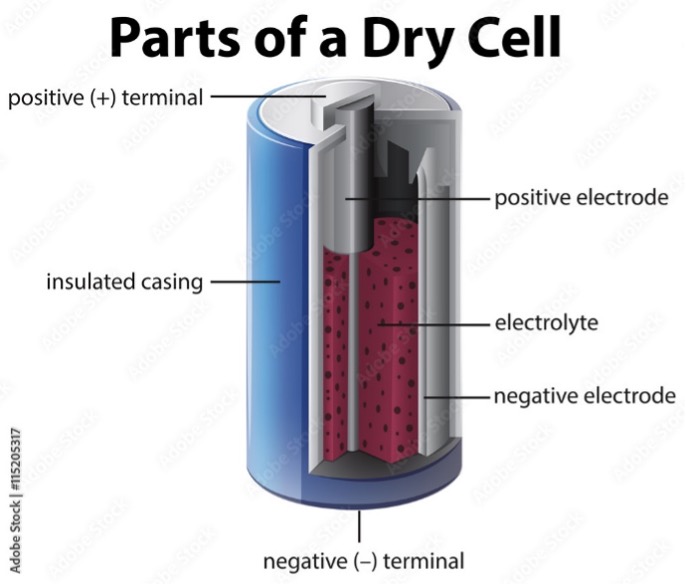
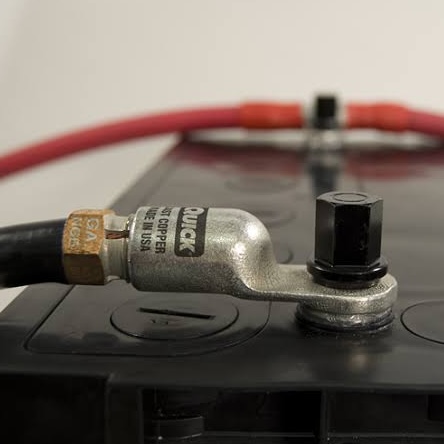
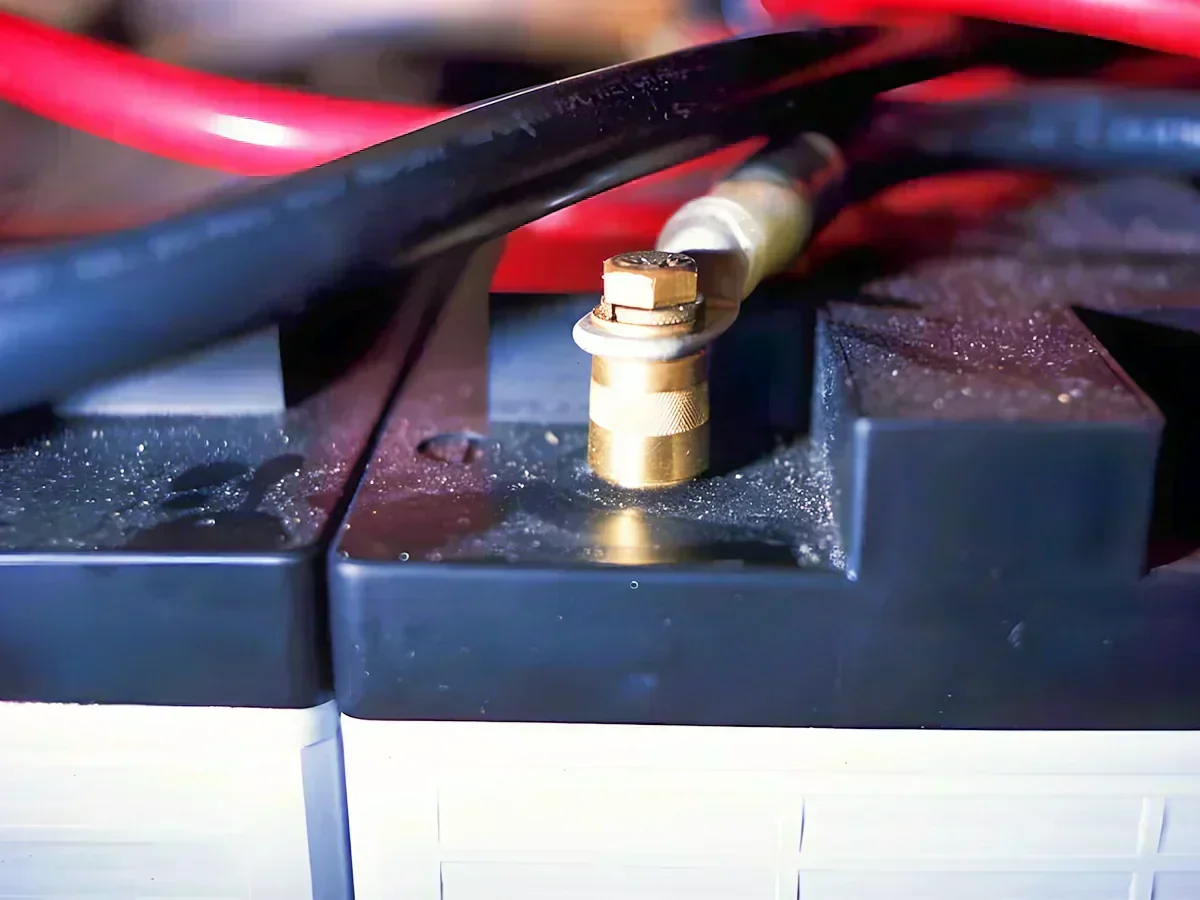
A complete terminal connection has five parts: the battery post or insert, the clamp or lug body, the fastener, the cable barrel, and the protective cover.
- Post or threaded insert: the battery-side conductor, typically lead alloy on SLI batteries and brass or copper on industrial cells.
- Clamp or lug body: the removable hardware that carries current from the post to the cable.
- Fastener: the bolt and nut generating clamping force; fastener grade determines whether the joint survives vibration.
- Cable barrel: the crimped or soldered section joining terminal to cable.
- Cover or boot: the insulating sleeve preventing accidental shorts and slowing corrosion ingress.
In summary, terminal failure can originate in any of the five parts — specifying the clamp alone leaves the rest uncontrolled.
What Are Battery Terminals Made Of, and Are Brass Terminals Better?
What Materials Are Used for Battery Terminals and Clamps?
Battery terminals and clamps are made from lead alloy, brass, tinned copper, or zinc-plated steel, with typical conductivity of ~8 % IACS for lead, ~28 % IACS for brass, and ~100 % IACS for copper.
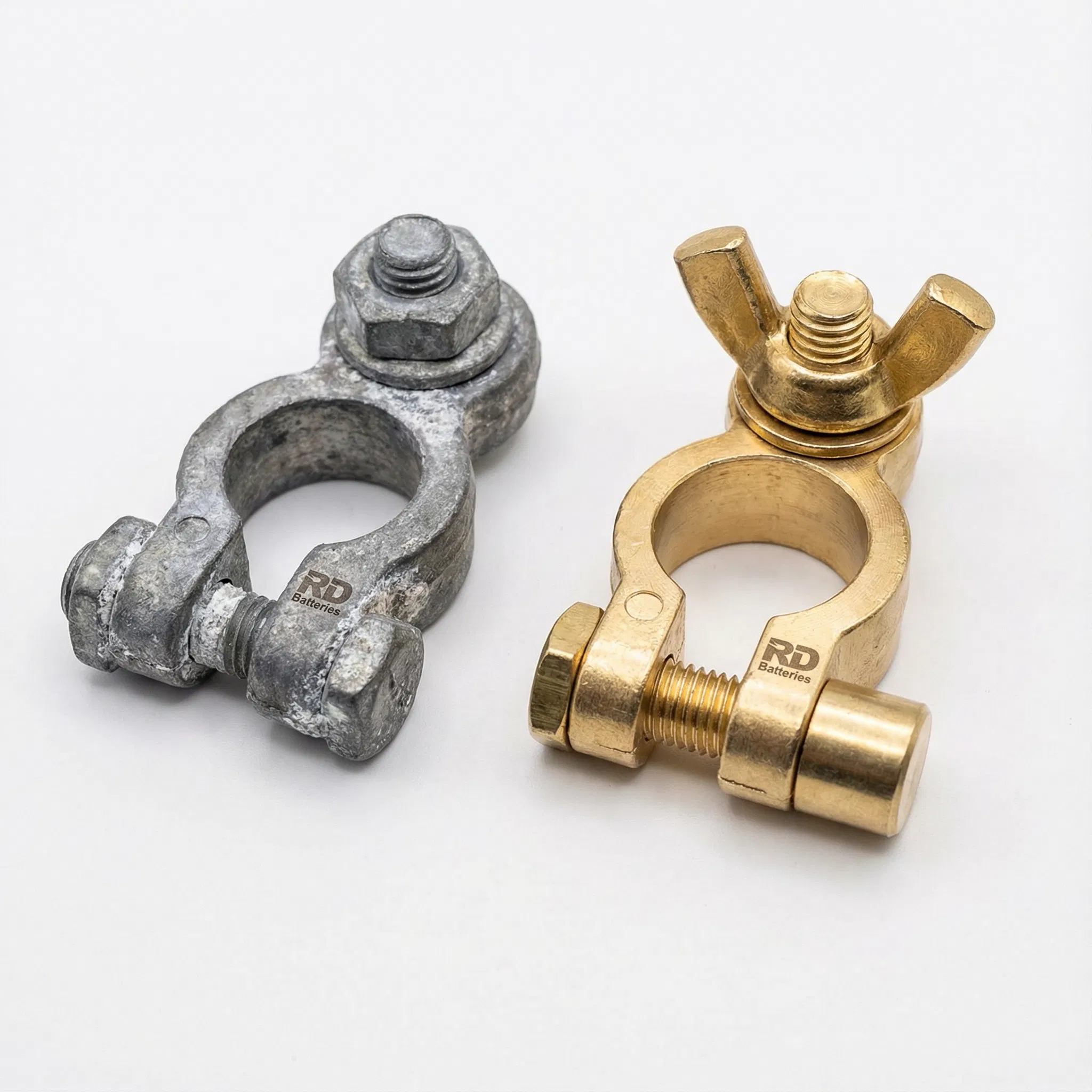
- Lead alloy: the traditional SLI clamp material; soft, self-conforming, and galvanically matched to lead posts, but mechanically weak under repeated removal.
- Brass: the mainstream upgrade; strong, machinable, and highly corrosion-resistant, with conductivity around one-quarter of copper — adequate for short clamp paths.
- Tinned copper: the highest-conductivity option; standard for crimp lugs on high-current cables.
- Zinc-plated steel: the budget option; strong but galvanically mismatched to lead posts, so corrosion accelerates once the plating wears.
In summary, material choice trades conductivity against strength and galvanic compatibility — the cheapest clamp is the most expensive failure.
Are Brass Battery Terminals Better Than Lead or Copper?
Brass terminals are better than lead for torque retention and corrosion resistance, and better than bare copper for machinability and cost — making brass the default for quality clamps, while tinned copper remains correct for crimped cable lugs.
- Versus lead: brass holds bolt torque far longer; lead clamps creep and loosen under thermal cycling, a classic origin of intermittent no-start faults.
- Versus copper: pure copper clamps are softer and harder to machine; brass trades unneeded conductivity for durability.
- Corrosion behavior: brass resists acid vapor and moisture; lead self-passivates but deforms; zinc-plated steel corrodes once scratched.
- Practical rule: brass or lead-alloy for post clamps; tinned copper for crimped lugs above ~50 A.
In summary, “brass is better” is accurate for clamps but incomplete for lugs — match material to joint function.
Which Battery Terminal Connector Types Fit Which Application?
Which Wire-to-Battery Connector Types Should Engineers Specify?
Wire-to-battery connectors fall into five families — ring lugs, clamp terminals, quick-release clamps, spade/flag terminals, and multi-pole power connectors — selected by current level, service frequency, and vibration exposure.
- Ring lugs: closed-ring crimp terminals bolted to stud posts; the most secure connection, standard on deep-cycle and industrial batteries from ~30 A to several hundred amps.
- Clamp terminals: post-clamping hardware for SAE/JIS top posts; the standard removable connection on SLI batteries.
- Quick-release clamps: lever-action post clamps for frequent battery swaps in fleets and backup systems.
- Spade and flag terminals: compact crimp terminals for F1/F2 tabs (4.75 mm / 0.187 in and 6.35 mm / 0.25 in) on sealed lead-acid batteries in UPS, alarm, and medical standby units.
- Multi-pole power connectors: keyed housings (for example SB-type) rated 50–350 A class for field-swappable lithium packs and material-handling equipment.
In summary, the connector family follows the service model: bolted lugs for permanent joints, post clamps for serviceable batteries, keyed multi-pole connectors for user-swappable packs.
Lug Terminals Are Commonly Used on Which Type of Battery?
Lug terminals are commonly used on deep-cycle batteries — marine, golf cart, RV house, solar storage, UPS, and motive-power batteries — because deep-cycle batteries use threaded stud posts (5/16-18 or 3/8-16) instead of tapered automotive posts.
- Why studs and lugs: deep-cycle batteries deliver sustained current for hours; a bolted ring-lug joint holds stable contact resistance far better than a clamp joint under continuous load.
- Typical stud sizes: 5/16-18 on golf-cart and marine batteries, 3/8-16 on larger L16 and industrial cells; lug hole size must match the stud.
- Cable matching: lug barrel size must match cable gauge (for example 2/0 AWG for 200 A class golf-cart packs), crimped with a calibrated die.
- Torque control: stud nuts typically follow 8–13 N·m (70–115 in·lb) for 3/8-16 studs — always confirm against the battery datasheet.
In summary, wherever the battery has threaded studs instead of tapered posts, the application expects lug terminals — deep-cycle duty is where that geometry dominates.
How Should B2B Buyers Specify Battery Terminals and Connectors?
How Do Terminal Material Options Compare on Cost and Reliability?
For B2B programs, tinned-copper lugs plus brass or lead-alloy post clamps deliver the best total cost of ownership, because the small premium over zinc-plated steel eliminates most corrosion-driven warranty failures.
|
Option |
Typical Relative Cost |
Conductivity (IACS) |
Corrosion Behavior |
Torque Retention |
Best Fit |
|---|---|---|---|---|---|
|
Lead-alloy clamp |
Low |
~8 % |
Self-passivating, galvanically matched |
Poor — creeps under cycling |
OEM SLI replacement |
|
Brass clamp |
Medium |
~28 % |
Excellent in under-hood and marine air |
Good |
Aftermarket clamps, fleets, marine |
|
Tinned-copper lug |
Medium |
~100 % (tin-protected) |
Very good with intact plating |
Bolt-dependent |
Deep-cycle, industrial, EV auxiliary cables |
|
Zinc-plated steel clamp |
Lowest |
~3–15 % class |
Sacrificial plating, degrades fast |
Good initially |
Short-life consumer use — avoid in B2B fleets |
The comparison shows that terminal hardware is a classic TCO trap: the gap between a zinc-plated clamp and a brass clamp is trivial at pack level, while one corroded terminal can strand a vehicle. For OEM programs needing custom battery packs with specified terminal hardware, cable sizing, and crimp validation, request a custom battery pack consultation to lock the connector BOM before design freeze.
What Should a Terminal and Connector Procurement Specification Include?
A robust B2B terminal specification defines geometry, material, and corrosion testing as acceptance criteria.
- Post geometry: SAE, JIS, side-terminal, or stud designation with mm/in dimensions per SAE J537, plus polarity keying.
- Material and plating: clamp alloy (lead, brass) and lug material (tinned copper), with plating thickness or grade called out.
- Mechanical values: fastener size and grade, installation torque in N·m/in·lb per the datasheet, and anti-rotation features for stud joints.
- Crimp quality: lug-to-cable crimps validated by pull-force testing per UL 486A-486B, with die and tool references recorded.
- Corrosion testing: salt-spray exposure per ASTM B117 with defined acceptance criteria, plus covers on every positive connection.
- Compliance linkage: terminal and cable design documented in the pack file supporting IEC 62133-2 or UL 2054 certification and UN 38.3 testing.
In conclusion, terminal hardware deserves the same written rigor as cells and BMS — contact the engineering team for a customized battery solution to define post geometry, materials, and crimp validation for your application.