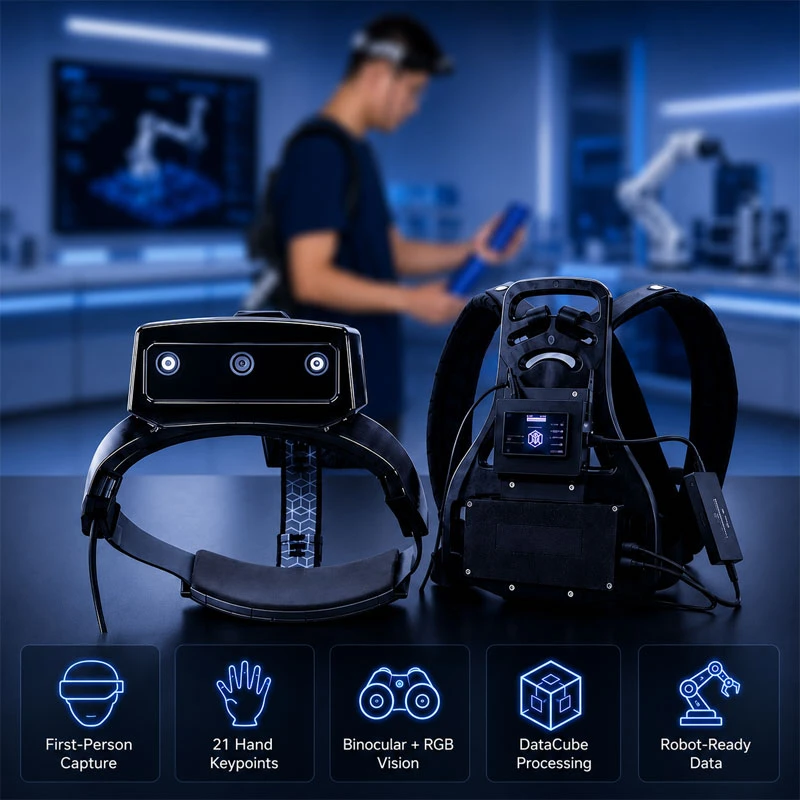
How Does an EGO Device Capture Data for Behavioral Cloning?
An Embodied AI Data Collection Device (EGO) workflow constitutes a strict closed-loop engineering sequence designed to translate unstructured human physical interactions into machine-readable dataset formats like ROSbag. This standard operating procedure encompasses multi-sensor spatial calibration, uninterrupted dynamic data recording, and localized edge data validation. The ultimate objective of this workflow is to capture high-fidelity behavioral cloning corpora without introducing kinematic distortion or spatial drift during prolonged physical operations in unpredictable environments.
【Key Takeaways】
-
Mathematical Sensor Alignment: Strict extrinsic calibration protocols align the visual coordinate systems of RGB-D cameras with inertial measurement tracking, ensuring absolute spatial consistency.
-
Real-Time Data Checkpointing: Edge computing systems actively slice multi-gigabyte sensory streams into discrete file chunks to prevent catastrophic data loss during unexpected physical hardware impacts.
-
Zero-Downtime Power Operations: Hot-swappable dual-battery architectures eliminate the severe labor costs associated with system reboots and sensor recalibration protocols.
How Are Multi-Modal Sensors Calibrated Before Physical Data Collection?
What Is the Spatial Alignment Process for RGB-D and IMU Sensors?
Extrinsic calibration mathematically unifies the optical coordinate system of the RGB-D depth cameras with the physical inertial reference frame of the Inertial Measurement Unit (IMU). Before an operator begins a data collection sequence, the EGO hardware cannot inherently distinguish the exact physical distance between the camera lens and the IMU chip mounted on the backpack chassis.
-
Checkerboard Targeting: Operators maneuver the EGO backpack in front of standardized physical calibration targets (such as high-contrast checkerboards) at varying distances and angles.
-
Transformation Matrices: The edge computing unit processes the visual data against the gravitational acceleration data from the IMU to generate a rigid 6-Degree-of-Freedom (6-DoF) transformation matrix.
-
Drift Mitigation: This calibration matrix ensures that when the human operator accelerates forward, the visual depth map updates in exact synchrony with the inertial velocity vectors, preventing spatial drift in the final dataset.
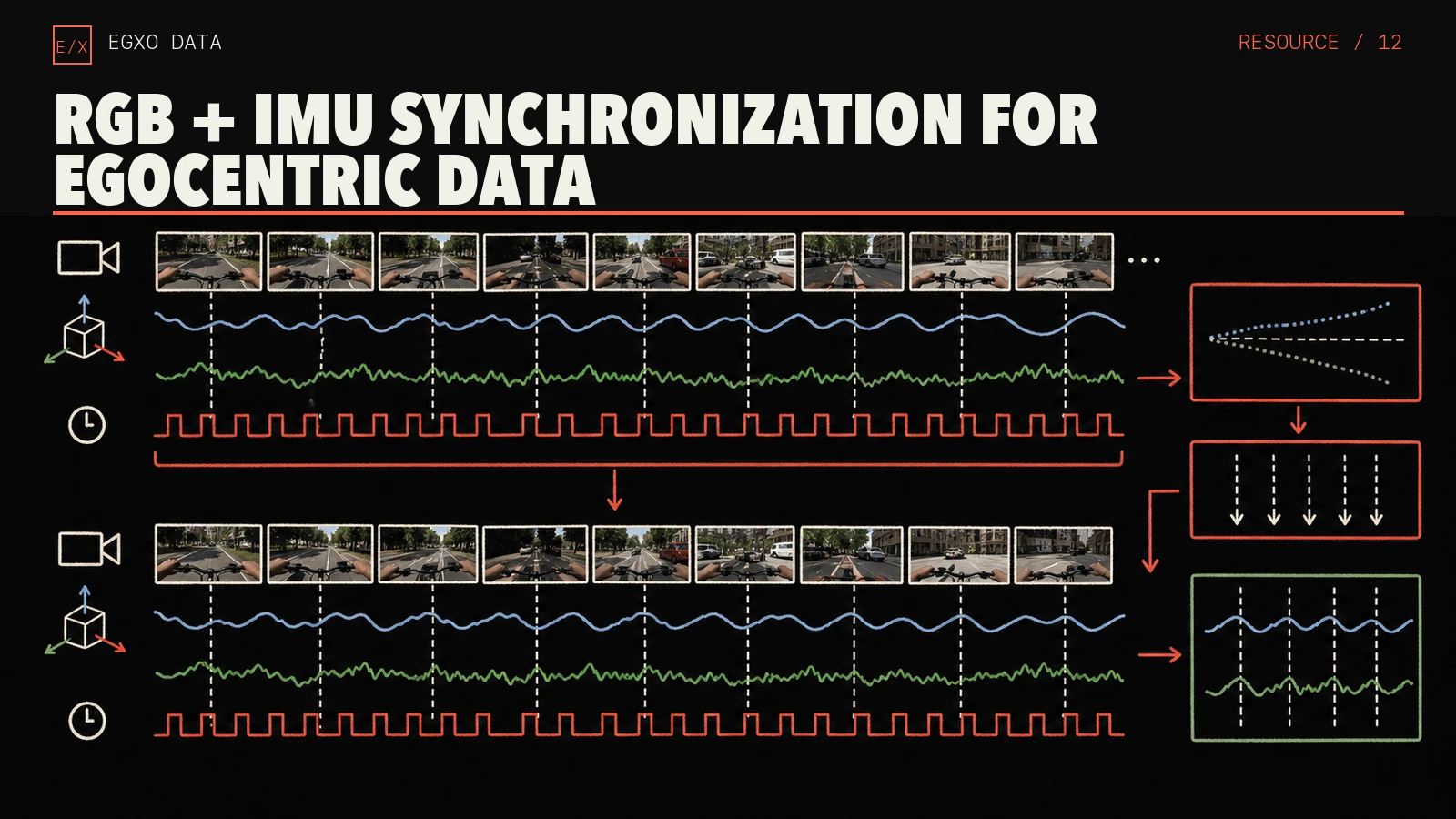
Executing precise extrinsic calibration is the absolute prerequisite for behavioral cloning; without this unified spatial map, the subsequent AI model will fail to correlate physical motion with visual input accurately.
Why Is Hand-Eye Calibration Essential for Tactile Gloves?
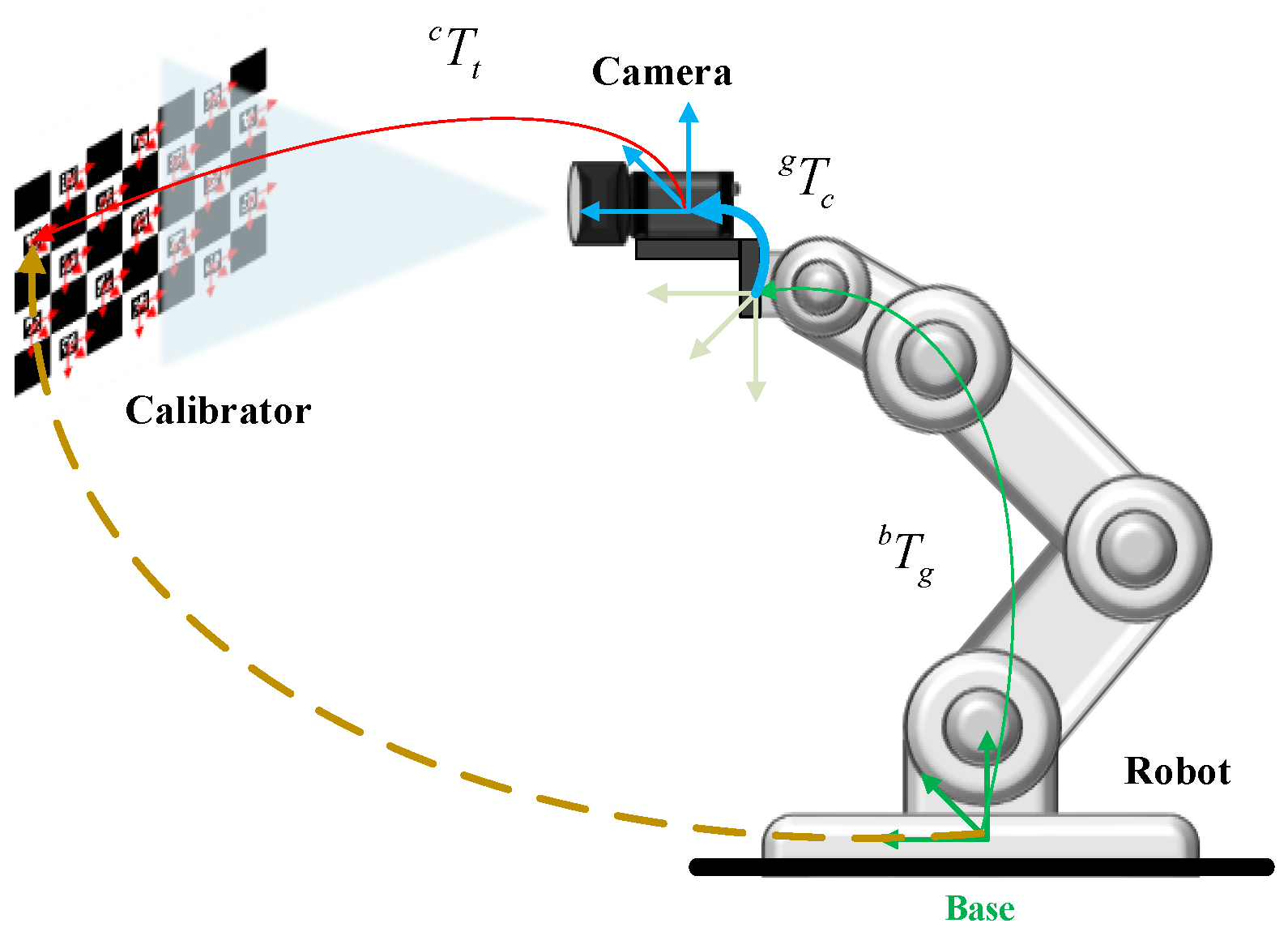
Hand-eye calibration algorithms map localized haptic force telemetry from wearable tactile gloves directly into the global visual coordinate system managed by the primary backpack camera array. When an operator interacts with a physical object, the force-torque sensors on the fingertips record micro-newtons of pressure in an isolated local coordinate frame.
-
Visual-Tactile Registration: The EGO software tracks fiducial markers (like ArUco tags) physically printed on the tactile gloves.
-
Coordinate Transformation: The system calculates the exact vector distance between the main backpack camera and the operator’s hands in 3D space.
-
Synchronized Logging: This mathematical bridge guarantees that the precise moment the camera visually records a finger touching a surface, the tactile sensor logs the corresponding physical resistance within the exact same microsecond timestamp.
By enforcing strict hand-eye calibration protocols, hardware engineers ensure that the robotic AI model learns the precise correlation between visual proximity and physical contact force, a fundamental requirement for complex manipulation tasks.
How Do Human Operators Execute Continuous Behavioral Cloning Workflows?
How Does Real-Time SLAM Maintain Spatial Consistency in Unstructured Environments?
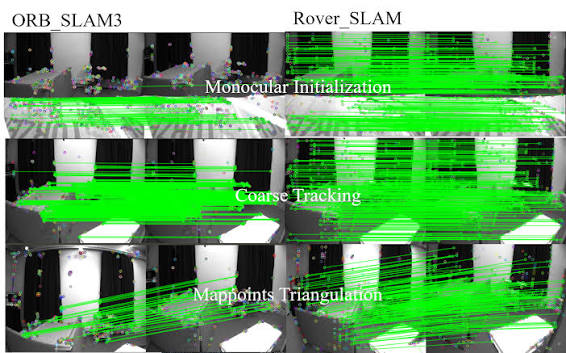
Simultaneous Localization and Mapping (SLAM) algorithms execute continuously on the edge computing node to construct a persistent 3D environmental map and track the operator’s trajectory precisely. As operators walk through unstructured physical environments like factory floors or residential living spaces, standard odometry relying purely on IMU data will accumulate mathematical drift over time.
-
LiDAR Point Cloud Generation: Spatial sensors scan the physical surroundings to generate high-density point clouds mapping rigid environmental structures (walls, machinery).
-
Loop Closure Execution: When an operator returns to a previously scanned physical location, the SLAM algorithm recognizes the geometric signature and executes a “loop closure,” correcting any accumulated spatial drift in the trajectory data.
-
Global Trajectory Export: The final output provides a stabilized global coordinate map, allowing researchers to pinpoint the exact 3D location of the operator during every recorded physical interaction.
Continuous SLAM processing demands substantial computational overhead from the edge processor, requiring robust passive thermal dissipation and highly stable direct current (DC) power delivery throughout the entire active capture session.
What Are the ROSbag Data Checkpointing Protocols During Active Capture?
Edge computing architectures slice continuous high-bandwidth sensory streams into discrete ROSbag files based on rigid time intervals or file size limits to isolate and prevent total dataset corruption. EGO backpacks ingest multiple gigabytes of uncompressed visual, LiDAR, and haptic data every minute. Writing this continuous stream into a single massive file creates a severe single point of failure.
-
Sequential Slicing: The Robot Operating System (ROS2) automatically terminates the current data write process and opens a new ROSbag file every 60 seconds or upon reaching a 2-Gigabyte threshold.
-
Volatile Memory Flushing: The operating system continuously flushes the volatile RAM buffer to the physical NVMe Solid State Drive (SSD), ensuring physical data persistence.
-
Impact Tolerance: If the operator experiences a severe physical fall or an abrupt system failure, only the active incomplete data slice is lost, preserving the integrity of all previously recorded ROSbag chunks.
Implementing aggressive data checkpointing protocols guarantees that highly expensive field data collection operations yield viable training corpora, even under unpredictable physical field conditions.
How Do Power Distribution Architectures Prevent Data Collection Interruptions?
Why Do Reboot Sequences Degrade EGO Field Efficiency?
System power loss forces a 10-to-15-minute hardware reboot sequence and mandates a complete spatial sensor recalibration protocol, drastically reducing the active data collection yield per operator shift. EGO workflows are highly sensitive to operational continuity. When an internal battery drains completely, the NVIDIA Jetson edge computer shuts down.
B2B Selection & TCO Comparison: Downtime Impact in EGO Workflows
| Power Architecture Type | Swap Power Interruption | Sensor Recalibration Required | Total Downtime per Swap | Effective 8-Hour Yield |
| Cold-Swap (Single Battery) | Yes (Total System Power Loss) | Yes (Extrinsic & Hand-Eye) | 15 – 20 Minutes | ~65% Active Capture |
| Hot-Swappable (Dual Battery) | No (Millisecond Failover) | No (Spatial map remains intact) | 30 Seconds | >95% Active Capture |
Upon installing a fresh cold-swap battery, the operator must wait for the Linux operating system to boot, restart the ROS2 nodes, and crucially, re-execute the complex checkerboard extrinsic calibration. Because the backpack physically shifted during the battery change, the previous spatial alignment matrix is no longer valid. This frequent recalibration destroys workflow efficiency and exponentially inflates human labor costs.
How Do Smart Lithium-Ion Battery Packs Enable Zero-Downtime Operations?
Hot-swappable dual-battery systems utilize System Management Bus (SMBus) telemetry to seamlessly transition power between modules, allowing operators to exchange depleted 18650 battery packs without interrupting edge compute processes. In a continuous data collection workflow, the power distribution board monitors two independent battery slots.
The active smart battery transmits highly precise State of Charge (SOC) percentages directly to the ROS2 power management node. When the active module drops below a 5% capacity threshold, the hardware controller executes a sub-millisecond switch to the standby battery. The edge computing unit, LiDAR, and RGB-D cameras maintain continuous operation. The operator receives an auditory alert and physically replaces the depleted battery module while continuing the data capture sequence, achieving true zero-downtime operations.
Custom Power Solutions for OEMs: Physical environments subject EGO backpacks to mechanical shock and vibration. Tefoo Energy operates as a custom manufacturer of 18650 lithium-ion battery packs specifically engineered for medical devices and instrumentation OEMs. We deliver tailored EGO power modules featuring specialized nickel tab welding for high structural integrity, custom wire harnesses, and IP67-rated hard-case encapsulation to withstand dynamic physical impacts.
Furthermore, replacing batteries without shutting down the system ensures the SLAM trajectory map remains completely intact, preserving spatial continuity across multi-hour behavioral cloning sessions.
Industrial Compliance & Reliability: High-concurrency continuous data capture demands uncompromising safety standards. As a custom manufacturer of 18650 battery packs, Tefoo Energy integrates dual-protection BMS logic designed to handle the high transient peak currents of edge processors. All engineered packs strictly comply with IEC 62133-2 and UL 2054 safety certifications, ensuring maximum operational safety for human personnel during intense data collection workflows.
Summary & Quick-Reference Guide
The typical Embodied AI Data Collection workflow transforms unstructured physical human interactions into standardized, temporally synchronized machine learning datasets. Executing this workflow successfully demands rigorous extrinsic sensor calibration, continuous SLAM-based spatial tracking, and aggressive data checkpointing. Most critically, optimizing the Total Cost of Ownership (TCO) for these operations requires eliminating hardware reboot sequences. By implementing hot-swappable dual-battery architectures utilizing industrial-grade 18650 smart modules, engineering teams can maintain uninterrupted edge computing, bypass recurrent recalibration penalties, and maximize the continuous yield of high-fidelity behavioral cloning data.
Quick-Reference Table: EGO Workflow Timing Metrics
| Workflow Phase | Typical Duration | Engineering Dependency |
| Extrinsic Sensor Calibration | 5 – 10 Minutes | Requires standardized physical target boards |
| Hand-Eye Spatial Calibration | 3 – 5 Minutes | Requires localized fiducial markers on gloves |
| Continuous ROSbag Slicing | Every 60 Seconds / 2GB | Requires NVMe SSD sustained write speeds > 2000 MB/s |
| Hot-Swap Battery Transition | < 10 Milliseconds | Requires SMBus telemetry and dual power controllers |
| Cold-Swap Total Delay | 15 – 20 Minutes | Requires full OS reboot and total spatial recalibration |
Frequently Asked Questions (FAQ)
What is extrinsic calibration in an EGO data collection workflow?
Extrinsic calibration mathematically calculates the physical distance and angle between the RGB-D camera and the IMU, ensuring visual and inertial data share a unified spatial coordinate system.
Why do EGO systems slice data into small ROSbag files?
Edge computers slice continuous data streams into smaller ROSbag chunks (e.g., every 2GB) to isolate data corruption; if the system crashes due to a physical impact, only the active, incomplete file is lost.
How does a hot-swappable battery architecture improve EGO data yield?
A hot-swappable architecture allows operators to replace depleted batteries without shutting down the edge computer, entirely eliminating the 15-minute penalty associated with system reboots and sensor recalibration.
What is the function of SMBus in EGO power management?
The SMBus protocol allows the smart battery to transmit precise State of Charge (SOC) data to the operating system, triggering the power distribution board to seamlessly failover to a standby battery before power is lost.
Why are 18650 battery packs used in wearable EGO systems?
18650 lithium-ion battery packs provide a critical balance of high energy density and low physical weight, delivering the high peak current required by edge processors without exceeding the strict payload limits of a human operator.