Why Is Li Ion Cell Balancing Critical for Industrial Battery Architectures?
Imbalanced cells within high-capacity energy storage systems routinely reduce absolute battery pack lifespan by up to 30% and trigger severe safety hazards, including thermal runaway events. When developing industrial infrastructure, robotics, or medical devices, engineers must deploy strict lithium ion cell balancing protocols to ensure each individual cell operates perfectly within mandated voltage limits. By preventing localized overcharging and deep discharging, balancing mechanisms dictate the foundational reliability, safety margins, and total operational lifespan of modern lithium-ion modules.
【Key Takeaways】
-
Proper battery cell balancing maintains uniform charge levels across lithium battery packs, directly preventing catastrophic overheating, internal hardware damage, and sudden system failures.
-
Active balancing circuits transfer surplus energy between specific cells, significantly improving overall energy efficiency and extending battery lifespan compared to passive shunt methodologies.
-
Advanced battery management systems (BMS) continuously monitor cell voltages to implement predictive balancing algorithms, strictly ensuring compliance with global safety standards such as UN 38.3 and IEC 62619.
How Does Battery Cell Balancing Prevent Capacity Fading?
Lithium ion cell balancing directly prevents capacity fading by keeping individual cell voltages within strictly defined operational thresholds, effectively eliminating localized overcharge or deep discharge events. By continuously equalizing the State of Charge (SoC), the battery management system maximizes the overall capacity of the pack and prevents premature degradation.
What Are the Mechanisms of State of Charge (SoC) Equalization?
State of Charge (SoC) equalization stabilizes the internal N/P ratio, which is the precise capacity balance between the internal cathode and anode structures. Maintaining an N/P ratio close to 1.0 severely reduces early capacity loss caused directly by lithium depletion from the cathode. Furthermore, ensuring the N/P ratio remains above 1.0 strictly prevents dangerous lithium plating on the anode during rapid charging sequences, a condition that rapidly accelerates aging and limits lifespan.
-
Imbalanced cells force the BMS to prematurely halt charging or discharging cycles to protect the weakest individual cell, which heavily reduces usable pack capacity.
-
Repeated operation without proper SoC equalization accelerates thermal wear, as fluctuating internal self-discharge currents degrade individual cells at highly variable rates.
-
Proper balancing guarantees uniform performance across all cells, ensuring the steady power delivery required for critical medical equipment and automated guided vehicles.
Consequently, implementing strict voltage equalization sustains reversible capacity and heavily extends the aggregate cycle life of industrial lithium packs.
How Does Balancing Impact Lithium Inventory Loss?
Balancing the coulombic consumption ratio between the positive and negative electrodes directly minimizes uncompensated lithium inventory loss, which serves as a primary factor in capacity fading. Experimental validation utilizing Gr||NMC532 and silicon-based cells confirms that optimizing the $i_p/i_n$ ratio actively reduces capacity decay. A self-regulating global charge inventory compensation mechanism, enabled exclusively by balanced coulombic consumption, allows lithium lost at one specific electrode to be physically compensated by the other. Ultimately, active cell equalization quantitatively improves capacity retention by minimizing this destructive internal inventory loss.
What Are the Differences Between Active and Passive Balancing Systems?
Active and passive balancing systems utilize fundamentally different electrical architectures to equalize cell voltages, directly impacting system thermal output and total energy efficiency.
How Do Passive Balancing Topologies Operate?
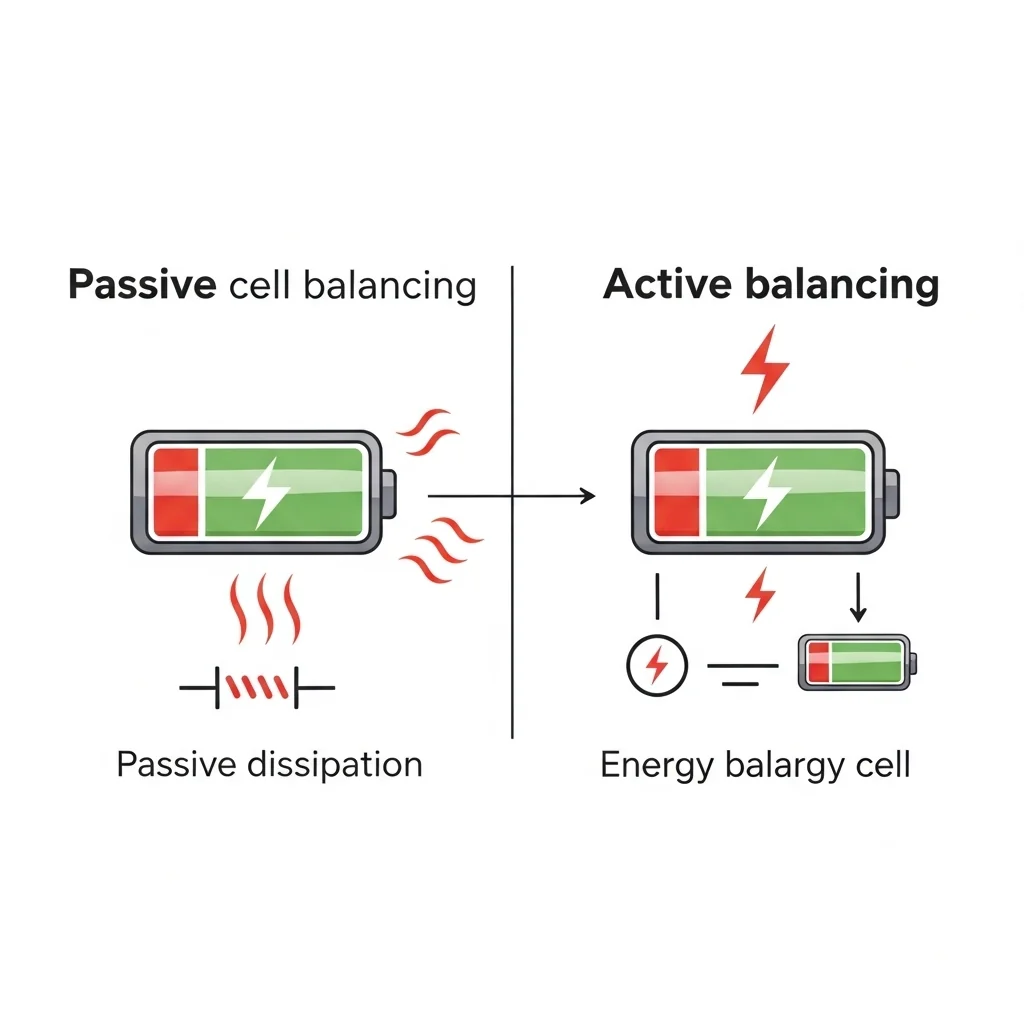
Passive balancing utilizes integrated resistors to physically dissipate excess electrical energy from higher-voltage cells as pure heat. This specific shunt method offers a highly simple, cost-effective hardware architecture suitable for smaller systems where budget takes absolute priority.
-
Passive balancing systems typically operate exclusively during the charging cycle and only actively balance the top 95% of total cell capacity.
-
The hardware architecture generates significant heat due to energy dissipation, necessitating robust thermal management in larger infrastructure applications.
-
The balancing current remains extremely low, often hovering around 0.25A (250 mA), resulting in a substantially slower voltage equalization process.
While cost-effective for basic consumer electronics, passive balancing yields absolutely no measurable improvement to fundamental battery lifespan or runtime for chemistries like LiFePO4 and NMC.
What Is an Active Cell Balancing Architecture?
Active cell balancing utilizes inductive or capacitive circuits to physically transfer surplus electrical charge from higher-voltage cells directly to lower-voltage cells. This method actively redistributes kinetic energy instead of wasting that energy as heat, maximizing usable capacity during both charging and discharging cycles. Active balancing architectures tolerate significantly higher balancing currents, routinely pushing up to 6A, which enables rapid voltage equalization across large-scale energy storage frameworks. Experimental studies confirm that optimization-driven active cell balancing directly increases total operational time by 3.2% under real-world current profiles.
【Technical Parameters Summary Comparison Table】
| Technical Aspect | Passive Balancing Architecture | Active Cell Balancing Architecture |
| Operational Principle |
Dissipates excess cell energy as heat via resistors.
|
Transfers energy between cells using inductive/capacitive circuits.
|
| Peak Balancing Current |
Typically low, approx. 0.25A (250 mA).
|
High current capacity, up to 6A (6000 mA).
|
| Energy Efficiency |
Low efficiency due to energy wasted as heat.
|
High efficiency due to direct energy redistribution.
|
| Operational Cycle Phase |
Usually functions only during the charging cycle.
|
Operates continuously during both charging and discharging.
|
| Impact on Battery Life |
No direct improvement to hardware lifespan.
|
Extends lifespan via superior SoC uniformity.
|
System integrators mandate active balancing architectures for demanding electric vehicle and robotic systems because the exact method directly extends cell life expectancy while drastically reducing active cooling requirements.
How Do System Engineers Specify Balancing Modules for High-Demand Applications?
System engineers specify li ion cell balancing modules by analyzing thermal mitigation requirements, compliance with stringent safety standards, and BMS predictive capabilities.
How Does Balancing Ensure Thermal Mitigation and Safety Compliance?
Engineers strictly specify advanced balancing modules to mitigate internal temperature gradients that directly precede thermal runaway and catastrophic battery fires. Cell imbalance inherently generates localized heat and severe temperature gradients within the physical battery enclosure. Uneven heat distribution rapidly accelerates degradation in hotter cells, vastly increasing internal resistance differences and elevating the risk of explosion.
-
Improper balancing modes or excessive balancing currents cause irregular aging and overcurrent events, directly triggering thermal runaway.
-
Over-discharged cells experience dangerous voltage reversal, posing extreme safety hazards in industrial configurations.
-
Regulatory safety standards, specifically NFPA 855 and UL 9540A, highlight the extreme dangers of thermal runaway strictly linked to internal pack imbalance.
Enforcing rigorous cell equalization protocols serves as the primary hardware defense against sudden battery failures. When deploying battery packs in mechanically harsh environments, procurement teams must integrate Custom Solutions (including IP67-rated potting enclosures, spot-welded pure nickel tabs, and custom wire harnesses exceeding 8 AWG / 8.36 mm²) to prevent moisture ingress or vibration from destroying the highly sensitive BMS balancing circuitry.
What Role Does Advanced Battery Management System (BMS) Integration Play?
Modern battery management systems utilize real-time cell monitoring and predictive analytics to deploy balancing algorithms proactively before critical voltage deviation occurs. The BMS acts as the central intelligence node, continuously tracking individual cell voltage, continuous current, and localized temperatures ranging from -20°C to 60°C (-4°F to 140°F). These microprocessors calculate exact State of Charge (SOC) and State of Health (SOH) metrics to govern the active balancing sequence. Advanced BMS hardware incorporates Machine Learning models and Model Predictive Control (MPC) logic to actively anticipate future cell states and dynamically adjust balancing currents in real time.
【B2B Procurement & Total Cost of Ownership (TCO) Match Table】
| Battery Chemistry | Recommended Balancing Topography | TCO Impact & Industrial Application Suitability |
| LiFePO4 / NMC |
Active Cell Balancing.
|
High initial cost, lowest TCO. Essential for electric vehicles and heavy robotics.
|
| LCO / LMO / LTO |
Active Cell Balancing.
|
Medium initial cost. Required for medical devices preventing unexpected shutdowns.
|
| Lead Acid / Basic Packs |
Passive Balancing (Shunt).
|
Lowest initial cost, high heat output. Suitable only for basic consumer security systems.
|
Implementing predictive maintenance powered by intelligent BMS controllers maximizes battery lifespan and heavily lowers ongoing operational maintenance costs across industrial deployments. To ensure perfect communication between the BMS module and the physical cell array, industrial buyers should prioritize Custom Solutions (such as application-specific BMS firmware flashing and custom-length shielded communication wire harnesses) to minimize data transmission latency across the pack infrastructure.
Summary & Quick-Reference Table
Lithium ion cell balancing represents a non-negotiable engineering requirement for maximizing the safety, operational efficiency, and longevity of industrial energy storage systems. By actively redistributing energy rather than dissipating it as heat, modern active balancing frameworks eliminate destructive temperature gradients, prevent thermal runaway, and ensure compliance with critical global safety standards.
【Quick-Reference Operational Parameters】
| Specification Parameter | Value / Technical Requirement |
| Passive Balancing Target |
Balances only the top 95% of cell capacity.
|
| Active Balancing Current |
Achieves up to 6A (6000 mA) transfer rates.
|
| SOC Improvement (Active) |
Example: 40% initial SOC improved to 87% SOC.
|
| Operational Time Increase |
Active balancing yields a 3.2% runtime increase.
|
| Key Safety Standards |
UN 38.3, IEC 62619, NFPA 855, UL 9540A.
|
FAQ
What is lithium ion cell balancing? Lithium ion cell balancing is the electrical process of equalizing the voltage or state of charge (SoC) among all cells in a battery pack to prevent destructive overcharge or deep discharge events.
How does active cell balancing improve system efficiency? Active cell balancing transfers surplus electrical energy directly from higher-voltage cells to lower-voltage cells using inductive or capacitive circuits, redistributing energy instead of wasting it as heat.
Is li ion cell balancing required for safety compliance? Yes, regulatory safety standards such as UN 38.3 and IEC 62619 strictly require battery management systems to monitor and manage cell voltages via balancing to prevent catastrophic failures.
How does cell imbalance cause thermal runaway? Variations in cell capacity and impedance generate localized heat and severe temperature gradients within the pack, heavily accelerating degradation in hotter cells and risking thermal runaway or explosions.
Which battery chemistries absolutely require active cell balancing? Lithium-ion chemistries, specifically including LiFePO4, NMC, LCO, LMO, and LTO, benefit most from active cell balancing due to their extreme internal sensitivity to overcharge conditions.