A fleet manager parks a vehicle for 90 days; on return, the 12 V battery reads 11.8 V and the engine will not crank. This scenario repeats across standby power rooms, seasonal equipment, and distribution warehouses — and it is driven by one parameter: self-discharge, the internal loss of state of charge under open-circuit storage, caused by electrochemical side reactions at the electrodes. For battery engineers and B2B procurement managers, the monthly self-discharge rate sets maintenance intervals, float-charging budgets, and total cost of ownership (TCO).
Key Takeaways
– Flooded lead acid batteries self-discharge 3–5 % per month at 25 °C (77 °F); AGM VRLA holds 1–3 % and lithium-ion packs 1–2 % — making AGM and lithium the default low self discharge batteries for long-storage duty.
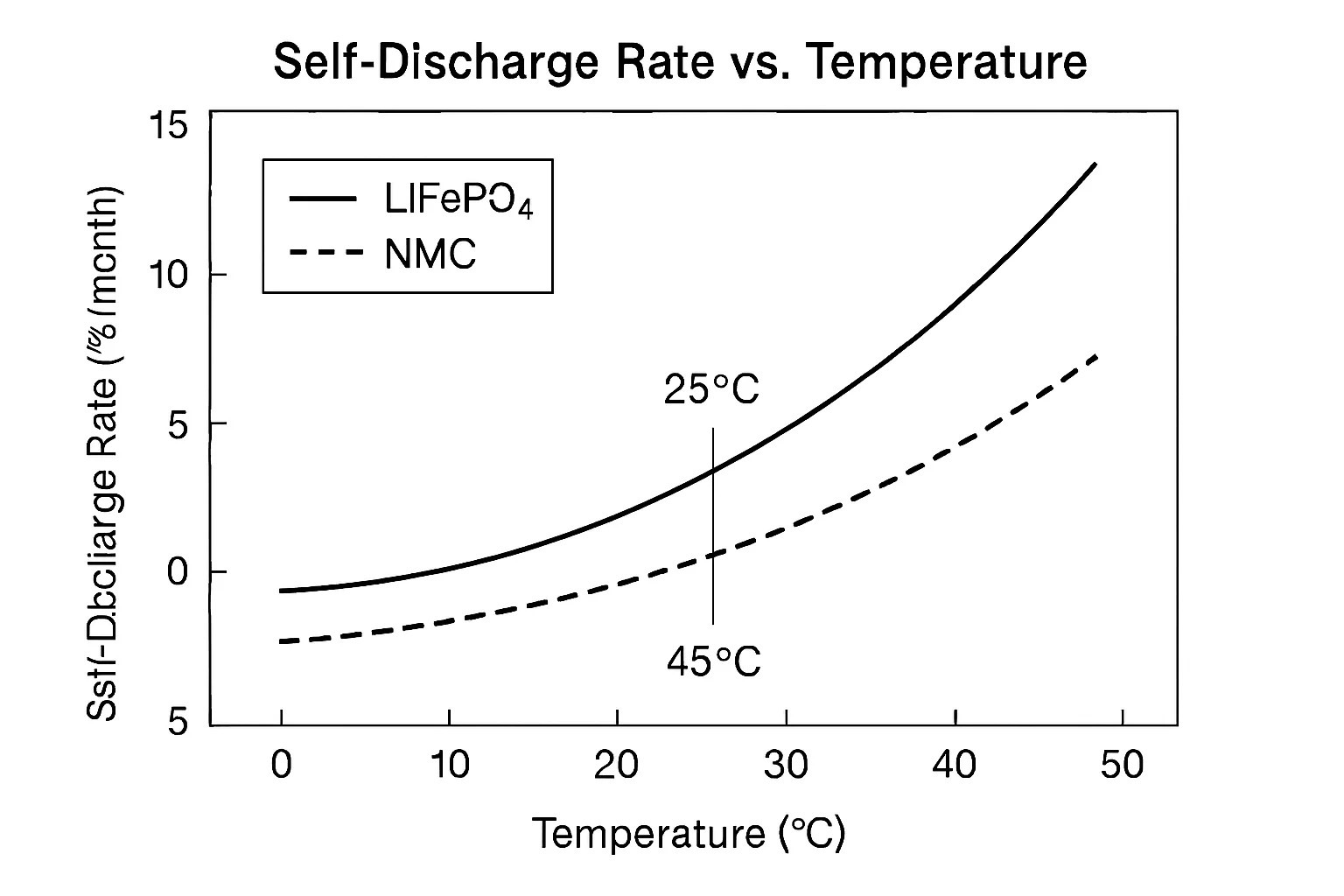
– Self-discharge rate roughly doubles for every 10 °C (18 °F) rise in storage temperature, so warehouse thermal control is as important as chemistry selection.
– Procurement teams should specify self-discharge limits, test standards (IEC 60896-21/-22, EN 50342, SAE J537), and float-charge protocols in writing — uncontrolled self-discharge below ~11.9 V causes irreversible sulfation.
What Is the Lead Acid Battery Self Discharge Rate per Month?
How Do Flooded, AGM, and Gel Lead Acid Batteries Differ in Monthly Self-Discharge?
A flooded lead acid battery self-discharges 3–5 % per month at 25 °C (77 °F), an AGM VRLA battery 1–3 % per month, and a gel VRLA battery approximately 2–3 % per month under the same conditions.
|
Lead Acid Construction |
Typical Monthly Self-Discharge @ 25 °C (77 °F) |
Electrolyte State |
Typical Application |
|---|---|---|---|
|
Flooded SLI (starter) |
3–5 % |
Liquid, free |
Automotive cranking, EN 50342 / SAE J537 ratings |
|
Flooded high-antimony |
5–8 % |
Liquid, free |
Legacy traction, low-cost standby |
|
AGM VRLA |
1–3 % |
Absorbed in glass mat |
UPS, telecom, start-stop vehicles |
|
Gel VRLA |
2–3 % |
Gelled silica |
Deep-cycle solar, mobility |
These are typical industry ranges; exact figures vary with grid alloy, electrolyte purity, and state of charge. AGM batteries discharge less because oxygen recombination at the negative plate suppresses water loss and gassing side reactions. In summary, AGM VRLA is the lowest-discharge lead acid construction at mainstream price points.
Why Does Grid Alloy Determine the Lead Acid Car Battery Self Discharge Rate per Month?
Grid alloy composition is the single largest controllable variable in the lead acid car battery self-discharge rate per month: lead-antimony grids self-discharge roughly twice as fast as lead-calcium or hybrid grids.
- Lead-antimony grids: antimony migrates from the positive grid to the negative plate, forming local galvanic couples that drive continuous hydrogen evolution.
- Lead-calcium grids: calcium suppresses antimony migration and cuts water electrolysis, which is why maintenance-free automotive batteries use calcium or calcium-tin alloys.
- Hybrid grids: calcium negative plus low-antimony positive balances deep-cycle tolerance against shelf life.
Engineers specifying batteries for seasonal vehicles or long logistics pipelines should request the grid alloy in the datasheet. In short, a lead-calcium AGM battery can halve the monthly charge loss of a legacy antimony design at identical temperature.
What Drives Self-Discharge in Lead Acid Batteries?
Which Electrochemical Side Reactions Consume Stored Charge?
Self-discharge in lead acid batteries results from three side reactions: sulfation at the negative plate, water electrolysis (gassing) driven by grid corrosion, and impurity-driven local cell action.
- Sulfation: PbSO₄ crystals grow and harden during stand storage, permanently removing active material below ~11.9 V on a 12 V battery.
- Water electrolysis and corrosion: positive grid corrosion at PbO₂ consumes water and releases O₂/H₂, directly converting stored amp-hours into gas.
- Local action from impurities: iron, copper, or antimony contamination in the electrolyte creates micro short-circuits on the plates, accelerating open-circuit decay.
High-purity electrolyte, tight separator quality control, and clean plate processing distinguish low self discharge batteries from commodity cells. Factory process control data is therefore a legitimate procurement criterion, not a marketing talking point.
How Do Temperature and Storage Conditions Change the Rate?
Self-discharge rate approximately doubles for every 10 °C (18 °F) increase in storage temperature (a Q10 ≈ 2 relationship), so a battery losing 4 % per month at 25 °C (77 °F) will lose roughly 8 % per month at 35 °C (95 °F).
- Recommended storage band: 10–25 °C (50–77 °F), dry.
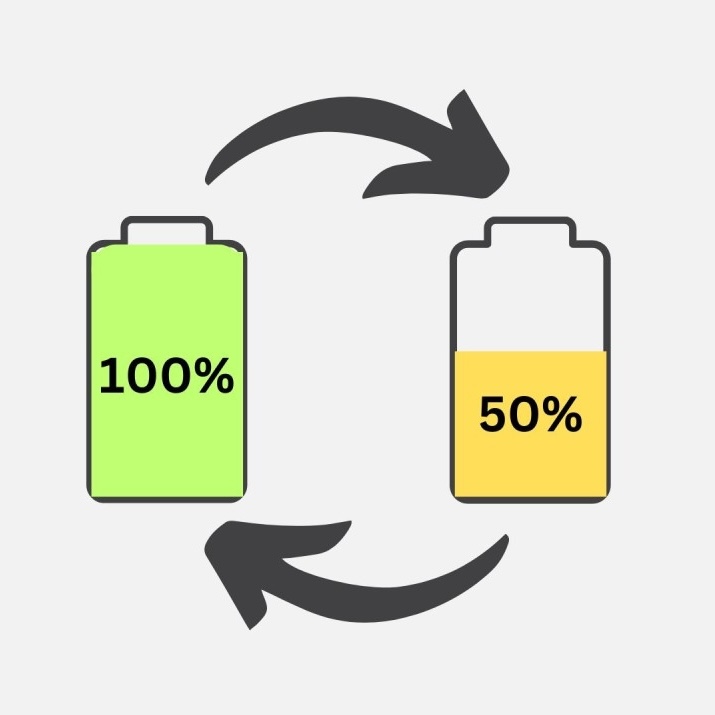
- Storage SoC: store lead acid batteries at 100 % SoC with periodic boost charging; store lithium-ion packs at 40–60 % SoC.
- Float maintenance: 13.5–13.8 V float on a 12 V lead acid battery at 25 °C (77 °F), temperature-compensated by −3 to −4 mV/°C per cell.
- Parasitic loads in vehicles: quiescent drain of 20–50 mA adds 1.4–3.6 % monthly loss on a 60 Ah battery, on top of chemical self-discharge.
In summary, warehouse temperature control and compensated float charging often deliver more shelf-life improvement than switching chemistry within the lead acid family.
How Do Low Self Discharge Batteries Compare Across Chemistries?
What Are the Typical Monthly Self-Discharge Rates by Chemistry?
Among mainstream chemistries, lithium primary cells are the lowest self discharge batteries (<1 % per year), followed by lithium-ion (1–2 % per month), AGM lead acid (1–3 % per month), flooded lead acid (3–5 % per month), and standard NiMH (up to 30 % per month).
|
Chemistry |
Self-Discharge |
Storage Temp. Range |
Storage SoC |
Notes |
|---|---|---|---|---|
|
Lithium primary (Li-SOCl2) |
<1 % per year |
−55 to +85 °C (−67 to 185 °F) |
Any |
Meters, IoT sensors |
|
Lithium-ion (NMC/LFP) |
1–2 % per month |
−20 to +45 °C (−4 to 113 °F) |
40–60 % |
Add BMS quiescent drain |
|
AGM VRLA lead acid |
1–3 % per month |
−20 to +50 °C (−4 to 122 °F) |
100 % |
Lowest-cost low-self-discharge option |
|
Flooded lead acid |
3–5 % per month |
−20 to +50 °C (−4 to 122 °F) |
100 % |
Requires watering and boost charges |
|
Gel VRLA lead acid |
2–3 % per month |
−20 to +50 °C (−4 to 122 °F) |
100 % |
Deep-cycle storage duty |
|
NiMH (standard) |
15–30 % per month |
−20 to +45 °C (−4 to 113 °F) |
Any |
Poor for standby storage |
|
NiMH (LSD type) |
~0.5–1 % per month |
−20 to +45 °C (−4 to 113 °F) |
Any |
Retains ~70 % after multi-year storage |
Values are typical published ranges at 25 °C (77 °F); always confirm against the cell manufacturer’s datasheet. Chemistry selection alone can change monthly losses by an order of magnitude.
When Should Engineers Select Lithium Packs Over VRLA?
Lithium-ion packs become the correct choice when storage exceeds 3–6 months without maintenance power, when weight and volume are constrained, or when cycle life above ~500 cycles is required alongside low self-discharge.
- Weight: LFP packs deliver roughly 3× the gravimetric energy density of VRLA, cutting enclosure mass in mobile equipment.
- Logistics: lithium packs require UN 38.3 test certification and Class 9 shipping documentation — a real procurement cost to budget.
- System design: a battery management system (BMS) adds 10–100 µA quiescent drain, which engineers must add to the chemical self-discharge figure.
For OEM programs that need customized lithium battery packs engineered around specific self-discharge, temperature, and certification targets, working directly with a pack manufacturer on cell selection, BMS sleep current, and storage firmware shortens validation cycles — request a custom battery pack consultation to scope the requirement. Lithium wins on self-discharge and weight; VRLA AGM wins on cost and shipping simplicity.
How Should B2B Buyers Evaluate TCO for Low Self Discharge Batteries?
How Do Battery Types Compare on Total Cost of Ownership?
For long-storage industrial programs, AGM VRLA typically delivers the lowest TCO for standby duty, while lithium-ion delivers the lowest TCO for high-cycle or maintenance-inaccessible deployments, despite 2–3× higher upfront cost.
|
TCO Dimension |
Flooded Lead Acid |
AGM VRLA |
Lithium-ion Pack |
|---|---|---|---|
|
Upfront pack cost |
1.0× (baseline) |
1.2–1.5× |
2.0–3.0× |
|
Monthly self-discharge |
3–5 % |
1–3 % |
1–2 % (+ BMS drain) |
|
Storage maintenance labor |
High (watering, boost) |
Low |
Very low |
|
Recharge energy during storage |
Highest |
Medium |
Lowest |
|
Typical cycle life |
200–400 cycles |
300–700 cycles |
1,000–3,000+ cycles |
|
Shipping complexity |
Class 8 (wet) |
Class 8 (non-spillable) |
UN 38.3 / Class 9 |
|
Sulfation scrap risk in storage |
High |
Medium |
Low (but over-discharge protection required) |
Self-discharge feeds TCO through three channels: maintenance labor, storage energy cost, and premature replacement from sulfation or over-discharge. Procurement teams modeling these channels routinely find AGM or lithium cheaper than flooded over a 3–5 year horizon.
What Should Go Into a Procurement Specification for Low Self Discharge Batteries?
A robust B2B specification for low self discharge batteries must state a numerical monthly self-discharge limit at a defined temperature, the applicable test standard, and the required storage documentation.
- Performance limit: e.g., “≤3 % capacity loss per 28 days at 25 °C ±2 °C (77 °F ±3.6 °F), per manufacturer method.”
- Standards references: IEC 60896-21/-22 for stationary VRLA, IEC 60254 for traction lead acid, EN 50342 / SAE J537 for starter batteries, UN 38.3 for lithium transport, IEC 62133-2 for lithium pack safety.
- Factory quality: electrolyte purity and separator data, ISO 9001 production, lot-level traceability.
- Logistics clauses: state of charge at shipment, date codes, and maximum warehouse dwell before first boost charge.
For programs sourcing custom battery packs for medical devices, security systems, robotics, or industrial equipment, an engineering-led supplier can co-develop the self-discharge test protocol and pack-level sleep design — contact the engineering team for a customized battery solution. In conclusion, a written specification converts self-discharge from a warranty dispute into a measurable acceptance criterion — the single most effective lever a procurement manager has over storage reliability.