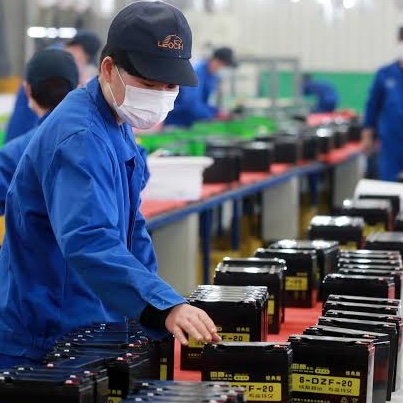
On June 28, 2025, security checkpoints at mainland Chinese airports began confiscating power banks without a legible CCC mark, after the State Administration for Market Regulation (SAMR) suspended or revoked CCC certificates held by several power bank and battery cell manufacturers following a wave of in-flight fire incidents. For battery engineers and procurement managers shipping portable power products into China, CCC certification is now an audited, actively enforced compliance gate. This guide maps the current CCC certification requirements for power banks, the applicable GB standards and test items, and the sourcing options for B2B buyers.
Key Takeaways
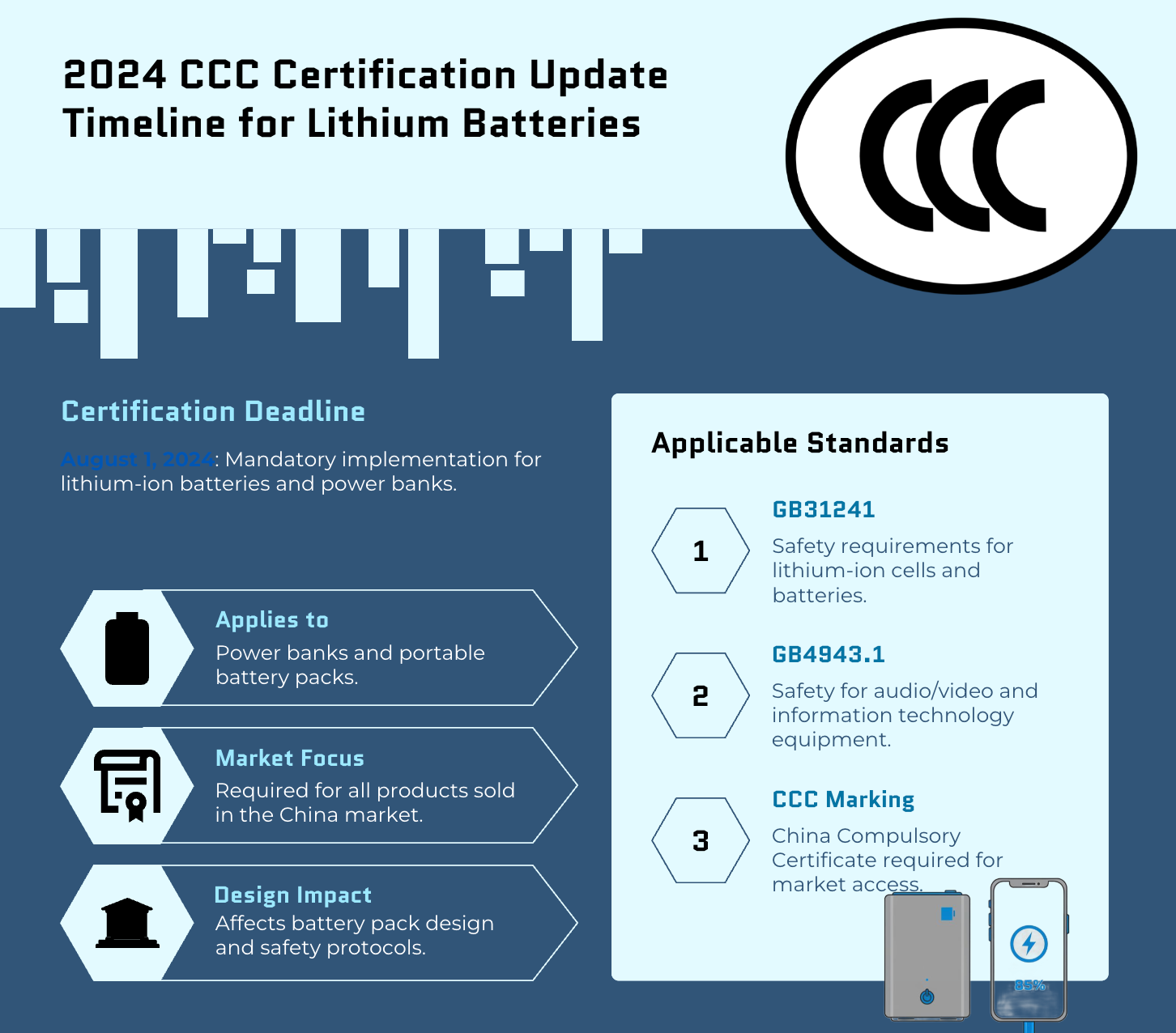
– CCC certification has been mandatory for power banks since August 1, 2024 under SAMR Announcement No. 10 (2023); the core technical standards are GB 31241-2022 and GB 4943.1-2022, supplemented by GB/T 35590-2017.
– Enforcement is now operational, not theoretical: since June 28, 2025, power banks without a clear CCC mark are banned from domestic flights in mainland China, and non-compliant products cannot legally be manufactured, sold, or imported.
– Requirements tightened again in 2026: new certificates issued from March 1, 2026 must carry a traceability QR code alongside the CCC mark, and the dedicated power bank safety standard GB 47372-2026 raises factory-audit and abuse-testing expectations.
Which Products Fall Under the CCC Certification Requirements for Power Banks?
Product Scope: CCC Categories 0914, 0915, and 0916
CCC coverage for portable power products is divided into three catalog categories, and the category assignment determines the applicable standards. Category 0914 covers mobile power banks — portable units with lithium-ion cells or battery packs, associated circuits, and an enclosure, delivering DC and/or AC output, weighing no more than 18 kg (39.7 lb), and rated above 600 mAh. Category 0915 covers lithium-ion batteries and battery packs for portable electronic products; e-cigarette batteries are explicitly excluded. Category 0916 covers cells and packs intended specifically for use inside power banks.
The classification matters for B2B buyers of custom battery packs: a dedicated pack designed for a fixed medical device or industrial instrument does not automatically fall into category 0914, while a general-purpose removable pack marketed for portable electronics typically does. Category determination should be confirmed with a designated certification body before a project budget is locked.
Applicable GB Standards and Test Items
Two compulsory national standards form the technical core of power bank CCC certification, with a product specification standard adding performance and marking criteria:
|
Standard |
Title (Scope) |
Key Requirement Areas |
|---|---|---|
|
GB 31241-2022 |
Safety technical specification for lithium-ion cells and batteries used in portable electronic products |
Overcharge, over-discharge, short circuit, crush, thermal abuse, protection-circuit validation |
|
GB 4943.1-2022 |
Audio/video, information and communication technology equipment — Part 1: Safety requirements |
Electrical insulation, temperature rise, fire resistance, mechanical strength, marking |
|
GB/T 35590-2017 |
General specification for portable digital equipment mobile power banks |
Capacity labeling accuracy, output voltage stability, conversion performance, marking elements |
|
GB 47372-2026 |
Dedicated safety standard for portable power banks (new framework) |
Expanded abuse testing, full-lifecycle supervision, supply-chain control |
GB 31241-2022 became fully effective on January 1, 2024 and replaced GB 31241-2014 with stricter thermal-runaway and protection requirements. A power bank certificate therefore covers the battery subsystem and the finished device as one system.
What Is the CCC Compliance Timeline From 2023 to 2027?
Key Regulatory Milestones
The CCC framework moved from voluntary application to full enforcement in staged steps, with two further milestones already scheduled:
|
Effective Date |
Milestone |
Practical Impact |
|---|---|---|
|
August 1, 2023 |
Designated bodies began accepting CCC applications for lithium-ion batteries and power banks |
Voluntary certification window opened |
|
August 1, 2024 |
Mandatory enforcement began |
Non-certified power banks cannot be manufactured, sold, or imported in China |
|
June 28, 2025 |
CAAC banned power banks without a clear CCC mark, or from recalled batches, on domestic flights |
Airport security confiscates non-compliant units; recalled models banned even if marked |
|
March 1, 2026 |
Traceability QR code required on newly issued certificates |
CCC mark must be paired with a QR code at the same height on the product |
|
March 1, 2027 |
QR-code requirement extends to all certified power banks |
Existing certified inventory must update labeling |
What GB 47372-2026 and QR Traceability Change for Manufacturers
The 2026 framework shifts CCC supervision from one-time product testing toward full-lifecycle verification: factory audits precede certification, abuse testing is broader, and the QR code links each certified unit to China’s national product traceability platform for real-time authenticity checks. A CCC certificate remains valid for five years, with renewal recommended 90 days before expiry — but a certificate can be suspended or revoked at any time, as the 2025 revocations demonstrated.
What Safety Tests Must a Lithium-Ion Battery Pack Pass for CCC Certification?
Cell- and Pack-Level Tests Under GB 31241-2022
GB 31241-2022 requires both cell-level and pack-level safety verification. The test program covers:
- Electrical abuse: overcharge, forced over-discharge, and external short-circuit tests; the protection circuit must interrupt fault conditions before hazardous temperatures develop.
- Mechanical abuse: crush, vibration, and drop tests simulating handling and transport stresses.
- Thermal and environmental stress: thermal abuse and temperature-cycling tests verifying that no fire or explosion occurs under defined fault conditions.
- Protection-function validation: overvoltage, overcurrent, overtemperature, and short-circuit protection must each trigger within specified limits, including functional verification of packs with cell-balancing and fuel-gauge electronics.
Factories must operate withstand-voltage, insulation-resistance, and ground-resistance testers on the production line, and mass-production units are checked for consistency with the tested sample.
Marking and Labeling Requirements
Every CCC-certified power bank must display the marking elements specified in GB/T 35590-2017: product name and model; manufacturer name; battery chemistry type; input/output port symbols; rated voltage and current; rated energy in Wh or kWh; and manufacture date in YYYY-MM-DD format. From March 1, 2026, the CCC mark must appear together with the traceability QR code on the product body. Marks that are worn, illegible, or printed only on packaging fail both market surveillance and airport security checks.
How Should B2B Buyers Source CCC-Compliant Battery Packs?
Certification Pathways and TCO Comparison
For equipment manufacturers, the decision is not whether to comply, but which sourcing pathway reaches compliance at the lowest total cost of ownership:
|
Dimension |
Custom Pack + Self-Run CCC Certification |
Pre-Certified Standard Battery Pack Platform |
Consumer-Grade CCC Power Bank (Adapted) |
|---|---|---|---|
|
Upfront certification cost |
Full type testing + factory audit per product family |
Borne by the battery manufacturer; shared across platform users |
Included in unit price |
|
Time to market |
Certification timeline added to development schedule |
Shortest — certified models ship from existing platforms |
Fast, but integration constraints |
|
Design fit |
Exact fit to device enclosure, voltage, and BMS protocol |
Standard footprints (e.g., 2S–4S 18650/21700 platforms, SMBus smart packs); minor adaptation |
Poor — output, connector, and firmware rarely match OEM needs |
|
Certificate risk |
Buyer controls the certificate and factory audits |
Certificate held and maintained by the battery manufacturer |
Revocation risk sits with a consumer brand outside the buyer’s control |
|
Best for |
High-volume programs with fixed designs |
Low-to-mid volume instruments, medical devices, and industrial equipment needing fast, compliant power |
Prototyping only; rarely acceptable for shipped equipment |
For procurement teams that need a certified power subsystem without funding a full certification program, pre-certified standard smart battery packs are usually the most capital-efficient route. TEFOO’s standard smart Li-ion series, for example, offers 18650/21700-based models from 11.88 Wh to 97.2 Wh carrying CCC alongside IEC 62133, UN 38.3, UL 2054, CE, and UKCA — engineering teams can request the certification file set and 2D/3D drawings to evaluate fit.
Supplier Verification Checklist Before Ordering
A certificate image on a datasheet is not verification. Before placing a B2B order for CCC-marked battery packs, buyers should:
- Verify the certificate number against the issuing body’s public database or the national traceability platform, and confirm the status is active, not suspended or revoked.
- Match the certificate scope to the exact model, cell configuration, and factory address on the purchase order.
- Request the underlying test reports for GB 31241-2022 and GB 4943.1-2022, not only the certificate cover page.
- Confirm marking compliance on physical samples — CCC mark, Wh rating, manufacture date, and, for certificates issued from March 1, 2026, the traceability QR code.
- Audit recall exposure by checking whether the cell or pack manufacturer appears in any SAMR revocation or recall notice.
Buyers sourcing battery packs for medical devices, test instruments, or robotics platforms can shorten this due-diligence cycle by engaging a manufacturer that maintains multi-market certification files in-house. TEFOO provides complete certification documentation — CCC, IEC 62133, UN 38.3, UL 2054 (File E531004), CE, FCC, and UKCA — with its standard and customized battery pack programs; contact the engineering team to review certificate scope against your device category.
Conclusion
CCC certification requirements for power banks have hardened into a three-layer system: GB-standard type testing, pre-certification factory audits, and unit-level QR traceability. The August 2024 mandate, the June 2025 aviation enforcement, and the 2026 traceability upgrade each closed a workaround that importers previously relied on. For B2B buyers, the durable strategy is to classify the product into the correct CCC category, select a sourcing pathway with acceptable certificate risk, and verify every certificate against official databases before the purchase order is signed.