Is Lithium Renewable or Nonrenewable in Industrial Battery Manufacturing?
Procurement managers and battery hardware engineers scaling energy storage systems (ESS) and electric vehicle (EV) fleets confront a critical supply chain bottleneck: lithium is a finite, nonrenewable elemental metal. While lithium-ion chemistries power renewable energy infrastructures, the raw material itself must be physically extracted from the earth’s crust through resource-intensive mining operations. When engineers ask is lithium renewable or nonrenewable, the strict metallurgical classification is nonrenewable, necessitating rigorous lifecycle management and procurement planning to sustain global manufacturing.
Key Takeaways
Why Is Lithium Classified as a Nonrenewable Resource in Battery Manufacturing?
Lithium carbonate ($\text{Li}_2\text{CO}_3$) and lithium hydroxide ($\text{LiOH}$) are refined from geological deposits that take millions of years to form, classifying the elemental metal as strictly nonrenewable.
What Defines the Material Scarcity of Global Lithium Reserves?
Global lithium reserves currently sit at over 14 million metric tons, heavily concentrated in specific geographical pockets rather than distributed evenly across the globe. Australia, Chile, and China account for approximately 90% of all global lithium mining, creating severe supply chain vulnerabilities for original equipment manufacturers (OEMs) relying on uninterrupted raw material flow.
Different geological formations yield different baseline lithium concentrations. For example, the Salar de Atacama brine deposit in Chile features a lithium concentration of 2,211 mg/l, whereas the Greenbushes hard rock mine in Australia yields an ore grade of 1.47% $\text{Li}_2\text{O}$. Because these specific deposits deplete continuously during extraction and cannot regenerate on human timescales, procurement models must treat lithium as a exhaustible commodity.
How Do Electric Vehicle Demand Projections Outpace Natural Replenishment?
The global transition to electric vehicles (EVs) creates an exponential depletion rate of nonrenewable lithium reserves, with market analysts projecting the lithium battery market to expand from $42.5 billion in 2021 to $184.15 billion by 2030, reflecting an 18.5% compound annual growth rate (CAGR).
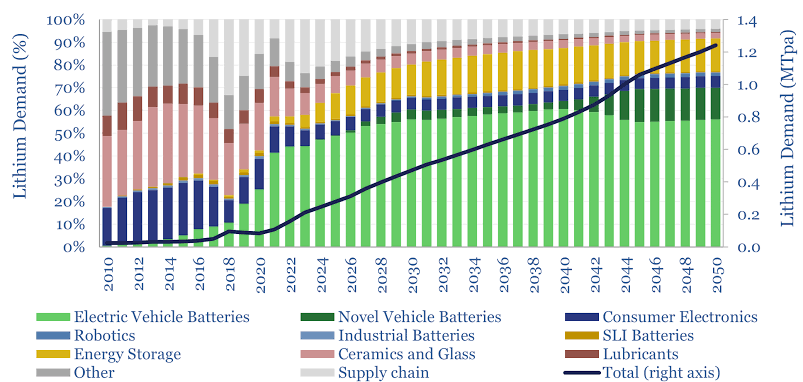
By 2050, base lithium demand will increase 26 times over 2021 baseline metrics, significantly outpacing the demand growth for other nonrenewable battery materials like nickel (12 times increase), graphite (9 times increase), and cobalt (6 times increase). Because new lithium mining operations require 6 to 10 years of lead time to clear regulatory and environmental hurdles, hardware developers face a severe structural deficit between rapid EV scaling and the sluggish extraction of nonrenewable ores.
How Do Extraction Methods Impact Global Lithium Supply Chains?
Engineers extract nonrenewable lithium primarily through two distinct industrial methodologies: hard rock mining (spodumene) and underground brine evaporation.
What Are the Engineering Differences Between Brine and Hard Rock Extraction?
Hard rock mining utilizes mechanical drilling, blasting, and high-heat roasting to extract lithium from solid ore, whereas brine extraction pumps underground mineral-rich saline water into massive surface evaporation ponds to concentrate the lithium over several months. Australia leads global hard rock mining output, while South American nations like Chile and Argentina dominate brine extraction.
Technical Specifications: Lithium Extraction Methodologies
| Extraction Parameter | Hard Rock Mining (Spodumene) | Brine Extraction (Salt Flats) |
| Primary Geographic Hub |
Australia
|
Chile, Argentina, Bolivia
|
| Extraction Timeframe | Rapid (Days/Weeks) |
Slow (Months/Years via evaporation)
|
| Carbon Intensity |
~3x higher than brine extraction
|
Lower baseline operational emissions
|
| Water Consumption | Moderate |
Extremely High
|
| Land/Ecological Disruption |
Significant physical land disruption
|
Severe local aquifer/ecological disruption
|
What Are the Environmental Costs of High-Volume Lithium Mining?
Processing one metric ton of lithium through brine extraction requires approximately 500,000 liters (132,086 gallons) of water. In heavily mined regions like the Atacama Salt Flat in Chile, 95% of the brine water pumped to the surface evaporates during the concentration process. This massive fluid displacement depletes local aquifers, degrades surrounding soil integrity, and disrupts fragile desert ecosystems.
Conversely, hard rock mining and Direct Lithium Extraction (DLE) techniques rely heavily on fossil fuels. DLE systems powered by diesel generators can emit up to 22 metric tons of $\text{CO}_2$ equivalent per metric ton of lithium carbonate produced. These environmental penalties force hardware manufacturers to balance zero-emission operational goals against the highly pollutive reality of nonrenewable resource extraction.
Can Closed-Loop Recycling Create a Fully Sustainable Battery Supply Chain?
End-of-life battery recycling mitigates the depletion of nonrenewable ores, but current hydrometallurgical and pyrometallurgical infrastructure lacks the throughput required to sustain global manufacturing demands independently.
What Role Does Battery Recycling Play in B2B Procurement?
Closed-loop recycling currently supplies only 10% to 20% of global industrial lithium requirements, meaning the remaining 80% to 90% must continually originate from destructive primary mining operations. While recycled lithium cells retain identical electrochemical performance to virgin cells, the low volume of end-of-life hardware returning to processing facilities prevents recycling from fully replacing primary nonrenewable extraction.
B2B Selection & TCO Procurement Matrix: Virgin vs. Recycled Lithium
| Procurement Variable | Virgin Lithium (Primary Mined) | Recycled Lithium (Secondary Processed) | B2B Engineering Impact |
| Supply Chain Availability |
High (80-90% of global supply)
|
Low (10-20% of global supply)
|
Recycled material cannot currently support large-scale OEM fleet manufacturing.
|
| Supply Chain Vulnerability |
High (Concentrated in Australia/Chile/China)
|
Low (Sourced from localized waste facilities) | Localized recycling reduces international shipping constraints and geopolitical risks. |
| Environmental Compliance |
Poor (High water usage & emissions)
|
Excellent (Reduces mining footprint) | Recycled materials assist OEMs in meeting strict ISO 14001 sustainability targets. |
Custom Engineering Solutions: Whether your industrial hardware utilizes virgin lithium or secondary recycled cells, integration requires highly resilient pack architecture. If your B2B application demands customized battery solutions—including precision spot-welded nickel tabs, NTC thermistors, custom wire harnesses, and ultrasonically welded IP67-rated waterproof enclosures—contact our engineering team to design power systems compliant with UL 2054 and UN 38.3 standards.
Summary & Quick-Reference Guide
The query is lithium renewable or nonrenewable yields a definitive industrial reality: lithium is an exhaustible, nonrenewable mineral that currently faces severe supply and demand bottlenecks. While the end-use applications (EVs, solar storage) champion renewable energy, the physical extraction relies heavily on water-intensive brine evaporation and carbon-intensive hard rock mining. Recycling supplements this deficit but cannot currently replace primary mining operations.
Global Lithium Supply Parameter Quick-Reference Table
| Industrial Parameter | Current Market Specification |
| Global Viable Reserves |
>14 million metric tons
|
| Global Production Leaders |
Australia, Chile, China (~90% market share)
|
| 2030 Market Valuation Target |
$184.15 billion USD
|
| Brine Water Consumption |
~500,000 liters per metric ton of lithium
|
| Recycling Market Share |
10% to 20% of total global supply
|
Frequently Asked Questions
Is lithium renewable or nonrenewable in the context of battery manufacturing?
Lithium is a strictly nonrenewable, finite elemental metal mined from the earth’s crust, meaning it cannot regenerate naturally on human timescales to replace the volumes consumed by industrial manufacturing.
What factors most affect lithium supply for battery pack manufacturing? Global lithium supply is constrained by total mining capacity, extraction technology efficiency, and the geopolitical stability of the three leading producing nations: Australia, Chile, and China.
How does lithium extraction impact local environments and sustainability goals? Lithium extraction heavily degrades local environments; brine extraction consumes approximately 500,000 liters of water per ton of lithium, depleting arid aquifers, while hard rock mining generates significant physical land disruption and carbon emissions.
Can lithium recycling fully support future battery pack demand? No, closed-loop battery recycling currently supplies only 10% to 20% of the total lithium required by manufacturers, mandating that 80% to 90% of all supply continues to rely on primary mining extraction.
Why is the industrial demand for lithium increasing so rapidly? Industrial demand is surging due to the global transition toward electric vehicles (EVs) and grid-scale energy storage, driving market projections to $184.15 billion by 2030 at an 18.5% compound annual growth rate.