What Is Nickel Metal Hydride Rechargeable Battery Technology and How Do Engineers Select It for Industrial Applications?
Industrial power system designs demand reliable energy storage that balances cycle stability, operating temperature range, and system safety without thermal runaway risks. Nickel metal hydride rechargeable battery chemistry provides a robust electrochemistry for commercial electronics, medical hardware, and backup infrastructure.
Key Takeaways
-
Electrochemical Stability: A nickel metal hydride rechargeable battery operates at a nominal voltage of $1.2\text{ V}$ with a specific energy of $60\text{–}120\text{ Wh/kg}$, serving as a drop-in or integrated power source without thermal runaway propagation hazards.
-
Low Self-Discharge Retention: Modern low self-discharge nimh battery cells retain $70\text{–}85\%$ of rated capacity after 12 months at $20\text{ }^\circ\text{C}$ ($68\text{ }^\circ\text{F}$), drastically reducing standby loss in critical equipment.
-
Total Cost Optimization: In high-drain industrial applications, a battery type ni mh lowers total cost of ownership (TCO) compared to single-use alkaline units by delivering 500 to 1,500 full charge-discharge cycles under IEC 61951-2 operating conditions.
What Are Nickel Metal Hydride Batteries and How Does Their Electrochemical Structure Work?
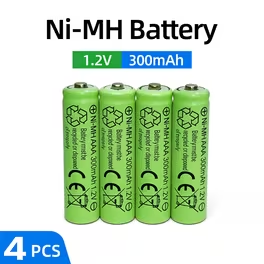
A nickel metal hydride rechargeable battery stores energy through hydrogen absorption and desorption within a metal hydride alloy matrix paired with a nickel hydroxide cathode.
What Is the Electrochemical Mechanism of an NiMH Battery Cell?
Nickel metal hydride rechargeable battery cells deliver a nominal output of $1.2\text{ V}$ via reversible proton transfer between a positive nickel hydroxide cathode, a negative hydrogen-absorbing alloy anode, and an aqueous potassium hydroxide ($\text{KOH}$) electrolyte.
-
Cathode (Positive Electrode): Nickel hydroxide ($\text{Ni(OH)}_2$) converts to nickel oxyhydroxide ($\text{NiO(OH)}$) during oxidation.
-
Anode (Negative Electrode): Metal hydride alloy ($\text{M}$, typically $\text{AB}_5$-type rare-earth alloys like $\text{LaNi}_5$ or $\text{AB}_2$-type titanium/zirconium alloys) absorbs atomic hydrogen ($\text{MH}$) during reduction.
-
Electrolyte Solution: Aqueous potassium hydroxide ($\text{KOH}$) with an approximate density of $1.30\text{ g/cm}^3$ provides ionic conductivity without being consumed in the net reaction.
Understanding what is ni mh battery electrochemistry clarifies why these cells maintain constant internal resistance ($\le 30\text{ m}\Omega$ for standard industrial AA units) throughout $80\%$ of their discharge curve.
How Does Low Self-Discharge NiMH Battery Technology Prevent Charge Loss?
A low self-discharge nimh battery minimizes internal micro-shorting and chemical decomposition by incorporating dense separator membranes and optimized alloy compositions, retaining up to $85\%$ capacity after one year of room-temperature storage.
Traditional battery ni mh cells lose approximately $1.0\text{–}3.0\%$ of their state-of-charge per day at room temperature due to impurities in the hydrogen storage alloy and nitrogen gas crossover. Advanced nimh low self discharge architectures overcome this using:
-
Sulfonated Polypropylene Separators: Dense separators restrict nitrate and impurity ion movement between electrodes.
-
Modified $\text{AB}_5$ Alloys: Replacing manganese or silicon with cobalt or aluminum stabilizes the metal crystal lattice, reducing surface corrosion.
-
Gas Pressure Control: Sealed safety vents rated at $1.0\text{–}2.0\text{ MPa}$ prevent hydrogen gas escape under standard floating charge profiles.
Deploying low self-discharge nimh batteries ensures operational readiness for emergency lighting, medical diagnostic monitors, and remote telemetry nodes that remain inactive for extended periods.
How Does Nickel Metal Hydride Battery Performance Compare to Alkaline and Lithium Chemistries?
Selecting between a nickel metal hydride battery vs alkaline cell or lithium-ion equivalent requires evaluating thermal operating windows, charge maintenance requirements, and cell discharge profiles under load.
What Are the Core Differences in Nickel Metal Hydride Battery vs Alkaline Performance?
A nickel metal hydride rechargeable battery maintains a flat discharge plateau at $1.2\text{ V}$ under high current draws ($\ge 1\text{C}$), whereas primary alkaline vs nickel metal hydride batteries exhibit continuous linear voltage drops under identical loads.
| Technical Parameter |
Battery Type NiMH |
Primary Alkaline (Zn/MnO2) |
Engineering Significance |
| Nominal Voltage |
$1.2\text{ V}$ |
$1.5\text{ V}$ |
NiMH delivers flat power output under load. |
| Cut-off Voltage |
$1.0\text{ V}$ |
$0.8\text{ V}$ |
Circuit cutoff thresholds must match chemistry. |
| Energy Density |
$60\text{–}120\text{ Wh/kg}$ |
$80\text{–}100\text{ Wh/kg}$ |
Comparable volumetric profile in standard sizes. |
| Internal Resistance |
$15\text{–}30\text{ m}\Omega$ |
$150\text{–}300\text{ m}\Omega$ |
NiMH maintains higher current efficiency. |
| Cycle Life |
$500\text{–}1,500\text{ cycles}$ |
$1\text{ cycle (Single-use)}$ |
NiMH yields lower cost per discharge cycle. |
| Leakage Propensity |
Extremely Low (Sealed Vent) |
Moderate-High (Corrosive KOH) |
NiMH reduces equipment terminal damage. |
When comparing alkaline vs nickel metal hydride batteries, primary alkaline cells drop below $1.0\text{ V}$ prematurely under heavy currents due to high internal resistance. Conversely, a ni mh aa battery maintains consistent power delivery, making it suitable for motor-driven actuators and high-intensity optical devices.
When Should Engineers Choose Battery Type NiMH Over Lithium-Ion Solutions?
Engineers select a battery type nimh over lithium-ion options when operating in hazardous environments where stringent transport controls, complex BMS circuit requirements, or severe thermal runaway risks preclude lithium chemistry.
-
Intrinsically Safe Environments: What are nickel metal hydride batteries valued for in hazardous locations? They do not produce metallic lithium dendrites or flammable organic electrolyte off-gassing during overcharge events.
-
Simplified Logistics: Battery type nimh shipments are non-hazardous cargo under UN 3480/3481 special provisions, avoiding complex Class 9 dangerous goods handling procedures.
-
Broad Temperature Compatibility: NiMH cells operate reliably from $-20\text{ }^\circ\text{C}$ to $+60\text{ }^\circ\text{C}$ ($-4\text{ }^\circ\text{F}$ to $+140\text{ }^\circ\text{F}$), whereas lithium chemistries often require heating elements below $0\text{ }^\circ\text{C}$ ($32\text{ }^\circ\text{F}$) during charge cycles.
While lithium-ion delivers higher energy density ($150\text{–}250\text{ Wh/kg}$), the structural stability and lower certification overhead of a nimh battery type make it a practical alternative for industrial hardware setups.
How Do Engineers Select and Design Custom Low Self-Discharge NiMH Battery Packs?
Designing custom industrial battery packs involves balancing electrical discharge rates, physical cell connections, environmental ingress protection, and total procurement costs over the equipment lifetime.
What Operational Parameters Govern Battery Type NIMH Selection in Industrial Environments?
Evaluating what are ni mh batteries capable of in industrial environments requires calculating C-rate performance, continuous thermal dissipation, and long-term operating costs across target duty cycles.
| Selection Metric |
Low-Drain Parameter |
High-Drain Industrial Parameter |
TCO & Engineering Impact |
| Target Capacity |
$800\text{–}1,300\text{ mAh}$ |
$2,000\text{–}2,700\text{ mAh}$ |
Defines total system runtime between charges. |
| Max Continuous Discharge |
$0.2\text{C}\text{ to }0.5\text{C}$ |
$3.0\text{C}\text{ to }5.0\text{C}$ |
Prevents localized ohmic heating in cell packs. |
| Self-Discharge Rate |
Standard ($15\text{–}30\%/\text{month}$) |
Low Self-Discharge ($10\text{–}15\%/\text{year}$) |
Dictates maintenance recharging intervals. |
| Operating Temperature |
$0\text{ }^\circ\text{C}\text{ to }40\text{ }^\circ\text{C}$ |
$-20\text{ }^\circ\text{C}\text{ to }65\text{ }^\circ\text{C}$ |
Determines thermal insulation requirements. |
| Compliance Standards |
IEC 61951-2, RoHS |
UL 2054, IEC 62133, REACH |
Essential for global market regulatory clearance. |
Selecting low self-discharge nimh batteries reduces maintenance cycles and device downtime, minimizing the Total Cost of Ownership (TCO) across 5-year deployment schedules.
Do NiMH Batteries Leak and How Can Custom Assembly Mitigate Failure?
Do ni mh batteries leak? High-quality nickel metal hydride rechargeable battery cells rarely leak under normal operating conditions because they use a resealable elastomeric safety vent rather than the destructive pressure rupture discs found in disposable alkaline cells.
Electrolyte leakage in a nihm battery occurs primarily under extreme mechanical stress, sustained over-charging above $1.5\text{C}$, or prolonged reverse-charging conditions. Custom B2B pack engineering prevents these failure modes through specialized manufacturing techniques:
-
Precision Spot-Welded Nickel Tabs: High-purity nickel strips ($0.12\text{–}0.20\text{ mm}$ thickness) are spot-welded directly to cell terminals to minimize contact resistance and vibration fatigue.
-
IP67 Sealed Enclosures: Custom outer housings using ultrasonically welded ABS/PC plastics prevent moisture ingress and mechanical damage.
-
Integrated Wire Harnesses & Thermistors: Factory-installed NTC thermistors and molex-compatible connectors interface directly with host-system management electronics to shut down charging if temperatures exceed $+45\text{ }^\circ\text{C}$ ($113\text{ }^\circ\text{F}$).
Custom Engineering Solutions: If your application requires customized nickel metal hydride rechargeable battery packs—featuring custom-welded nickel tabs, flame-retardant heat-shrink insulation, IP67 enclosures, or custom wiring harnesses—consult our technical team for a tailored engineering design.
Summary & Quick-Reference Guide
The nickel metal hydride rechargeable battery remains an efficient choice for industrial applications requiring safety, temperature resilience, and low life-cycle cost. By selecting the correct cell capacity, C-rate, and pack architecture, engineers can achieve reliable power delivery across demanding operational environments.
Industrial NiMH Cell Specification Quick-Reference
| Feature / Metric |
Industrial AA Cell Specification |
| Nominal Voltage |
$1.2\text{ V}$ |
| Energy Density |
$60\text{–}120\text{ Wh/kg}$ ($140\text{–}300\text{ Wh/L}$) |
| Typical Capacity Range (AA) |
$1,300\text{ mAh}\text{ to }2,700\text{ mAh}$ |
| Charge Temperature Range |
$0\text{ }^\circ\text{C}\text{ to }45\text{ }^\circ\text{C}$ ($32\text{ }^\circ\text{F}\text{ to }113\text{ }^\circ\text{F}$) |
| Discharge Temperature Range |
$-20\text{ }^\circ\text{C}\text{ to }60\text{ }^\circ\text{C}$ ($-4\text{ }^\circ\text{F}\text{ to }140\text{ }^\circ\text{F}$) |
| Storage Capacity Retention (LSD) |
$80\text{–}85\%$ after 12 months at $20\text{ }^\circ\text{C}$ ($68\text{ }^\circ\text{F}$) |
| Industry Certification Standards |
IEC 61951-2, UL 2054, RoHS, REACH, UN 38.3 |
Frequently Asked Questions
What is an NiMH battery and how does its voltage compare to alkaline?
A nickel metal hydride (NiMH) battery is a rechargeable electrochemical energy storage cell operating at $1.2\text{ V}$ nominal output, maintaining a constant voltage plateau under load compared to the sloping $1.5\text{ V}$ down to $0.8\text{ V}$ discharge profile of primary alkaline batteries.
Do NiMH batteries leak during long-term industrial storage?
NiMH batteries rarely leak because they are equipped with resealable safety valves that vent internal pressure safely, unlike single-use alkaline batteries that rupture and spill corrosive potassium hydroxide when depleted.
How long do low self-discharge NiMH batteries hold their charge?
Low self-discharge (LSD) NiMH batteries retain approximately $70\text{–}85\%$ of their total rated capacity after 12 months of storage at standard room temperature ($20\text{ }^\circ\text{C} / 68\text{ }^\circ\text{F}$).
Can NiMH battery packs be customized with welded tabs and wire harnesses for industrial devices?
Yes, industrial NiMH cells can be configured into custom multi-cell battery packs using spot-welded nickel tabs, custom wiring harnesses, thermistors, and IP67-rated protective enclosures designed for specific device geometries.
Is a nickel metal hydride rechargeable battery subject to transportation restrictions like lithium batteries?
No, standard NiMH batteries are classified as non-dangerous goods under UN 3480/3481 special provisions for land and sea transport, simplifying global shipping logistics compared to lithium-ion batteries.