What Is the Difference Between a Lithium and Alkaline Battery in Industrial Equipment?
Hardware designers developing remote telemetry nodes, multi-parameter patient monitors, and handheld spectrum analyzers face unexpected field failures when primary batteries experience premature voltage droop or electrolyte leakage. Selecting an inadequate power chemistry compromises measurement accuracy, triggers microprocessor reset loops, and escalates field maintenance costs for original equipment manufacturers (OEMs). Resolving this power subsystem challenge requires analyzing electrochemical mechanisms, internal resistance behavior, discharge voltage stability, and thermal limits across varying operational duty cycles.
What Is the Difference Between a Lithium and Alkaline Battery at the Electrochemistry Level?
What is the difference between a lithium and alkaline battery centers on internal active materials, electrolyte composition, volumetric energy density, and internal direct current resistance (DCIR) during continuous discharge. Hardware engineers selecting primary power sources must evaluate how these electrochemical mechanisms impact energy delivery under static and dynamic load conditions. Unmatched cell selection causes terminal voltage drop, localized thermal dissipation, and shortened system operational life.
How Do Li-FeS2 and Zn-MnO2 Chemical Reactions Impact Voltage Output?
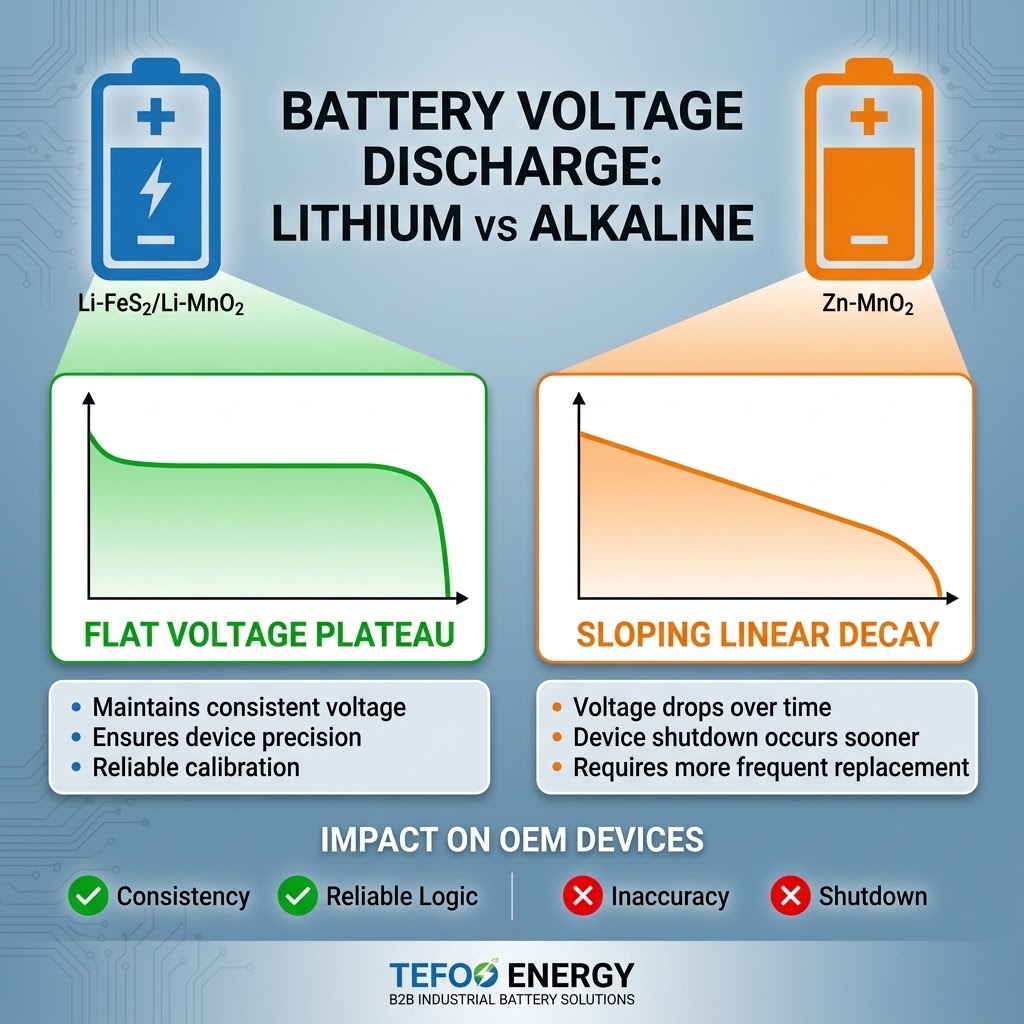
Primary lithium chemistries deliver a flat voltage plateau throughout 80% of operational runtime, whereas zinc-manganese dioxide alkaline chemistries exhibit a continuous linear decrease in terminal voltage under load.
The fundamental divergence in voltage stability stems from the underlying reduction-oxidation reactions and electrolyte conductivity within each battery cell chemistry:
-
Electrochemical Couple: Alkaline batteries combine a zinc anode, manganese dioxide cathode, and aqueous potassium hydroxide (KOH) electrolyte, delivering a nominal 1.5V per cell. Primary lithium batteries pair a metallic lithium anode with iron disulfide (Li-FeS2) or manganese dioxide (Li-MnO2) in a non-aqueous organic electrolyte, yielding nominal potentials from 1.5V to 3.0V per cell.
-
Electrolyte Behavior: Aqueous KOH electrolyte in alkaline cells suffers increased internal resistance as chemical reaction byproducts accumulate during discharge. Non-aqueous organic electrolytes in primary lithium cells maintain stable ionic conductivity across extended discharge durations.
-
Discharge Profile: Alkaline terminal voltage slopes linearly from an initial 1.5V down to a 0.9V cutoff threshold. Lithium primary chemistry maintains a consistent voltage output near nominal rating until near-total capacity exhaustion.
Selecting primary lithium chemistry prevents unexpected brownouts in microprocessors that require stable input voltages above tight low-voltage cutoff thresholds.
How Do Energy Density and DCIR Characteristics Compare Under Dynamic Load?
Primary lithium batteries achieve volumetric energy densities up to 400 Wh/kg with DCIR below 50 mΩ, while alkaline batteries offer approximately 150 Wh/kg with DCIR exceeding 200 mΩ under load.
Internal direct current resistance (DCIR) growth directly controls how effectively a battery pack delivers peak current pulses without experiencing localized thermal losses:
-
Volumetric Energy Density: Metallic lithium anodes provide high specific capacity, allowing primary lithium cells to store more energy per unit volume than zinc-based alkaline cells.
-
Internal Resistance Under Load: Alkaline cell DCIR increases exponentially as active materials deplete, causing localized heating and severe voltage drop during high current pulses. Primary lithium cell DCIR remains low and stable across most of the state-of-charge spectrum.
-
Weight Efficiency: Primary lithium batteries weigh approximately 33% less than equivalent-sized alkaline batteries, reducing total mass in portable equipment.
Lower internal resistance enables primary lithium batteries to support peak current demands without triggering false low-battery fault alerts in host hardware.
How Long Will a 9 Volt Battery Last in Industrial Instrumentation and Medical Devices?
How long will a 9 volt battery last depends directly on continuous load current, ambient operating temperature, internal cell construction, and host device voltage cutoff parameters. Calculating operational runtime requires evaluating total milliamp-hour (mAh) capacity against the active current profile of host equipment. Dynamic current spikes or sub-zero ambient temperatures reduce expected runtime if chemistry selection is misaligned with operating conditions.
How Does Discharge Current Draw Dictate 9 Volt Alkaline vs Lithium Lifespan?
A 9 volt primary lithium battery rated at 1200 mAh capacity lasts over two times longer than a 9 volt alkaline battery rated at 550 mAh under continuous loads exceeding 25 mA.
Internal cell structural configuration dictates total usable milliamp-hour capacity when device current draw increases:
-
Internal Cell Construction: A standard 9V alkaline battery houses six 1.5V AAAA cylindrical cells connected in series, experiencing heavy internal resistance losses at discharge rates above 25 mA. A 9V lithium battery contains three 3.0V Li-MnO2 pouch cells or cylindrical elements in series, maintaining low internal impedance.
-
Low-Drain Runtime Performance: Under a light 10 mA load, a 550 mAh 9V alkaline battery delivers roughly 50 to 55 hours of runtime, while a 1200 mAh 9V lithium battery delivers over 120 hours of continuous operation.
-
High-Drain Runtime Performance: Under heavy 100 mA discharge pulses in wireless transmitters, alkaline capacity drops sharply due to internal resistive heating, whereas lithium capacity remains fully accessible.
High-drain industrial equipment requires 9V primary lithium chemistry to maximize operational runtime and prevent premature power interruption.
How Does Sub-Zero Temperature Impact 9 Volt Battery Operating Runtime?
Operating ambient temperatures below 0°C reduce 9 volt alkaline battery runtime by up to 80%, while 9 volt primary lithium batteries maintain reliable power across -40°C to 60°C environments.
Thermal extremes alter electrolyte viscosity and electrochemical reaction kinetics, directly impacting usable battery capacity:
-
Alkaline Low-Temperature Limitations: Water-based KOH electrolyte in alkaline cells experiences dramatic ionic conductivity drops near 0°C, increasing DCIR and causing terminal voltage collapse under load.
-
Lithium Thermal Range: Non-aqueous organic electrolytes in primary lithium cells retain low viscosity and high ionic mobility at sub-zero temperatures down to -40°C.
-
High-Temperature Stability: Ambient temperatures up to 60°C accelerate self-discharge and electrolyte leakage in alkaline cells, whereas primary lithium chemistries maintain structural stability.
Specifying 9V primary lithium batteries ensures continuous winter operation for unheated outdoor metering stations and cold-chain environmental monitors.
How Do OEM Engineers Select Between Lithium and Alkaline Battery Chemistries?
Selecting between lithium and alkaline battery chemistries requires balancing initial bill-of-materials cost against maintenance visit frequency, spatial constraints, and device uptime requirements. System architects must evaluate whether field service labor expenses outweigh higher initial unit acquisition costs. Designing power subsystems around application requirements optimizes total cost of ownership over the equipment service lifecycle.
When Should Engineers Specify Alkaline Batteries in System Designs?
Engineers should specify alkaline batteries for low-drain OEM devices operating in climate-controlled environments where low initial unit acquisition cost overrides extended runtime needs.
Cost-sensitive handheld instruments with low power requirements benefit from the low upfront expense and widespread retail availability of alkaline cells:
-
Low-Drain Suitability: Devices drawing continuous current below 5 mA—such as basic digital multimeters, wall clocks, and desktop infrared thermometers—run efficiently on alkaline power.
-
Bill-of-Materials (BOM) Economy: Alkaline batteries offer lower initial unit acquisition costs, reducing initial manufacturing expenses for budget-focused hardware.
-
Regulatory Simplicity: Non-hazardous alkaline chemistry simplifies shipping compliance and eliminates UN 38.3 transport testing requirements.
Alkaline batteries provide a practical energy storage solution for accessible, low-power tools operating under normal indoor conditions.
When Do Portable Medical Equipment and Industrial Sensors Require Lithium Power?
Portable medical monitors, robotics, and remote industrial sensors require primary lithium power when continuous reliability, high peak current support, and minimal weight are critical engineering specifications.
Mission-critical hardware cannot tolerate unexpected shutdown or frequent battery changeouts in difficult-to-access locations:
-
Medical Device Reliability: Patient monitors and infusion devices require stable voltage and extended runtime to guarantee continuous operation without power interruption.
-
Remote Telemetry Maintenance: Outdoor IoT sensors and pipeline monitors in isolated locations minimize field service expenses by utilizing 10-year lithium primary cells.
-
Mass Reduction: Handheld field testers benefit from the lighter weight of lithium cells, improving user ergonomics for field technicians.
High-performance industrial and medical equipment relies on primary lithium energy storage to ensure operational integrity and minimize total lifecycle costs.
Which Regulatory Standards and Self-Discharge Rates Govern Industrial Battery Integration?
Integrating primary lithium or rechargeable lithium battery packs into OEM hardware mandates UN 38.3 transport safety certification and IEC safety compliance, whereas alkaline cells operate under general non-hazardous shipping guidelines. Compliance frameworks verify electrical and mechanical safety prior to global commercial distribution. Regulatory oversight protects supply chains from shipping delays and legal liabilities.
How Do UN 38.3 and IEC 62133 Compliance Requirements Affect Lithium Battery Deployment?
UN 38.3 transportation testing ensures lithium batteries withstand environmental shocks during global transport, while IEC 62133 validates electrical and mechanical safety in portable applications.
Regulatory compliance guarantees that lithium energy storage systems meet strict safety baselines prior to commercial distribution:
-
UN 38.3 Transport Testing: Subjecting lithium cells to altitude simulation, thermal shock, mechanical vibration, external short circuit, and impact testing verifies transportation safety.
-
IEC 62133 Standard: Testing portable lithium batteries for insulation resistance, case stress, and overcharge protection ensures safe operation in medical and industrial tools.
-
Alkaline Exemptions: Aqueous alkaline cells avoid hazardous material transport classification, lowering shipping administrative overhead.
Incorporating pre-certified lithium cells or completing UN 38.3 testing early prevents regulatory delays during commercial product rollout.
How Does Self-Discharge Rate Impact Warehouse Shelf Life and Backup Power Readiness?
Primary lithium batteries exhibit an annual self-discharge rate below 1% to 2%, enabling up to a 10-year shelf life compared to alkaline cells that lose 2% to 5% capacity per year.
Shelf stability determines whether long-term backup equipment remains operational after multi-year storage in emergency inventories:
-
Passivation Layer Protection: Primary lithium chemistries form a protective passivation layer on the metallic lithium anode, restricting parasitic chemical reactions during idle storage.
-
Alkaline Capacity Loss: Chemical degradation in aqueous alkaline cells leads to steady capacity loss and increased electrolyte leakage risk during extended storage.
-
Emergency Readiness: Emergency medical monitors and infrastructure backup units powered by primary lithium batteries maintain full rated capacity over multi-year periods.
Low self-discharge rates make primary lithium batteries the superior choice for long-term standby power and spare inventory retention.
Frequently Asked Questions
What is the difference between a lithium and alkaline battery?
A lithium battery utilizes metallic lithium or lithium compounds to deliver flat discharge voltage, low internal resistance, and high energy density, whereas an alkaline battery uses zinc and manganese dioxide with lower energy density and a sloping voltage curve.
How long will a 9 volt battery last in continuous industrial sensor applications?
A 9 volt alkaline battery rated at 550 mAh lasts approximately 50 to 55 hours under a continuous 10 mA drain, while a 9 volt primary lithium battery rated at 1200 mAh delivers over 120 hours of continuous operation under identical load conditions.
Can a 9 volt primary lithium battery directly replace a 9 volt alkaline battery in existing hardware?
A 9 volt primary lithium battery serves as a direct drop-in replacement for a 9 volt alkaline battery because both battery types deliver a compatible nominal 9 volt output within standard device operating tolerances.
Why do lithium batteries perform better than alkaline batteries at low operating temperatures?
Lithium batteries utilize non-aqueous organic electrolytes that maintain low internal resistance and high ionic mobility at sub-zero temperatures down to -40°C, whereas aqueous electrolytes in alkaline cells freeze and sharply increase internal resistance below 0°C.
What safety certifications are required for integrating lithium battery packs into OEM medical devices?
OEM medical devices integrating lithium battery packs must pass UN 38.3 transportation testing for shipping safety and IEC 62133-2 compliance for electrical and mechanical safety.