We design and build custom lithium-ion battery packs for medical, industrial and e-mobility equipment. Most of our OEM customers are not asking whether the EU Battery Regulation is real. They are asking which parts of it hit a battery pack, and when. The short answer is 18 February 2027 — but the details depend on the battery category, not the watt-hour rating alone.
Key Takeaways
18 February 2027 is two deadlines, not one. Every battery placed on the EU market needs a QR code. Light means of transport (LMT) batteries, industrial batteries over 2 kWh and EV batteries also need a battery passport.
The 2 kWh threshold is not a universal passport exemption. It applies to industrial batteries only. A 720 Wh e-bike pack is LMT and still needs a passport; a portable pack under 5 kg does not.
The operator placing the finished battery on the EU market owns the passport. Pack makers supply data, unique identifiers and durable marking. They do not take over the OEM’s legal responsibility.
Most of the pages ranking for this topic are written by regulators, law firms, test labs or passport software vendors. They are useful on the legal text. They are less useful when you are trying to fit a QR code on a 10-cell pack and work out who owns the data. This article is the pack-maker view.
What Changes on 18 February 2027?
The QR code becomes mandatory for every battery
Short answer: from 18 February 2027, every battery placed on the EU market or put into service must carry a QR code, not just the ones that need a passport.
Article 13(6) is wider than the passport rules. It covers portable, industrial, EV, LMT and SLI (starter, lighting and ignition) batteries. The QR code is the access point to information; the passport is one of the things it can open.
-
LMT, industrial over 2 kWh and EV batteries: the QR code must link to the battery passport.
-
Other batteries: the QR code must link to the label information, the EU declaration of conformity, the Article 52(3) due diligence report where applicable, and waste information.
-
All batteries: the information behind the QR code must be complete, up-to-date and accurate.
-
Transitional stock: the requirement applies to batteries placed on the market or put into service from 18 February 2027. If you hold stock that was placed earlier, confirm the transition position with your EU importer before you rely on it.
What this means for your pack: The QR is a line item in the artwork, marking process and data ownership plan. If it is added after the pack is qualified, it becomes a change-control problem.
Bottom line: 18 February 2027 is not a passport deadline for everyone; it is a QR deadline for everyone, plus a passport deadline for three battery categories.
LMT, industrial over 2 kWh and EV batteries also need a passport
Short answer: the passport is required for LMT batteries of any capacity, industrial batteries with a capacity greater than 2 kWh, and EV batteries.
Article 77(1) sets the scope. The 2 kWh figure is part of the industrial battery definition; it is not a general exemption for every battery under 2 kWh.
-
LMT batteries: all capacities.
-
Industrial batteries: only those with a capacity greater than 2 kWh.
-
EV batteries: all.
-
Portable batteries, industrial batteries at or below 2 kWh, and SLI batteries: no passport.
The passport is an electronic record, not a PDF. It contains model-level and individual battery data, with public and restricted access. The unique identifier is attributed by the economic operator placing the battery on the market, and the QR code must resolve to it.
The European Commission publishes a data-point list by battery category. Start from that list rather than treating Annex XIII as a single flat checklist; some fields are model-level, some are per-battery, and some depend on the category.
What this means: If your product is an e-bike pack, an EV pack or an industrial pack over 2 kWh, assume the passport applies. If it is a portable pack, assume the QR applies but the passport does not.
Bottom line: The category decides the passport, not the kilowatt-hour figure alone.
Removability and spare parts land on the same date
Short answer: Article 11 also applies from 18 February 2027, and it is the requirement most likely to change your enclosure, not just your label.
The main obligations are:
-
Portable batteries in appliances: the end-user must be able to remove and replace them with commercially available tools. Proprietary tools, thermal processes and solvents are out. Instructions must be available permanently online.
-
LMT batteries: removal and replacement must be possible by an independent professional.
-
Spare batteries and packs (for appliances in scope): they must be available for at least five years after the last unit of the equipment model is placed on the market, at a reasonable and non-discriminatory price.
-
Software: it must not impede replacement with a compatible battery or key component.
-
Exemptions: some appliances regularly exposed to water, and professional medical imaging, radiotherapy and in vitro diagnostic devices, can use the independent-professional route. The only full exemption is where continuity of power and a permanent connection are necessary for safety or data integrity.
That medical exception is narrower than it sounds. A ventilator is not an imaging, radiotherapy or IVD device. If you make ventilators, the default is still a replacement route that the user or a professional can follow without destroying the enclosure.
“our medical device team is hitting the same wall. we’d been using a chemical weld on the case halves and now we’re looking at a gasketed door with captured screws. the BOM cost is up about $3 per unit just for the extra molding and seal material… testing a double lip gasket with a snap fit but i worry about tolerance stack after 500 door cycles.”
— enchanting_tendon,
That $3 per unit is the part the legal text does not show you. Removability is a mechanical design decision, and it is cheaper to make it at the concept stage than after the tooling is cut.
Bottom line: If your enclosure is welded or glued, 2027 is not a labeling project; it is a redesign project.
Does the 2 kWh Threshold Mean Your Battery Pack Is Exempt?
The legal test is the battery category, not the watt-hour rating
Short answer: no. The 2 kWh threshold is part of the industrial battery definition. It does not create an exemption for LMT batteries, and portable batteries are not in that category.
The regulation sorts batteries into portable, LMT, SLI, industrial and EV. The passport scope follows those categories.
| Category | Typical example | Passport from 18 February 2027? |
|---|---|---|
| Portable (sealed, ≤5 kg, not industrial, EV, LMT or SLI) | Handheld medical device, power tool | No |
| LMT | E-bike, e-scooter, e-moped | Yes, any capacity |
| Industrial, greater than 2 kWh | Stationary storage, professional equipment | Yes |
| Industrial, 2 kWh or less | Small industrial pack | No |
| EV | Electric vehicle | Yes |
| SLI (starter, lighting and ignition) | Starter battery for an internal combustion engine | No |
Exactly 2.0 kWh is not “greater than 2 kWh”. If you are at the boundary, document the rated capacity and the category rationale.
Bottom line: Build the category decision into the product specification, not into a sales email.
Why the 2 kWh figure gets misread
Short answer: people take a rule written for industrial batteries and apply it to every battery.
Four examples show why the category matters more than the number:
-
720 Wh e-bike pack: LMT, so a passport is required even though the pack is below 2 kWh.
-
1.8 kWh industrial pack: below the threshold, so no passport; the QR code is still required.
-
2.4 kWh industrial pack: above the threshold, so a passport is required.
-
100 Wh handheld medical pack: portable, so no passport; the QR code is still required
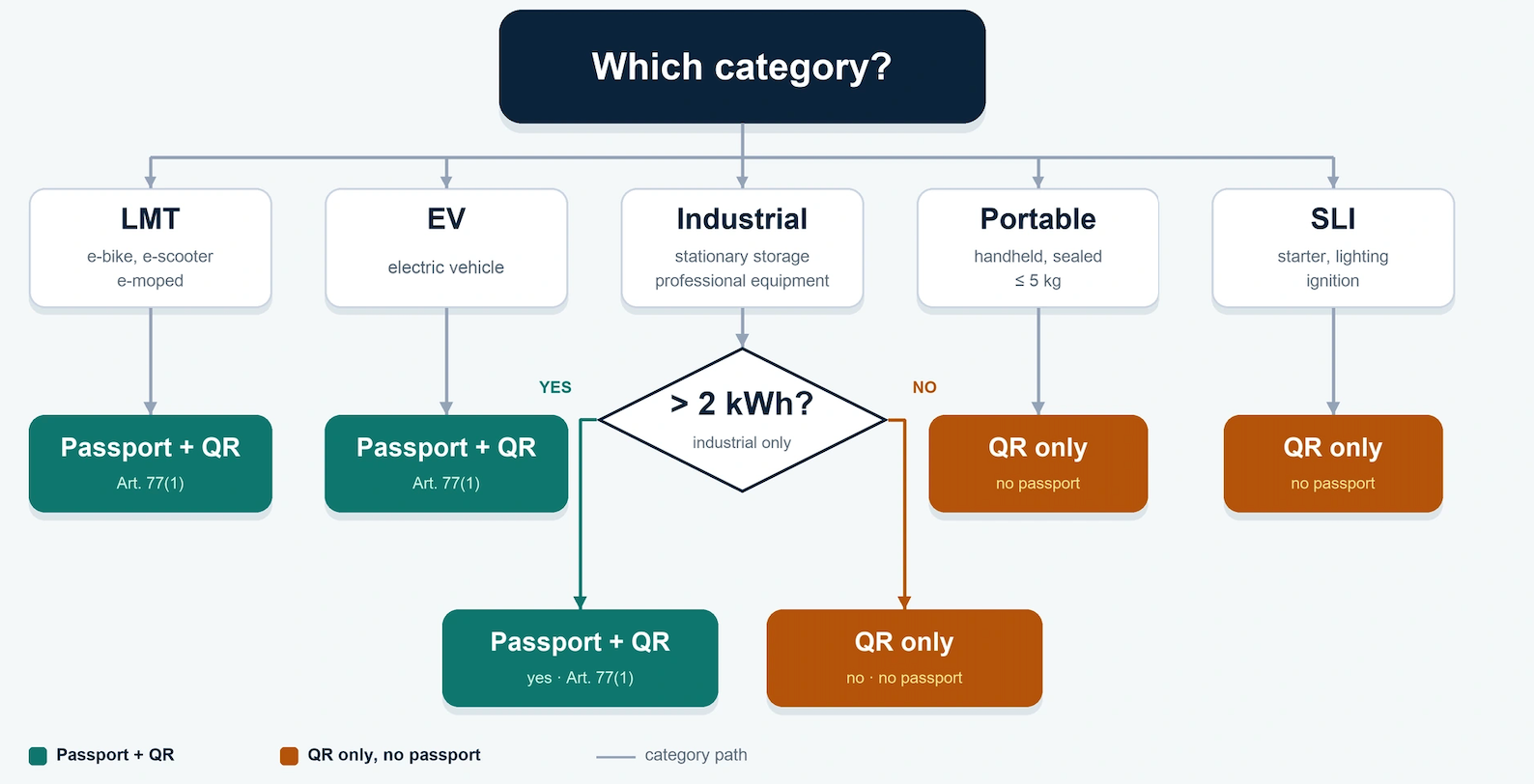
The category is not determined by the buyer’s market alone. A pack does not become “industrial” because it is sold to a factory, and it does not become “portable” just because it is small. Check the definitions and the product’s intended use.
Bottom line: If someone tells you “under 2 kWh means no passport”, ask which category they are in.
What about spare packs and replacement batteries?
Short answer: a spare pack is still a battery placed on the market, so the QR and passport rules follow its category, not its status as a spare.
Article 11(7) requires spare batteries to be available for five years. It does not exempt those spare batteries from Article 13(6) or Article 77(1).
-
Replacement LMT pack: LMT category, so a passport is required.
-
Replacement industrial pack over 2 kWh: passport required.
-
Replacement portable pack: QR required; no passport.
-
Five-year availability: this is a separate commercial commitment. Build it into your forecast, MOQ and EU stock plan.
Bottom line: The aftermarket is where category mistakes get expensive, because every replacement unit carries the same obligation as the original.
What Does a Compliant QR Code Need to Include?
Passport-linked and non-passport QR codes are different
Short answer: the QR code is the same physical feature, but the destination is different.
| Battery type | QR destination | What has to be behind it |
|---|---|---|
| LMT, industrial over 2 kWh, EV | Battery passport | Unique identifier, model and individual data, public and restricted access, current record |
| Other batteries | Label information, EU declaration of conformity, Article 52(3) report where applicable, waste information | Current documents, not a dead PDF |
Article 13(6) requires the information to be complete, up-to-date and accurate. A QR code that opens a 2024 PDF and never changes is not a good implementation, even if it scans.
The QR code is also not a replacement for the CE mark or the EU declaration of conformity. It is an additional access point.
What this means: Decide early whether your QR is a passport entry point or a document entry point. The data model is different.
Bottom line: A QR code that points to a static file is a link; a QR code that points to a maintained record is compliance.
The mark has to survive the battery, not just the shipping box
Short answer: Article 13(7) requires the QR code to be printed or engraved visibly, legibly and indelibly on the battery.
Packaging and accompanying documents are allowed only where the nature or size of the battery makes it impossible or unwarranted. That is a narrow fallback, not a default for small packs.
-
Printed or engraved: a sticker is not expressly banned, but it is not the default. You need evidence that it stays legible and attached for the battery’s life.
-
Annex VI Part C: the QR code must be in high contrast to the background and large enough for a commonly available reader. Check the final implementing act before you freeze artwork.
-
Reader test: validate with the readers your customers actually use, not only a lab scanner.
-
Use-profile test: abrasion, cleaning agents, temperature cycles, UV and handling.
-
Placement: keep the mark away from wear points, terminals and areas that are likely to be covered by the enclosure.
The regulation sets the outcome — visible, legible and indelible — rather than a single test method for every chemistry. You have to build a validation file that matches your battery’s life.
Bottom line: A QR code that fails after 18 months is not compliant, even if it passed at PPAP.
The unique identifier is a data key, not a serial number sticker
Short answer: the unique identifier is what ties the physical battery to its passport record, and it has to follow a recognized identification standard.
Article 77(3) requires the QR code and unique identifier to comply with ISO/IEC 15459-1:2014 through 15459-6:2014, or equivalent. The QR Code symbology itself is specified in ISO/IEC 18004.
-
Use a resolver or persistent URL, not a fixed PDF path.
-
Make the identifier unique at the individual battery level, not just the model level.
-
Plan for data changes: supplier change, cell change, firmware change, repair, repurposing.
-
Test the full chain: scan → resolver → passport → access control → data.
-
Plan a fallback for readers that cannot access the network, such as a human-readable identifier, but do not treat it as a substitute for the passport.
What this means: The QR is the front door. The resolver and the data model are the building. Most of the cost is in the building.
Bottom line: Do not encode a PDF path and call it a passport.
Who Owns the Passport — and What Should OEMs Prepare Now?
The operator placing the finished battery on the market owns the passport
Short answer: the obligation sits with the economic operator that places the finished battery on the EU market, not with every component or module supplier.
| Scenario | Who is the operator placing the battery on the market? | What TEFOO can do |
|---|---|---|
| TEFOO-brand pack sold into the EU | TEFOO as manufacturer; the EU importer is normally the operator placing it on the market, and a non-EU manufacturer may also need an authorised representative — confirm this in the contract | Provide data package, unique ID, QR marking and DoC support |
| TEFOO builds a pack for an EU OEM’s branded device | The OEM placing the finished device or battery on the market | Provide pack data, test reports and change notifications |
| OEM buys cells or modules and assembles the pack | The OEM as manufacturer | Supply cell or module data where we are the supplier |
Responsibility follows the placing on the market, not the country where the cell was made. A Chinese pack maker does not become the passport owner just because the pack was built in China; the operator that places the finished battery on the EU market does.
“most companies now understand what the passport is supposed to contain. The harder part is whether they can actually get the data from all the places it currently lives and keep it updated.”
— Poli_at_beSirius,
The follow-up question is the one that breaks spreadsheets: who owns each data point, where is the evidence, and what happens when a supplier changes? A passport is a data chain, not a one-time upload.
Bottom line: The OEM can delegate data collection. It cannot delegate the legal responsibility that comes with placing the battery on the market.
What a pack maker can hand over — and what it cannot
Short answer: we can deliver the pack-level data and marking package; we cannot take over the OEM’s legal responsibility for the finished device.
What we can provide:
-
Battery specification, chemistry, capacity, voltage and energy.
-
Test reports such as IEC 62133-2 and UN 38.3, where applicable to the project.
-
Material composition and supplier declarations we hold.
-
BMS data and firmware or version information needed for the passport.
-
Unique identifier and QR marking on the pack.
-
Change notification when a cell, BMS or process changes.
What we cannot do:
-
Sign the OEM’s EU declaration of conformity for the finished device.
-
Take over the passport obligation that sits with the operator placing the battery on the market.
-
Guarantee upstream data that we do not own or cannot verify.
-
Guarantee a compliant retrofit onto a pack that was designed without a marking area.
What this means: The cleanest model is a written data package in the supply agreement, with named owners for each field and a change-notification clause. That is less glamorous than a passport platform, but it is what makes the platform true.
Bottom line: A supplier who promises to “make you compliant” is usually promising more than they can legally deliver.
A practical 2027 readiness checklist
Short answer: treat 18 February 2027 as a program milestone, not a labeling task.
| # | Action | Owner |
|---|---|---|
| 1 | Confirm the battery category and whether the passport applies | Product and compliance |
| 2 | List every passport data field and name a data owner | Engineering and compliance |
| 3 | Put data-delivery and change-notification clauses in cell and BMS contracts | Procurement and legal |
| 4 | Choose the unique identifier scheme (ISO/IEC 15459) | Engineering |
| 5 | Design the QR location and validate durability | Mechanical and process |
| 6 | Build the resolver and access controls | IT and compliance |
| 7 | Review the Article 11 enclosure, tools and spare-parts plan | Mechanical and service |
| 8 | Check due diligence scope and the 18 August 2027 date | Compliance |
| 9 | Check the current status of the labelling implementing act | Compliance |
Two dates are easy to confuse. 18 February 2027 is the QR, passport and Article 11 date. 18 August 2027 is the due diligence date. The due diligence rules apply to larger operators — groups with net consolidated turnover above €40 million — so not every SME is in scope. Check your group position rather than assuming.
The labelling rules are a third track. The general label obligations are tied to 18 August 2026 or 18 months after the labelling implementing act, whichever is later. Confirm the current status before you print artwork; do not treat a 2026 label deadline as automatically live.
Bottom line: The companies that will be ready are the ones that assigned data owners in 2026, not the ones that started scanning in 2027.
If you are selecting a pack for a device launching in 2027, send us the device profile, the target EU market and the battery category. We will come back with a pack specification that includes the marking area, the unique identifier, the data package and the change-control plan. We will also tell you which obligations stay with you as the operator placing the finished device on the market, because that is the part we cannot sign for you.
Bottom line: 18 February 2027 is close enough that the pack design is already being frozen. The cheapest time to add a QR code is before the enclosure tooling is cut.
About the author
Peter Pan is CTO at Shenzhen Grace Technology Development Co., Ltd., the company behind TEFOO. He works with OEM engineering teams on custom lithium-ion battery packs for medical, industrial and e-mobility devices. Connect with him on .
Follow TEFOO: · · ·
Sources
This article reflects Regulation (EU) 2023/1542, Regulation (EU) 2025/1561 and the Commission guidance available on 20 November 2026. It is an engineering summary, not legal advice. Check the latest implementing and delegated acts before you freeze artwork or contracts.