What’s the Difference Between 2S and 3S Batteries in Medical Device Design?
Medical device R&D engineers and procurement teams face crucial architectural trade-offs when selecting lithium battery subsystems for portable patient monitors, infusion pumps, and diagnostic instruments. Selecting the incorrect battery architecture affects PCB step-down regulator conversion efficiency, increases internal thermal dissipation, and risks non-compliance with IEC 60601-1 medical electrical safety standards. Understanding what’s the difference between 2s and 3s batteries allows OEM engineering teams to match system voltage requirements, optimize battery management system (BMS) topologies, and maximize single-charge operational runtimes within strict volumetric chassis constraints.
Voltage and Series Architecture: What Is the Electrical Difference Between 2S and 3S Battery Configurations in Medical Devices?
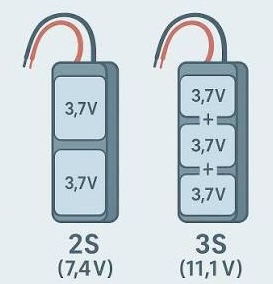
The fundamental difference between 2S and 3S lithium battery configurations is the number of series-connected cells, which determines nominal output voltage at 7.4V DC versus 11.1V DC. Connecting cells in series adds individual cell voltages together while maintaining a unified amp-hour (Ah) capacity rating across the cell string.
Nominal Voltage Platforms and Charging Cut-Off Thresholds in 2S and 3S Li-Ion Cell Strings
A 2S lithium-ion battery pack utilizes two cells connected in series to deliver a 7.4V nominal voltage, whereas a 3S pack utilizes three cells connected in series to deliver an 11.1V nominal voltage. Assuming standard Nickel Manganese Cobalt (NMC) or Lithium Cobalt Oxide (LCO) lithium-ion cell chemistry with a 3.7V nominal platform, a 2S pack operates across a functional voltage window of 5.6V to 8.4V DC. In contrast, a 3S lithium-ion pack operates across a functional voltage window of 8.4V to 12.6V DC.
Step-Down DC-DC Regulator Efficiency and Current Draw Metrics Across 7.4V and 11.1V Supply Rails
Operating at a higher nominal system voltage in a 3S battery architecture reduces total current draw for equivalent electrical power loads, decreasing resistive $I^2R$ power loss and thermal buildup inside sealed medical devices. According to Ohm’s Law ($P = V \times I$), powering a 30-Watt load from a 7.4V 2S battery pack draws approximately 4.05 Amperes of continuous current. Powering the same 30-Watt load from an 11.1V 3S battery pack draws only 2.70 Amperes of current. Lower current levels reduce copper trace heating on printed circuit boards (PCBs) and improve DC-DC buck converter efficiency.
System Integration and Enclosure Volume: How Do 2S and 3S Battery Form Factors Impact Portable Medical Equipment Chassis Design?
Integrating a 2S battery architecture requires 33% less physical cell volume and mass than a 3S battery architecture using equivalent cell sizes, making 2S packs optimal for ultra-compact handheld medical equipment. Mechanical engineering teams must balance battery compartment space against operational runtime demands when selecting cylindrical or pouch cell configurations.
Volumetric Constraints and Ergonomic Footprints in Handheld Monitors vs. Portable Workstations
Handheld diagnostic tools prioritize 2S battery pack configurations to maintain low device weight and compact ergonomic handle geometry. Devices such as handheld pulse oximeters, electronic stethoscopes, and portable otoscopes feature tight spatial enclosures where adding a third lithium cell compromises handle comfort. Conversely, mobile medical workstations, diagnostic ultrasound carts, and bedside monitors provide adequate internal volume to accommodate 3S cylindrical cell arrays.
Thermal Management and Heat Dissipation Profiles in Sealed IP67 Medical Housings
Operating a 3S lithium battery pack under high current discharge loads generates less internal heat than a 2S pack, reducing thermal isolation requirements inside IP67 fluid-sealed enclosures. Sealed medical instruments cannot utilize forced-air cooling fans due to ingress protection and sterilization requirements. Lower continuous current in 3S architectures mitigates internal battery cell heating, extending overall battery calendar life and preventing localized circuit overheating. For detailed comparisons of underlying cylindrical cell sizes used in multi-cell assemblies, engineers can review our technical guide on [18650 vs 21700 for portable medical devices].
Battery Management Systems (BMS) and Cell Balancing: How Do Protection Requirements Differ Between 2S and 3S Lithium Assemblies?
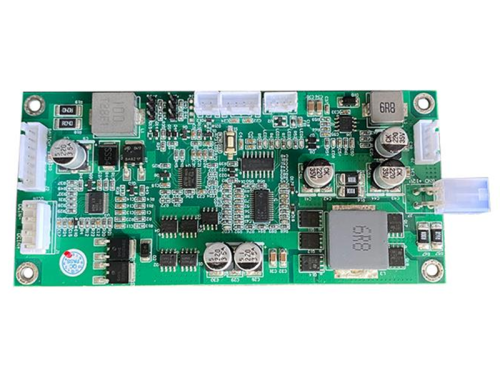
Protecting a 3S lithium battery pack requires an advanced Battery Management System (BMS) with three individual cell monitoring channels and complex balancing logic compared to a two-channel 2S BMS. Smart BMS circuits maintain battery pack safety and prolong cycle life by preventing individual cell overvoltage, under-voltage, and thermal runaway events.
Multi-Channel Voltage Monitoring and Active Cell Balancing Circuitry in Smart BMS PCBA Design
Smart BMS microcontrollers monitor individual cell voltages in series strings to prevent series cell imbalance during continuous charge and discharge cycles. A 2S BMS monitors two series cell groups via a single balance tap wire, whereas a 3S BMS monitors three series cell groups using two balance tap wires. As series cell counts increase, manufacturing variations in cell internal resistance ($R_{\text{DC}}$) cause cell state-of-charge divergence. Integrating active or passive cell balancing circuitry inside the BMS equalizes individual cell voltages during the Constant Voltage (CV) charging phase.
Single-Fault Tolerances and Safety Shutdown Mechanisms Under IEC 62133-2 and IEC 60601-1
International medical electrical safety standards mandate single-fault safety protection circuits in both 2S and 3S battery protection modules to prevent electrical hazards in clinical environments. Under IEC 60601-1 and IEC 62133-2, secondary lithium battery packs must maintain active certification verified through the IECEE CB Scheme. Dual-protection BMS hardware incorporates secondary analog front-end (AFE) ICs that independently cut off charge and discharge MOSFETs if primary BMS microcontrollers fail during overcharge, short circuit, or thermal over-temperature conditions.
Application Selection Guide: Matching 2S and 3S Battery Architectures to Medical OEM Device Power Specifications
Selecting between 2S and 3S battery architectures requires matching device operating power limits, DC input voltage ranges, and targeted operational runtimes. R&D engineers must analyze system load profiles to select the optimal series configuration.
2S Battery Pack Suitability in Portable Diagnostic Monitors and Handheld Pulse Oximeters
Low-power handheld medical devices drawing under 15 Watts achieve optimal energy efficiency and spatial compact form factors when powered by 2S lithium battery packs.
-
Vital Sign Spot-Checkers: 7.4V supply rails efficiently power low-power display screens and optical sensor LEDs.
-
Digital Otoscopes and Stethoscopes: Compact 2S pouch cell layouts fit narrow ergonomic device handles.
-
Wireless ECG Telemetry Transmitters: Low voltage requirements minimize overall patient-worn mass.
3S Battery Pack Suitability in Medical Infusion Pumps, Portable Ventilators, and Mobile Ultrasound Units
Medical instruments incorporating electric motors, fluid pumps, or high-brightness displays require 3S lithium battery packs to maintain stable 11.1V operating rails.
-
Ambulatory Infusion Pumps: 11.1V supply rails drive stepper motors smoothly without excessive current draw.
-
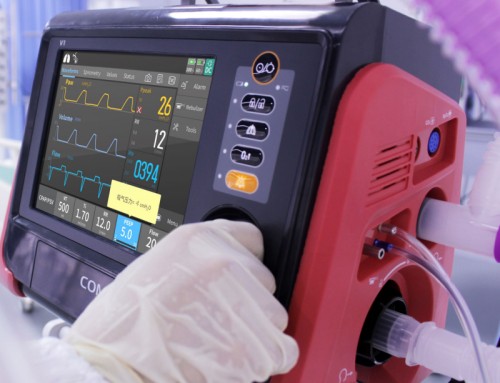
Portable Medical Ventilators: Higher voltage powers micro-turbine blowers during high-pressure ventilation cycles.
-
Mobile Diagnostic Ultrasound Units: Stable 3S voltage platforms supply noise-free power to acoustic transducers.
Frequently Asked Questions
Q1: What is the main electrical difference between a 2S and a 3S lithium battery pack?
The main electrical difference is nominal operating voltage, where a 2S battery outputs 7.4V DC and a 3S battery outputs 11.1V DC.
-
2S Architecture: Combines 2 series cells (7.4V nominal / 8.4V peak).
-
3S Architecture: Combines 3 series cells (11.1V nominal / 12.6V peak).
-
Current Efficiency: 3S draws lower current for identical power loads.
Q2: Can a 3S lithium battery pack directly replace a 2S battery pack in a medical device?
A 3S battery pack cannot directly replace a 2S pack unless the medical device circuit supports a wide 8.4V to 12.6V DC input range.
-
Overvoltage Risk: Connecting 11.1V to a 7.4V circuit risks destroying sensitive ICs.
-
Mechanical Fit: 3S packs require larger battery bay dimensions.
-
BMS Configuration: Charger parameters and BMS balance taps must match the cell count.
Q3: Why does a 3S battery pack generate less heat than a 2S battery pack under equal power loads?
A 3S battery pack generates less thermal heat because higher operating voltage reduces continuous current draw across PCB traces.
-
Lower Current: Higher voltage lowers current ($I = P / V$) for fixed wattage loads.
-
Reduced Loss: Lower current exponentially reduces resistive heating ($P_{\text{loss}} = I^2R$).
-
Thermal Safety: Mitigates thermal buildup inside sealed IP67 medical enclosures.
Q4: What safety certifications are required to export 2S and 3S medical lithium battery packs globally?
Global export of medical lithium battery packs mandates compliance with IEC 62133-2, IEC 60601-1, UL 2054, and UN 38.3 standards.
-
IEC 62133-2: Verifies secondary lithium cell electrical and mechanical safety.
-
UN 38.3: Certifies safe air and ground transportation for lithium battery assemblies.
-
ISO 13485: Ensures full medical manufacturing supply chain quality traceability.
Q5: How does BMS cell balancing differ between 2S and 3S lithium battery pack architectures?
A 3S BMS requires three monitoring channels and two balance taps, whereas a 2S BMS requires two channels and one balance tap.
-
Monitoring Complexity: 3S BMS tracks voltage divergence across three series cell groups.
-
Active Balancing: Equalizes individual cell state-of-charge during the CV charging phase.
-
Protection Logic: Prevents individual cell overcharge hazards across larger series strings.
Optimize Your Medical Power Architecture with Tefoo Energy
Engineering custom medical equipment that utilizes 2S or 3S lithium battery architectures requires balancing voltage platforms, enclosure dimensions, BMS protection, and regulatory compliance. Tefoo Energy manufactures ISO 13485-certified custom 2S, 3S, and multi-series lithium battery pack solutions tailored for global OEM medical and instrumentation applications.